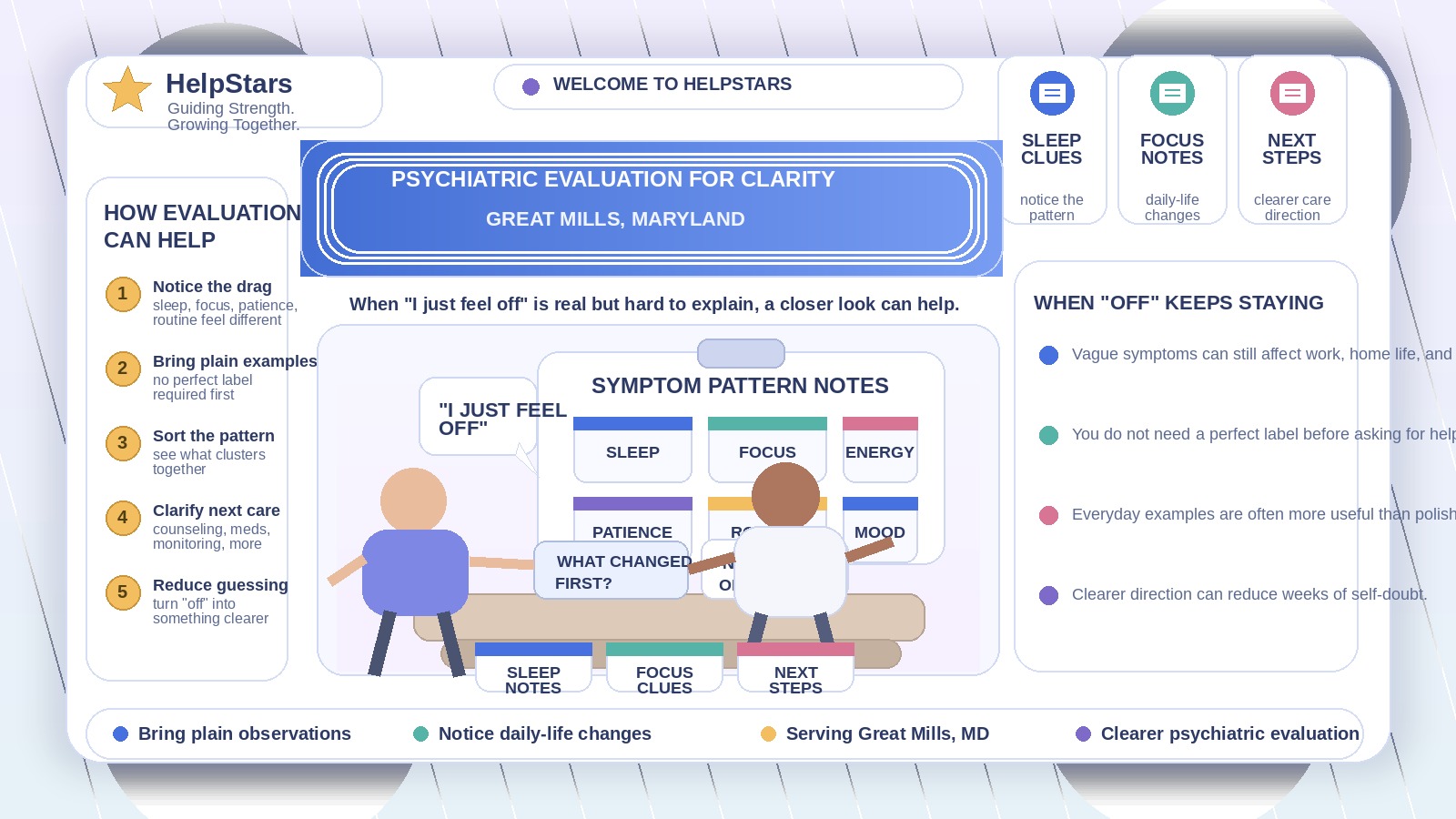
If You Keep Saying “I Just Feel Off”: How a Psychiatric Evaluation Can Help Adults in Great Mills, Maryland
Some adults do not delay getting help because nothing is wrong. They delay because nothing feels clear enough to describe. The words keep coming out too vague. Tired. Off. Irritable. Scattered. Not quite myself. The person knows daily life feels different, but every time they try to explain it, the pattern sounds too ordinary to count.
For adults in Great Mills, Maryland, a psychiatric evaluation can help when something has shifted but the symptoms still feel too blurry or inconsistent to summarize well. The goal is not to turn every hard week into a diagnosis. The goal is to look more carefully at mood, sleep, energy, focus, patience, and daily functioning so uncertainty does not keep doing all the decision-making by itself.
HelpStars LLC supports adults and families across Southern Maryland with compassionate behavioral health services. When the problem is not only how you feel but how hard it is to explain what has been changing, an outpatient evaluation can be a practical starting point.
Vague Symptoms Can Still Disrupt Real Life
Many adults assume they need a cleaner story before asking for an evaluation. They expect symptoms to arrive in a dramatic or perfectly organized way. Real life is usually less tidy. A person may still be going to work, answering the most urgent texts, and handling the basics while quietly noticing that ordinary life now takes more effort than it used to.
That may sound like:
- “Nothing is exactly wrong, but I am definitely not functioning like myself,”
- “I keep calling it stress, but that answer is starting to feel thin,”
- “By the time someone asks how I am doing, I cannot explain it clearly,”
- “I am still getting through the day, but it feels harder to stay steady,” or
- “I do not know what category this fits in, but it is affecting too much to ignore.”
Symptoms do not have to sound dramatic to matter. If concentration is slipping, patience is shorter, sleep feels less restorative, motivation is less reliable, or routine is getting harder to hold together, a closer look may be useful even if no single explanation feels complete yet.
Why “I Feel Off” Can Be Harder To Act On Than a Clearer Symptom
Adults often take action faster when they can point to one obvious issue. It is easier to describe panic attacks than a general sense of internal drift. It is easier to name insomnia than the feeling that sleep, mood, and energy no longer recover in the way they used to. When the pattern is broad, changeable, or hard to pin down, people often keep waiting for it to become more explainable.
That waiting can stretch out because vague symptoms invite self-doubt:
- maybe it is only a demanding month,
- maybe other people are handling worse,
- maybe it is only fatigue,
- maybe a better weekend will reset it, or
- maybe it is not specific enough to bring up yet.
But sometimes the lack of clarity is exactly the reason an evaluation helps. The point is not to prove distress dramatically. The point is to organize it before it spreads any further into work, home life, or relationships.
What a Psychiatric Evaluation Can Clarify When the Story Feels Blurry
Some adults hear psychiatric evaluation Great Mills MD and imagine that they need polished insight before they show up. In practice, the visit is often most useful when it starts with everyday observations rather than perfect conclusions.
Depending on the person’s situation, an evaluation may help clarify:
- whether the broader pattern sounds more connected to anxiety, depression, trauma-related stress, attention difficulties, mood instability, burnout, or another concern,
- how changes in sleep, energy, concentration, irritability, and follow-through may be interacting,
- which parts of daily life are being affected first or most heavily,
- whether outpatient counseling, medication support, further monitoring, or another level of care may be worth discussing next, and
- what information is still missing before treatment decisions become clearer.
The first benefit is often not instant certainty. It is moving from a vague internal worry to a more usable clinical picture.
Five Everyday Clues That “Off” May Deserve a Closer Look
- Your usual explanations keep rotating. One week you call it stress. The next week you call it bad sleep, irritability, low energy, brain fog, or just a phase.
- Functioning still happens, but with more drag. Tasks get done more slowly, conversations feel harder to stay present for, and small demands take more recovery time.
- You sound vague even to yourself. When someone asks what changed, you keep reaching for words like “off,” “weird,” or “not right” because nothing sounds precise enough.
- Short resets are not resetting much. A day off or quieter weekend may bring partial relief without making life feel truly steadier again.
- Other people are noticing something before you can name it. A spouse, friend, sibling, parent, or coworker may be commenting on tension, withdrawal, forgetfulness, low patience, or low energy before you feel ready to define the pattern yourself.
None of those clues prove one diagnosis. They do suggest that more guessing may not be the most useful next move.
A Great Mills Example: Still Functional, Harder To Reach
Imagine an adult in Great Mills, Maryland who is still showing up for the responsibilities that cannot be skipped. Work is still getting done, at least on the outside. Meals are still mostly happening. Appointments are not being missed often enough to trigger alarm. But the internal experience has changed.
The person is taking longer to start simple tasks. They reread messages more than once before responding. Family conversations feel harder to stay patient through. They get home more depleted than they used to, then second-guess whether the problem is emotional strain, poor sleep, overload, or something else they cannot sort out. When someone asks how they are doing, the answer stays frustratingly flat: “I do not know. I just feel off lately.”
In that situation, a psychiatric evaluation can help narrow the question. Instead of forcing the person to arrive with the right label, the evaluation can help examine what changed first, what now feels harder than before, and what kind of support may fit the pattern more accurately.
You Do Not Need the Perfect Words Before the Appointment
Many adults postpone an evaluation because they think they need a better script first. Usually, plain details are more helpful than polished insight. A provider can do more with ordinary examples than with a forced summary that does not really fit.
If you are considering an evaluation, useful notes may include:
- what has felt different in the last few weeks or months,
- whether the change shows up more in sleep, focus, patience, motivation, energy, appetite, or follow-through,
- which parts of work, home life, or relationships now feel heavier than they used to,
- whether the harder days have any pattern around time of day, stress, or routines,
- what coping strategies, counseling, medications, or self-management steps have already been tried, and
- what you hope will feel clearer after the conversation.
That is enough to begin. You do not need to present your symptoms neatly for them to deserve attention.
Why This Can Matter Before Life Looks “Serious Enough”
Adults sometimes wait for something more dramatic before asking questions. But many mental health patterns become easier to address when they are taken seriously earlier, while the main signs are still inconsistency, drag, and reduced capacity rather than a larger crisis.
That matters in St. Mary’s County, where adults in Great Mills and nearby communities may already be balancing work shifts, commuting, family demands, errands, appointments, and other routine pressures. A problem does not need to be extreme to start reshaping how someone moves through that week.
When “off” keeps showing up in multiple parts of life, the next useful step may be more clarification, not more self-doubt.
Questions Adults Often Ask
Do I need a psychiatric evaluation if I am still getting through my responsibilities?
Not always, but many adults seek an evaluation while they are still functioning because they can tell the effort, instability, or confusion has changed.
What if I cannot describe my symptoms well?
That is often one of the clearest reasons to seek an evaluation. You do not need a perfect label first. Specific examples from daily life are often enough to start the conversation well.
Does a psychiatric evaluation automatically mean medication?
No. An evaluation is meant to clarify symptoms and options. Medication may or may not be part of the next-step discussion depending on the clinical picture.
Can this fit alongside counseling or other outpatient support?
Yes. Depending on the person’s needs, a psychiatric evaluation may complement counseling, medication management, or other behavioral health services by making the broader picture clearer.
A Better Explanation Can Be Its Own Kind of Relief
There is a particular kind of exhaustion that comes from feeling different while never being able to explain the difference well enough. Sometimes the most helpful next step is not trying harder to self-interpret. It is letting a fuller evaluation organize what your daily life has already been showing you.
HelpStars LLC serves adults and families across Southern Maryland with compassionate behavioral health support. For adults in Great Mills, Maryland who keep saying “I just feel off” while life gets harder to manage, an outpatient psychiatric evaluation may help turn vagueness into a clearer direction.