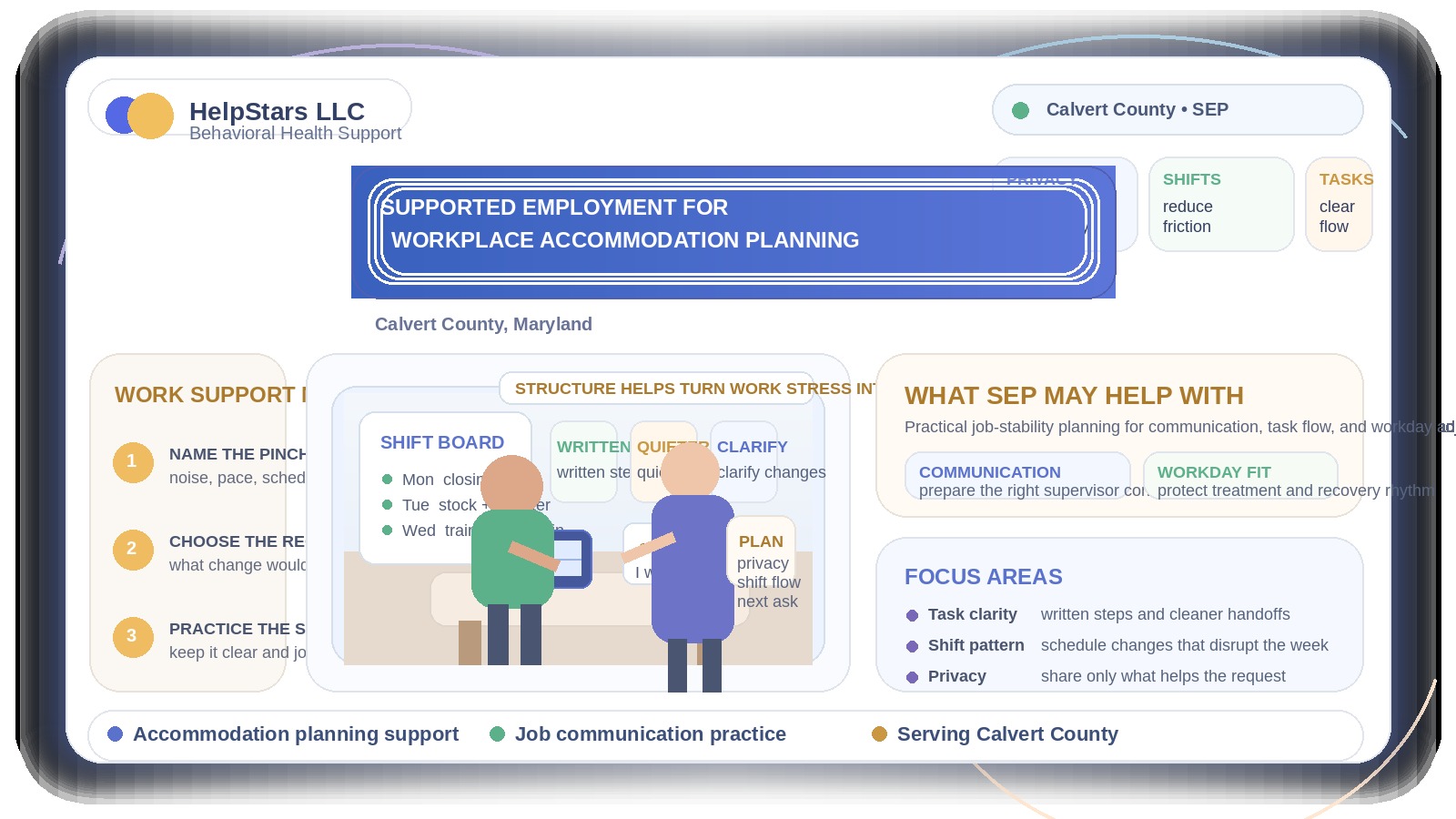
How Supported Employment Can Help Adults Prepare for Workplace Accommodations and Job Communication in Calvert County, Maryland
A job can be going mostly well and still feel fragile. The employee is showing up, trying hard, and doing enough to avoid obvious problems, but the workday takes more energy than anyone else can see. A noisy space makes concentration drop fast. A shift change throws off medication timing or sleep. Instructions are clear in the moment but harder to hold onto once the pace picks up. The person does not necessarily need to leave the job. They may need a better plan for how to communicate, what to ask for, and how to protect the parts of the workday that keep them steady.
For adults in Prince Frederick, Lusby, Huntingtown, Dunkirk, North Beach, Chesapeake Beach, Solomons, and nearby Calvert County communities, a supported employment program can help with more than resumes and interviews. It can also help a person prepare for practical workplace conversations when mental health symptoms, attention problems, stress sensitivity, or treatment routines start affecting job stability.
HelpStars LLC serves adults across Southern Maryland with compassionate behavioral health support. When the question is not “Can I work?” but “How do I make this job more workable without everything unraveling?”, supported employment may offer the kind of structured planning that turns vague worry into concrete next steps.
Work Problems Often Start as Invisible Friction
Many job difficulties do not begin with a major incident. They begin with friction that builds quietly across the week. A person may need extra time to recover after high-interaction shifts. They may get thrown off when tasks change without warning. They may miss details after several hours of overstimulation, or freeze when they have to ask a supervisor for clarification in a fast-moving setting.
That friction can show up as:
- losing focus when the environment gets loud or crowded,
- struggling with last-minute schedule changes,
- needing clearer written steps for multi-part tasks,
- feeling flooded during conflict, redirection, or rapid feedback,
- worrying about how treatment appointments will affect attendance, or
- not knowing how much personal information to share when something at work stops feeling manageable.
Without a plan, these issues can be misread as laziness, unreliability, or poor attitude. In reality, the employee may be working very hard and simply lacking the right structure around the job.
Supported Employment Is Not Only About Getting Hired
Some adults hear supported employment and assume it only applies before a person starts working. In practice, employment support can still matter after the job begins. The focus may shift from finding openings to protecting job fit, improving day-to-day communication, and solving the real problem behind repeated workplace stress.
Depending on the situation, supported employment may help a person:
- sort out whether the biggest problem is schedule unpredictability, task load, sensory stress, communication style, transportation timing, or confidence,
- prepare for a conversation with a supervisor, manager, or human resources contact,
- practice how to ask for clarification without feeling embarrassed,
- identify which work conditions are merely difficult and which ones are truly destabilizing,
- build a routine around shifts, breaks, medications, meals, and recovery time, and
- decide when outside treatment providers may need to be part of the planning process.
That is important because job stability is often shaped by small systems, not only motivation. A person can want the job, value the job, and still need help creating a work plan they can actually sustain.
Four Workplace Conversations That Often Feel Harder Than the Job Itself
The work itself is not always the most stressful part. For many adults, the hardest moment is the conversation that comes before improvement. Supported employment can help a person prepare for discussions such as:
- Asking for clearer task expectations. This may involve requesting written steps, checklists, or a cleaner handoff when duties change.
- Talking about schedule pressure. A person may need to raise concerns about back-to-back closing and opening shifts, inconsistent hours, or patterns that repeatedly disrupt sleep and treatment follow-through.
- Explaining a change in performance without oversharing. Some employees want to communicate that they are addressing a health-related issue while still keeping appropriate privacy.
- Preparing for a formal or informal adjustment request. In some jobs, a small change in process, break structure, workspace, or communication method can make the role more workable.
These conversations are easier when they are specific. “I am struggling” is often too broad. “I do best when I receive the full task list in writing before the shift gets busy” gives an employer something clearer to respond to.
A Practical Planning Frame: Protect, Request, Practice
One useful way to prepare is to separate the issue into three categories instead of approaching work stress as one giant problem.
- Protect: What already helps the person function better? Examples might include a consistent first task, predictable break timing, a quieter setup for paperwork, or advance notice when priorities change.
- Request: What change would make the workday more workable right now? This might be written instructions, one main point of contact, a more stable shift pattern, or a better way to ask questions during busy periods.
- Practice: What communication skill needs rehearsal before the employee speaks up? This may include how to phrase a concern, how to ask for clarification, or how to respond if the first answer is incomplete.
This framework can keep the conversation grounded in work function rather than shame. It shifts the focus from “What is wrong with me?” to “What conditions help me do this job more reliably?”
Scenario: The Job Is Fine, but the Work Environment Keeps Knocking the Week Off Track
Imagine an adult in Calvert County working in a busy retail or service setting. They like the role and want to stay employed. The problem is the environment. The loud pace, constant switching between tasks, and unclear mid-shift changes leave them mentally drained before the day is over. By the time they get home, they are skipping meals, isolating, or struggling to reset for the next day. After a few weeks, attendance becomes shaky and confidence drops.
In that situation, supported employment may help the person step back and identify the actual pinch points. Maybe the issue is not the entire job. Maybe it is the last-minute shift swaps, the lack of written task flow, or the fear of asking for a short reset before overload turns into shutdown. A targeted plan might include scripting a conversation with a supervisor, organizing a simple shift-prep checklist, and identifying which adjustments are reasonable to explore through the employer’s existing process.
That kind of planning is very different from generic advice to “just speak up” or “try harder.” It respects that communication becomes much harder when someone already feels dysregulated.
Formal Accommodations and Informal Adjustments Are Not the Same Thing
Not every workplace change needs to begin as a formal accommodation request, and not every situation should stay informal. Sometimes an employee benefits from a practical conversation about workflow, training, or scheduling. In other cases, the person may need to ask the employer about the formal process for workplace accommodations or provide documentation through the appropriate channel.
Supported employment can help adults think through that decision, but it is not a substitute for legal advice or an employer’s own policies. The goal is to help the person prepare, stay organized, and communicate more effectively with the people directly involved in the workplace decision.
That preparation may include:
- deciding what outcome the employee is actually hoping for,
- keeping the request connected to job function rather than vague distress,
- gathering any notes or treatment information the employer may require through its own process, and
- planning how to follow up if the first conversation does not fully resolve the issue.
Why This Topic Matters for Adults Serving Calvert County Communities
Adults across Calvert County are often balancing work with caregiving, school schedules, transportation demands, treatment appointments, and ordinary household responsibilities spread across several towns. A work problem rarely stays only at work. Once the job becomes unstable, sleep, relationships, confidence, and treatment follow-through can start sliding too.
That is why mental health employment support in Calvert County can be so valuable. It does not reduce the person to a diagnosis. It looks at the real-life conditions surrounding work: how the shift affects the rest of the day, how stress spills into home life, and what practical supports may help the employee stay engaged without burning out.
What Loved Ones Can Do Without Taking Over
Family members and supporters often see workplace strain before the employee talks about it openly. They may notice shutdown after shifts, dread before certain workdays, or a pattern of quitting jobs right when the pressure rises. Support can help, but it works best when it increases the person’s control rather than replacing it.
Helpful support may look like:
- helping the person notice patterns instead of arguing about motivation,
- encouraging them to write down specific work problems before a meeting,
- practicing short communication scripts with them, and
- supporting follow-through with treatment and employment services when they want that help.
When the person is treated like the decision-maker in their own employment plan, support tends to feel steadier and less conflict-heavy.
A Better Work Plan Can Protect Recovery as Much as the Job
Some adults wait too long to ask for help because they assume the only options are to push through silently or leave the job. There is often a third option: understand the pressure points more clearly, prepare for the right conversation, and build a more workable structure around the role.
HelpStars LLC serves adults across Southern Maryland with behavioral health support that can include practical employment-focused planning. For adults looking for a supported employment program in Calvert County, the right support may begin with something simple but powerful: identifying what the job needs from you, what you need from the job, and how to communicate that difference before instability becomes another resignation.