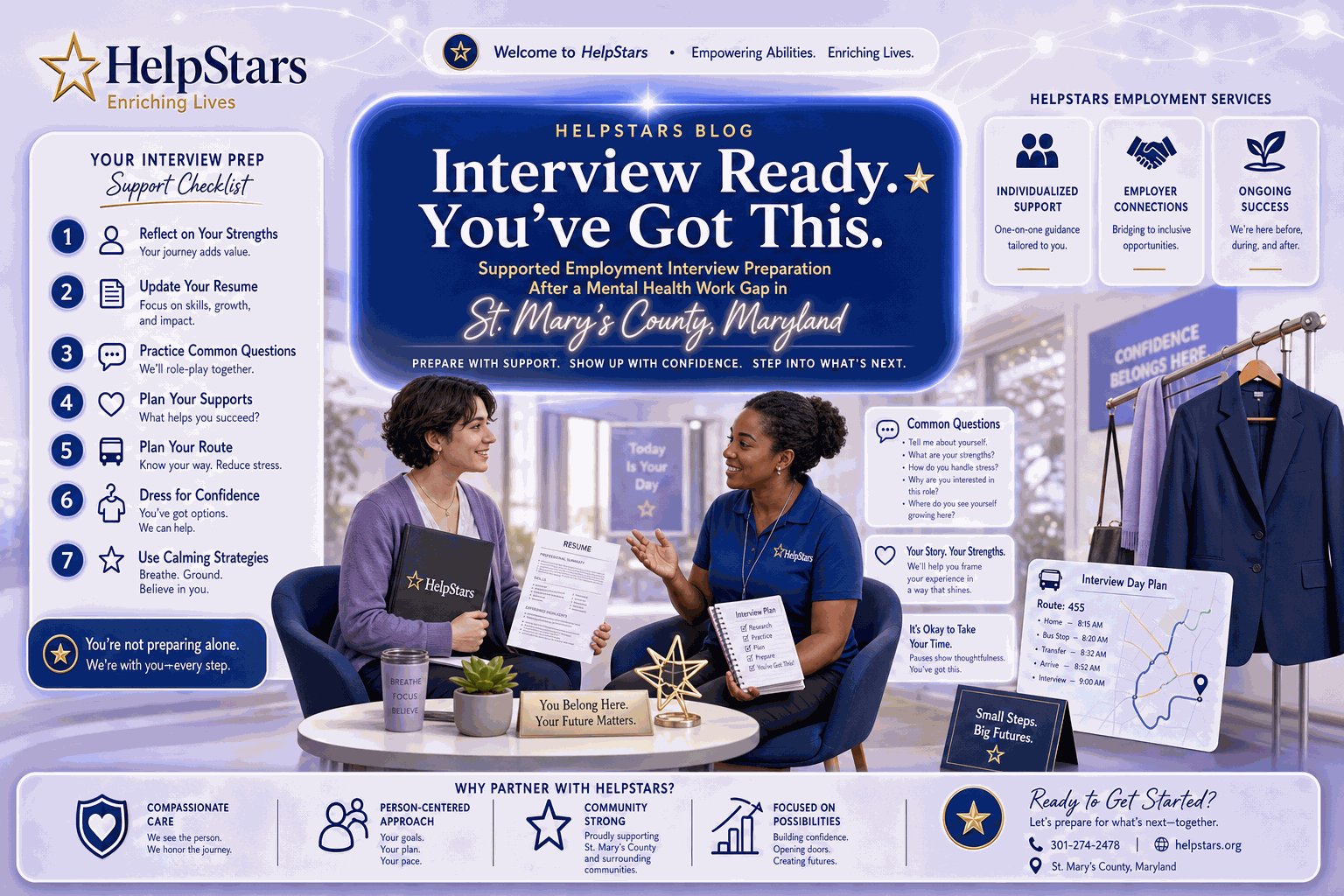
How Supported Employment Can Help Adults Prepare for Job Interviews After a Mental Health Work Gap in St. Mary’s County, Maryland
Getting an interview after time away from work can bring two feelings at once: relief that an opportunity finally showed up, and pressure to prove everything is back on track immediately. For many adults, the stress is not only about answering questions well. It is also about deciding what to say about the gap, finding clothes that feel right, getting there on time, staying regulated enough to think clearly, and walking into the room without feeling defeated before the conversation even starts.
That is where a Supported Employment Program (SEP) can be useful. Supported employment is not only for job placement after everything is already figured out. It can also help with the preparation that comes first. For adults in St. Mary’s County, Maryland, interview readiness may involve practical support around confidence, planning, routines, and follow-through so the job search feels more manageable and less isolating.
HelpStars LLC supports adults and families across Southern Maryland with compassionate behavioral health services, including employment-focused support that respects both recovery and real-life responsibilities.
Why Interview Prep Can Feel Harder After a Mental Health Setback
An employment gap can happen for many reasons. Sometimes a person needed time to stabilize, return to treatment, adjust medications, recover from burnout, manage depression or anxiety, or rebuild a daily routine after a difficult stretch. Even when someone is ready to start moving forward, interviews can stir up fear quickly.
Common concerns may sound like this:
- "I do not know how to explain the gap without oversharing."
- "I am worried I will freeze or lose my train of thought."
- "I have the skills, but I do not feel confident talking about myself right now."
- "I have not had a work routine in a while, and everything around the interview feels harder than it should."
- "I want to work, but the process itself is making my symptoms worse."
These are not signs that someone lacks motivation. They are often signs that the return-to-work process needs more structure and support than generic job advice can provide.
What Supported Employment Can Help Organize Before Interview Day
Supported employment services can break interview readiness into smaller, realistic tasks. Instead of expecting someone to solve everything at once, the process can focus on the pieces that are getting in the way right now.
That may include support with:
- Identifying the kinds of jobs that match a person’s current strengths and goals
- Refreshing a resume after time away from work
- Practicing how to talk about experience without apologizing for every gap
- Planning transportation, timing, directions, and backup options
- Preparing for common interview questions in a calmer, more structured way
- Choosing a realistic schedule for applications, calls, and follow-up
- Building routines around sleep, meals, and morning preparation before the interview
For some adults, the biggest win is not a perfect mock interview. It is walking into the actual interview feeling less scattered and more prepared than the last time.
A Practical Example of How Preparation May Unfold
Interview support often works best when it is concrete. Rather than treating confidence as something a person should simply feel, supported employment can help build it through repetition and planning.
Step 1: Narrow the target
Instead of applying everywhere, the first step may be focusing on roles that fit the person’s present stamina, transportation, communication style, and work history.
Step 2: Rebuild the story
A specialist may help the client describe prior experience, strengths, and goals in a way that is honest but not self-defeating. The goal is a steady, forward-looking explanation, not a defensive one.
Step 3: Practice the setting
That can include mock questions, a walkthrough of what to bring, and a plan for what to do if anxiety rises before or during the interview.
Step 4: Prepare the logistics
Directions, travel time, documents, clothing, phone charging, and arrival timing can all be decided ahead of time so fewer decisions are left for the last minute.
Step 5: Plan the follow-through
After the interview, support may shift to sending a follow-up message, tracking the application, and deciding what the next step should be instead of shutting down from uncertainty.
What to Say About a Work Gap Without Sharing More Than You Want To
Many adults worry that one question about employment history will undo the entire interview. In reality, a gap explanation usually works best when it is brief, truthful, and directed toward the future. A person may choose to say they were addressing health needs, managing personal circumstances, or taking time to regain stability and are now ready to return to work with a clearer plan.
Supported employment can help someone practice language that feels natural rather than overly rehearsed. The point is not to hide in panic or to disclose deeply personal details. It is to answer confidently, return to qualifications, and keep the conversation moving.
Just as important, adults do not need to build their entire interview around the gap. They also need help recognizing what they still bring to a workplace: reliability goals, past experience, problem-solving ability, people skills, willingness to learn, and the insight that comes from working hard to move forward.
When the Real Goal Is Confidence, Not Perfection
Some interview advice makes people feel as if one awkward answer means the opportunity is gone. That mindset can make symptoms worse. Supported employment can offer a more practical goal: show up prepared, stay as grounded as possible, answer honestly, and keep going even if every word does not come out exactly right.
For adults living with anxiety, depression, bipolar disorder, trauma-related stress, or other behavioral health challenges, confidence often returns through action rather than waiting for fear to disappear first. Small preparation steps can lower the pressure enough for someone to re-enter the job process with more stability.
Questions Adults in St. Mary’s County Often Ask About Supported Employment
Do I have to disclose a mental health diagnosis in an interview?
Not usually. Many adults choose to keep the explanation general and focused on readiness to return to work. Supported employment can help someone practice language that feels appropriate for their situation.
Can supported employment help before I even get an interview?
Yes. Support may begin with job-search structure, resume preparation, application follow-through, and interview practice long before an offer is on the table.
What if I have been out of work for a long time?
That does not automatically mean the process is unrealistic. It may mean the first goal should be a more supported, step-by-step plan that rebuilds confidence and consistency over time.
Is supported employment only for people who already know exactly what job they want?
No. Some adults start by exploring fit, pace, strengths, and practical barriers before narrowing down the right work direction.
Why Local Support Matters in St. Mary’s County
Interview preparation is easier when the plan fits local life. Adults in Leonardtown, Lexington Park, California, Great Mills, Mechanicsville, and nearby St. Mary’s County communities may be juggling transportation limits, family responsibilities, treatment appointments, and the emotional weight of restarting after a hard season. Local support can make the process feel more practical because it stays connected to the routines, travel patterns, and daily realities people are actually navigating.
That matters because returning to work is rarely only about the interview itself. It is also about whether the preparation is realistic enough to repeat, adjust, and build on from one opportunity to the next.
Getting Ready for the Interview Is Part of Getting Ready for the Job
A long work gap does not erase a person’s strengths. It may simply mean the path back needs more structure. Supported employment can help adults in St. Mary’s County prepare for interviews in a way that is organized, compassionate, and focused on real next steps instead of shame.
When the process is broken into manageable pieces, the interview can stop feeling like a final judgment and start feeling like one step in a larger return-to-work plan. HelpStars LLC provides behavioral health support for adults and families across Southern Maryland, including services that help people move toward greater confidence, consistency, and community participation.