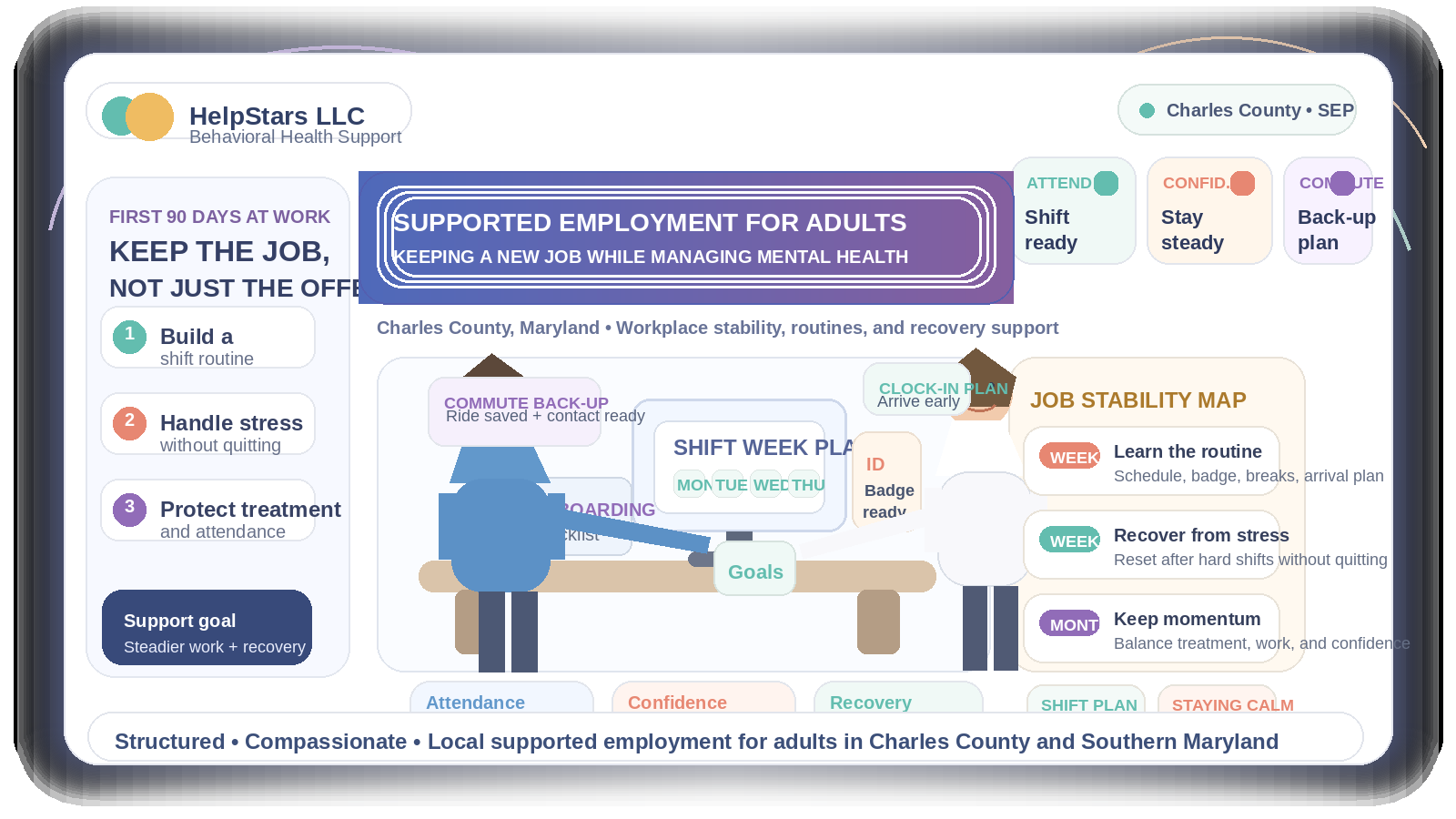
How Supported Employment Can Help Adults Keep a New Job While Managing Mental Health in Charles County, Maryland
A job offer can feel like a major step forward. Then the first full workweek begins, and the pressure changes shape. The alarm has to go off on time. Transportation has to line up. Breaks have to be used well. Stress has to stay manageable enough to make it through a shift and do it again the next day. For adults in Charles County, Maryland, that early stage of employment can be the point where hope and overwhelm show up at the same time.
That is one reason supported employment services matter. A Supported Employment Program, often called SEP, is not only about finding a job opening. It can also help adults hold onto new work when behavioral health challenges are making consistency harder than motivation alone can solve. For someone living with anxiety, depression, bipolar disorder, trauma-related stress, or another ongoing mental health concern, job retention may depend on structure, problem-solving, and the right kind of support around real-life barriers.
The First Few Weeks on the Job Can Be the Most Fragile
Many adults are capable of working and want to succeed. The harder part is staying steady once the routine becomes real. A new supervisor, changing expectations, paperwork, schedules, social pressure, and fear of making mistakes can all raise stress quickly. Even positive change can feel destabilizing when a person is already working hard to manage symptoms and daily responsibilities.
In Charles County communities such as Waldorf, La Plata, White Plains, and nearby areas, people may also be balancing childcare, medication appointments, transportation needs, court obligations, or long commutes while trying to protect a brand-new opportunity. When those demands pile up, keeping a job can become less about work ethic and more about whether the person has enough support to stay organized and recover from setbacks.
Why Job Retention Can Be Harder Than Getting Hired
Searches for supported employment in Charles County often start before a person is hired, but many employment struggles show up afterward. Someone may interview well, accept the job, and still run into problems during the first 30 to 90 days because the day-to-day pattern is difficult to maintain. Common issues can include:
- Missing shifts because sleep, anxiety, or transportation problems disrupt the morning
- Feeling overwhelmed by orientation steps, forms, or new-task instructions
- Having trouble managing stress after difficult interactions at work
- Falling behind on communication with supervisors or support systems
- Losing confidence after one bad day, one late arrival, or one misunderstanding
- Struggling to balance treatment appointments with a changing work schedule
These barriers do not mean a person is not ready for employment. Often they mean the transition into work needs more planning and follow-through support than the person currently has.
What Supported Employment Can Focus On After a Job Starts
A behavioral health supported employment program can be especially helpful when the goal is not simply job search, but job stability. Instead of treating work as a separate issue from recovery, supported employment can address the practical factors that make it easier to stay employed.
Depending on the person, support may include improving attendance habits, organizing a weekly work-and-treatment schedule, practicing ways to respond to stress on the job, identifying transportation backup plans, or breaking a large adjustment period into smaller workable steps. The purpose is not to remove every challenge. It is to help the person build a steadier system around those challenges before they turn into job loss.
Examples of Practical Support During a New-Job Transition
For adults in Charles County, supported employment may help make the early weeks of a new job feel more manageable through support such as:
- Creating a reliable pre-shift routine for sleep, meals, medication timing, and leaving home
- Planning how counseling, psychiatry, or PRP appointments fit around the work schedule
- Problem-solving transportation for early shifts, split shifts, or longer commutes
- Building reminders for paperwork, badge requirements, uniforms, or onboarding deadlines
- Strengthening confidence after mistakes so one difficult day does not become a quitting point
- Talking through workplace stressors in a recovery-focused, realistic way
This kind of support matters because the first goal is often not perfection. It is consistency. Keeping the job long enough to settle in can be a major recovery step.
How Supported Employment Differs From General Career Advice
Traditional employment advice often assumes the main problem is résumé quality, interviewing, or motivation. Supported employment services take a different view. They recognize that a person may already have the desire to work and even the skills to do the job, while still needing behavioral health support around stamina, routines, stress tolerance, confidence, and follow-through.
That distinction matters. An adult who is managing depression or anxiety may not need a generic productivity lecture. They may need a concrete plan for getting to work on time after a night of poor sleep, recovering after a tense interaction, or keeping treatment connected to their work goals instead of competing with them.
Why Local Charles County Support Can Make a Difference
Employment barriers are often local. Shift times, commute distances, available rides, neighborhood routines, and employer expectations can all shape whether a plan is realistic. Behavioral health employment support in Charles County is more useful when it reflects the community where someone is actually trying to build stability.
For some adults, that may mean planning around travel between home, treatment appointments, and workplaces in Waldorf or La Plata. For others, it may mean anticipating how childcare coordination, bus timing, or family demands affect attendance. Local support can help turn a broad goal like “keep this job” into a more specific plan that fits everyday life in Southern Maryland.
Signs It May Be Time to Ask About Extra Employment Support
It may be worth exploring a Supported Employment Program when a person is close to losing a job, keeps cycling through short-term positions, or feels emotionally flooded by the transition into work even though they want to succeed. Other signs can include:
- Repeatedly calling out during the first weeks of employment
- Difficulty recovering from stress after shifts
- Trouble keeping both treatment and work commitments organized
- Low confidence that leads to quitting before a routine has time to form
- Feeling capable in theory, but unable to hold the structure together consistently
Reaching for extra support early can be a strength. In many cases, it is easier to protect a job when support begins before patterns of lateness, absence, or discouragement become harder to reverse.
Work Stability Can Be Part of Recovery
For many adults, employment is not separate from mental health recovery. It affects confidence, daily structure, finances, relationships, and a sense of direction. When behavioral health symptoms keep interfering with that progress, supported employment can be a practical way to strengthen stability without losing sight of the person behind the schedule.
HelpStars LLC provides compassionate behavioral health support for adults across Southern Maryland. For individuals in Charles County who want to keep a new job while managing mental health challenges, supported employment services may be an important next step toward steadier work and steadier recovery.