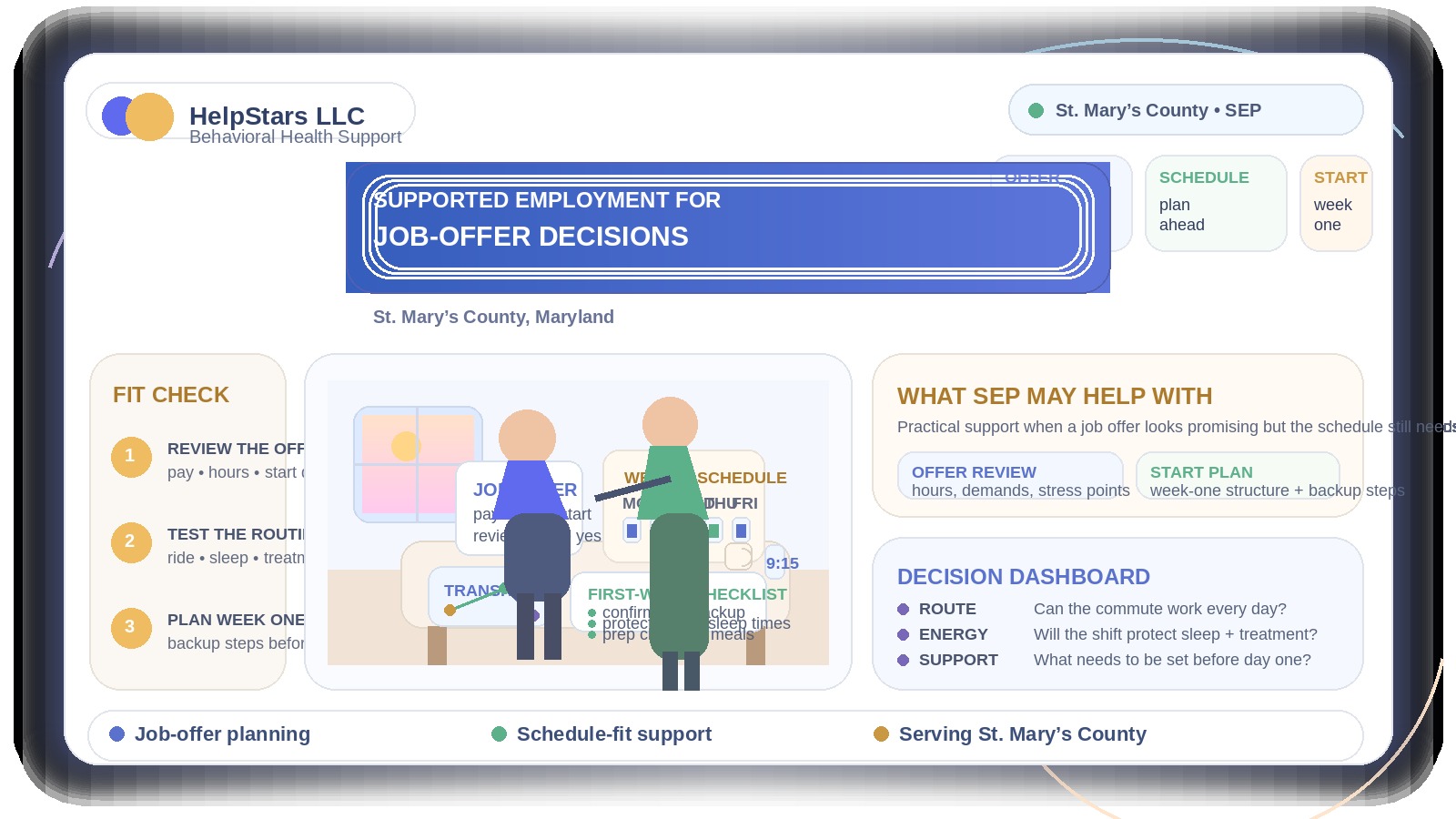
How Supported Employment Can Help Adults Evaluate Job Offers and Work Schedules in St. Mary’s County, Maryland
The call finally comes. A manager wants to move forward. An email with pay details lands in the inbox. Family members feel relieved. Friends say, “Take it.” From the outside, accepting a job offer can look like the easy part. For many adults managing mental health recovery, it is not. The offer may be good news and still raise real questions about energy, transportation, schedule stability, treatment routines, and whether the job is truly workable in everyday life.
For adults in St. Mary’s County, Maryland, supported employment can help make that decision more practical and less overwhelming. A supported employment program is not only about finding openings. It can also help adults think through whether a specific job is a good fit, what support may be needed to succeed, and how to protect recovery while moving back into the workforce.
HelpStars LLC provides compassionate behavioral health support for adults and families across Southern Maryland. When someone wants to work but does not want to step into a role that could quickly become unmanageable, a more thoughtful plan can make a meaningful difference.
The Hardest Part May Be Deciding Whether an Offer Fits Real Life
Many adults feel pressure to say yes quickly because opportunities can feel fragile. They may worry that turning down a role means they are not serious about work. They may feel embarrassed to admit that practical questions keep circling in their mind. But job success is rarely determined by motivation alone.
A person may be asking themselves things like:
- Can I handle this shift consistently with my current treatment routine?
- Will the commute wear me down before the workday even starts?
- What happens if the schedule changes every week?
- Do I have enough structure at home to get ready reliably?
- Will this environment support me, or will it push me into shutdown, panic, or repeated call-outs?
Those are not signs of laziness or lack of ambition. They are the kinds of questions that can help someone avoid stepping into a role that looks promising at first but falls apart under the weight of everyday logistics.
Why the First Available Job Is Not Always the Right Next Step
Returning to work after a period of mental health instability can bring hope, pride, and momentum. It can also bring pressure to prove something quickly. That pressure sometimes leads adults to accept jobs that do not match their transportation options, sleep patterns, symptom triggers, family obligations, or current ability to tolerate overstimulation and unpredictability.
When that happens, the problem is not always the person. Sometimes the fit was never realistic to begin with. An offer might involve rotating shifts that disrupt medication or sleep routines. A workplace may be technically reachable but difficult to manage on time every day. A role may sound simple in the interview and turn out to require more pace, noise, multitasking, or social contact than expected.
Supported employment can help adults slow that decision down just enough to look at the full picture before saying yes. That can protect both employment stability and recovery progress.
What Supported Employment Can Help Sort Out Before Accepting a Job
Supported employment in St. Mary’s County can be valuable when someone does want to work, but needs help deciding whether an offer is workable and what the first weeks may require. Depending on the person’s goals, support may include:
- reviewing the job schedule and identifying conflict points before they become attendance problems,
- thinking through transportation timing, backup plans, and commute stress,
- discussing how the job fits with treatment appointments, family responsibilities, or benefit-related concerns,
- comparing more than one opportunity based on stability rather than urgency alone,
- preparing for common first-week challenges such as paperwork, routines, and communication expectations, and
- building a practical support plan so the transition into work feels more structured.
The goal is not to talk someone out of work. The goal is to help them move toward work in a way that is realistic enough to last.
A St. Mary’s County Example: The Offer Looks Good, but the Week Already Feels Tight
Imagine an adult in St. Mary’s County who receives a job offer for a position they genuinely want. The pay sounds fair. The employer seems friendly. But the schedule starts earlier than expected, the bus timing is narrow, and the person already has counseling or psychiatry appointments that matter to their stability. A family member says they should take the opportunity before it disappears, yet the person quietly worries that one missed morning could put the whole job at risk.
In that situation, supported employment may help turn vague anxiety into concrete planning. Is there a better route? Can appointments be reviewed around the workweek? Does the person need to practice a morning sequence before the start date? Is the work setting likely to be energizing, overstimulating, or hard to recover from? Looking at those questions directly can help the person make a stronger decision than simply accepting the offer and hoping the rest works itself out.
Sometimes the answer is yes, this role can work with the right preparation. Sometimes the answer is that another opportunity may be a better fit. Either outcome can be useful if it prevents a fast cycle of job loss, discouragement, and self-blame.
Questions Worth Asking Before Saying Yes
Adults do not need to approach every offer with fear, but it can help to pause long enough to ask practical questions such as:
- What will this schedule ask of me every week? A job is not only the shift itself. It also includes travel time, preparation time, recovery time, and how changes in routine affect the rest of life.
- What parts of this role look steady, and what parts look unpredictable? Predictability often matters when someone is working to protect mental health stability.
- What has made past jobs hard to keep? The answer may involve attendance, overstimulation, conflict, transportation, fatigue, or difficulty with task transitions.
- What support needs to be in place before day one? That may include reminders, ride planning, clothing prep, meal planning, or a calendar that clearly maps the week.
- Will this job support my long-term goals, or only solve this week’s urgency? A rushed yes can sometimes create a harder setback later.
These questions are often easier to work through with structured support than in isolation.
Success Often Depends on the First-Month Plan, Not Only the Offer Letter
Many employment setbacks happen after the offer is accepted but before a dependable rhythm is built. The first few weeks may bring new paperwork, unfamiliar expectations, fatigue from learning tasks, transportation stress, and pressure to appear confident before the person actually feels settled.
Supported employment can help shift attention from “I got the job” to “How do I make this week repeatable?” That may involve creating a realistic bedtime and wake-up routine, mapping the commute more than once, identifying who the person can contact if a problem comes up, rehearsing how to ask clarifying questions at work, or building a recovery plan for hard days instead of disappearing after the first mistake.
That early structure can matter because work stability is often built through repetition, not motivation bursts.
Who May Benefit From This Type of Job-Decision Support
Adults and families may want to ask about a supported employment program in St. Mary’s County when someone is:
- excited about working but unsure whether a specific offer is a realistic fit,
- worried that transportation or shift timing will lead to attendance problems,
- trying to return to work while maintaining mental health treatment and daily structure,
- choosing between multiple opportunities and unsure which is more stable,
- concerned about repeating a pattern of accepting jobs too quickly and losing them soon after, or
- needing practical help to plan the first weeks of employment more carefully.
Support can be helpful even before a crisis happens. In many cases, the strongest move is not waiting until a new job starts falling apart.
Why Local Logistics Matter Across St. Mary’s County
Work decisions happen inside real community routines. Adults in Leonardtown, Lexington Park, California, Great Mills, Hollywood, Charlotte Hall, and surrounding St. Mary’s County communities may be balancing transportation limits, shared household schedules, medical appointments, benefits coordination, childcare, or uneven energy from week to week.
That local context matters because a job that looks good in theory may not fit the actual route, timing, and daily flow of the person’s life. Employment support becomes more useful when it accounts for where someone lives, how they get around, and what kind of structure they realistically have available on Monday morning instead of what they wish they had.
Common Questions About Supported Employment and Job Offers
Is supported employment only for finding job listings?
No. It can also help with planning, job-match decisions, routines, communication, and the practical steps that make employment more sustainable.
What if I want to work but I am afraid of accepting the wrong job?
That is a reasonable concern. A thoughtful decision can be more protective than a rushed one, especially if past jobs became unstable because the fit was poor from the beginning.
Does needing help evaluating a job offer mean I am not ready to work?
Not at all. It may mean you are taking the decision seriously and trying to build a better foundation for success.
Can supported employment help after I accept the job too?
Yes. Many adults benefit from support with the transition into the first weeks of work, especially when routines, transportation, or stress tolerance still need strengthening.
A Thoughtful Yes Can Be Stronger Than a Fast Yes
A job offer can be a real opportunity, but the best next step is not always the quickest one. When adults have space to evaluate schedule demands, transportation, treatment routines, and long-term fit, they are often better positioned to choose work that they can actually maintain.
HelpStars LLC serves adults and families across Southern Maryland with compassionate behavioral health services. For adults in St. Mary’s County who want practical help thinking through a job opportunity, supported employment may provide a steadier path toward confident decisions, stronger first-week planning, and more sustainable progress in the workplace.