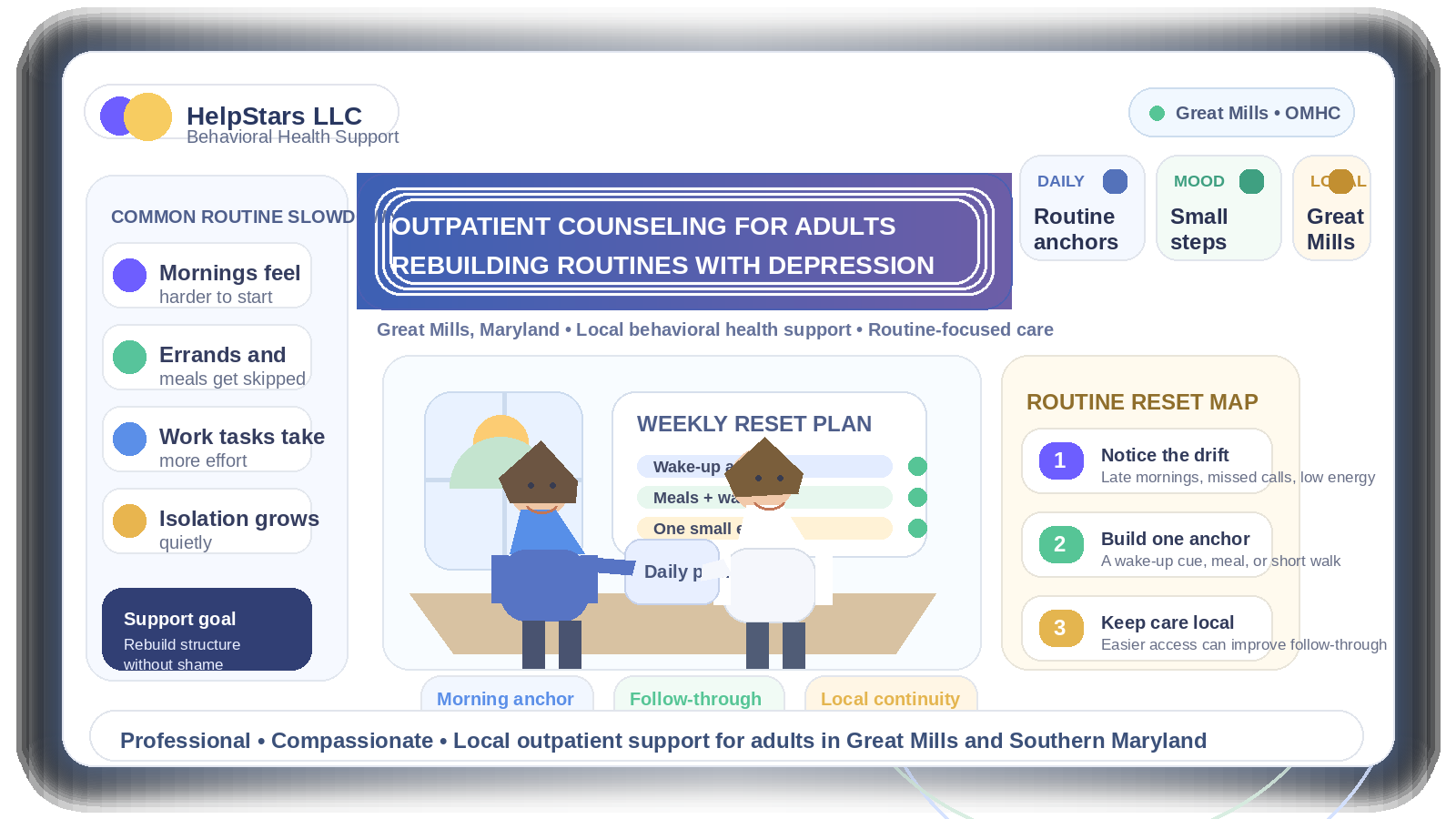
How Outpatient Mental Health Counseling Can Help Adults With Depression Rebuild Daily Routines in Great Mills, Maryland
Some adults do not describe their first concern as depression. They describe a week that keeps getting away from them. Laundry stays in the basket. Meals become irregular. Calls go unanswered. Getting ready for work takes longer than it used to. The calendar fills up, but follow-through gets harder. In Great Mills and across St. Mary’s County, that kind of daily slowdown can be one of the clearest signs that emotional strain is beginning to affect how life functions.
Outpatient mental health counseling can offer more than a place to talk about feeling low. It can provide structured support for adults whose motivation, concentration, energy, and routines have started slipping in ways that make home life, work, parenting, or community responsibilities harder to manage. For people looking for depression support in Great Mills, Maryland, early behavioral health care can help turn vague overwhelm into a clearer next step.
When Daily Tasks Start Feeling Heavier Than They Used To
Depression does not always appear as a dramatic crisis. Sometimes it shows up as a slower, quieter loss of traction. Tasks that once felt ordinary may begin to take far more effort. A person might still be getting through the day, but only by pushing through exhaustion, withdrawing from people, or letting important routines slide.
That matters because daily functioning often changes before someone feels ready to say, “I need help.” By the time depression affects sleep, appetite, punctuality, household routines, or relationships, the issue is already touching more than mood alone.
Common Routine Disruptions Adults May Notice
Adults in Great Mills who begin searching for outpatient mental health support for depression are often trying to make sense of changes such as:
- Difficulty getting out of bed or starting the day on time
- Low motivation around meals, errands, or housekeeping
- Trouble concentrating well enough to stay organized at work
- Pulling back from friends, family, or church and community activities
- Missing appointments or putting off responsibilities that feel mentally heavy
- Feeling emotionally flat, discouraged, or easily overwhelmed by simple decisions
These shifts can build gradually. Because of that, adults sometimes normalize them for too long. They may assume they just need to try harder, rest more, or wait for the stress to pass. But when routines keep shrinking, it is reasonable to consider whether depression-related symptoms are starting to shape everyday life.
Why Outpatient Counseling Can Be a Practical Starting Point
One of the strengths of outpatient mental health counseling is that it allows support to begin while a person stays connected to real life. Adults can continue living at home, working, caring for family, attending school, or managing other responsibilities while also building a treatment plan around what feels hardest right now.
For depression support, that can be especially helpful. Many adults do not need a dramatic intervention as their first step. They need a consistent place to sort out what has changed, what daily patterns are slipping, and what kind of support may be realistic enough to sustain. Outpatient care can help people name the problem earlier, rather than waiting until daily functioning has dropped even further.
What Early Depression Support May Focus On
A strong outpatient plan is not only about describing symptoms. It is also about restoring traction in daily life. Depending on the person’s needs, early counseling may focus on:
- Identifying when routine changes first became noticeable
- Understanding how mood, stress, sleep, and isolation may be affecting follow-through
- Creating realistic goals for mornings, appointments, meals, work tasks, or home responsibilities
- Building strategies for staying engaged even when motivation feels low
- Noticing whether anxiety, grief, trauma history, or family stress are also contributing to the depression picture
That kind of work can be valuable because many adults are not dealing with one issue in isolation. They may be carrying relationship strain, financial stress, parenting pressure, recent loss, health concerns, or a long stretch of emotional exhaustion at the same time. Counseling can help organize those stressors into a plan that feels more manageable.
Questions Adults Often Have Before Reaching Out
People looking for depression counseling in St. Mary’s County often pause because they are unsure whether their situation is “serious enough” for treatment. Others worry that they will be expected to explain everything perfectly on day one. Common questions include:
- What if I can still go to work but everything feels harder than it should?
- What if my routines are slipping, but I am not in a crisis?
- Will counseling help if I mostly feel stuck, disconnected, or unmotivated?
- How do I know whether standard outpatient care is enough support for me right now?
These are practical questions, not signs of weakness. A thoughtful first conversation should help clarify how symptoms are affecting functioning, what goals make sense to start with, and whether outpatient counseling appears to match the level of care needed.
Why Local Access Matters in Great Mills and Nearby Communities
Support is easier to use when it fits the realities of local life. Adults in Great Mills may be juggling commuting demands, shift work, parenting schedules, caregiving, transportation limitations, or responsibilities spread across Lexington Park, California, Leonardtown, and other parts of Southern Maryland. If care is too difficult to coordinate, even a well-intended plan can become hard to maintain.
Local outpatient mental health services can make consistency more realistic. That consistency matters because depression often improves through steady follow-through, not through one perfect conversation. When appointments, care planning, and service coordination are close enough to keep using, support is more likely to become part of a workable routine.
When It May Be Worth Discussing Additional Support
Weekly outpatient counseling can be an appropriate starting point for many adults with depression, but not every situation looks the same. If symptoms are making it difficult to manage basic responsibilities, keep appointments, maintain safety, or function through the week, it may be worth discussing whether added behavioral health support should be considered. Depending on the person’s needs, that conversation could include psychiatric rehabilitation support or a more structured level of care.
The goal is not to overcomplicate treatment. It is to make sure support matches what daily life is actually requiring.
Small Routine Gains Can Be Meaningful Progress
Depression can convince people that nothing has changed enough to justify help or that improvement only counts if it happens all at once. In reality, progress often begins in smaller ways: getting through mornings with less dread, returning calls, eating more regularly, keeping appointments, or feeling more able to rejoin daily life. Those changes matter.
HelpStars LLC provides compassionate, professional behavioral health support for adults in Great Mills, St. Mary’s County, and surrounding Southern Maryland communities. When depression is starting to interfere with routines, energy, and day-to-day functioning, outpatient mental health counseling can offer a steady place to begin rebuilding momentum.