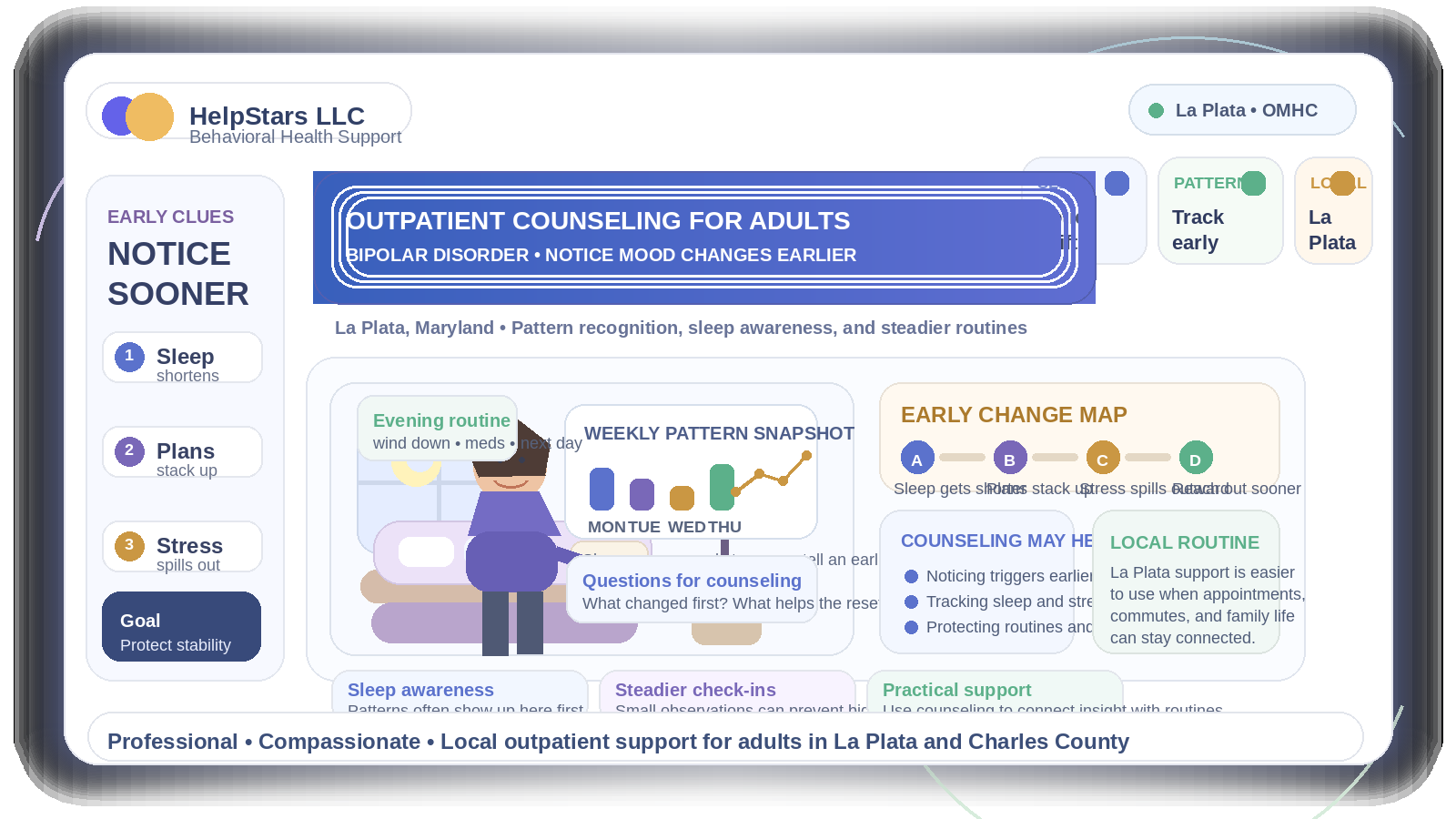
How Outpatient Mental Health Counseling Can Help Adults With Bipolar Disorder Notice Mood Changes Earlier in La Plata, Maryland
Not every bipolar-related setback begins with an obvious crisis. Sometimes it starts with a few shorter nights, a sudden burst of energy that feels productive at first, a calendar that gets overfilled, faster speech, more irritability at home, or spending that becomes harder to slow down. In La Plata, Maryland, adults and families often notice that something feels different before they know exactly what to call it.
That is one reason outpatient mental health counseling can be valuable. It offers a steady place to notice patterns earlier, talk through what has changed, and build a plan before stress, mood shifts, and day-to-day consequences start piling up. For adults living with bipolar disorder, counseling is not only about discussing feelings in the abstract. It can support insight, routines, communication, and practical follow-through that make life feel more stable.
At HelpStars LLC, behavioral health support is grounded in compassionate care, realistic goals, and local access for adults across Charles County and Southern Maryland.
Sometimes the Earliest Clues Show Up in Daily Patterns
Adults do not always seek help because they are in immediate danger. Often, they reach out because normal routines are starting to feel less predictable. Sleep may become inconsistent. Work pace may suddenly speed up or fall off. A person may feel unusually confident one week and deeply drained the next. Loved ones may notice more conflict, impulsive decisions, or difficulty settling back into an ordinary schedule.
Common early changes that may be worth discussing in counseling include:
- Sleeping less or sleeping at irregular times without feeling rested
- Taking on too many commitments during a high-energy period
- Becoming more irritable, restless, or emotionally reactive at home or at work
- Having trouble slowing thoughts down enough to stay organized
- Withdrawing after a stressful stretch and struggling to restart routines
- Seeing mood changes begin to affect spending, communication, or follow-through
These experiences can look different from person to person. The important point is not to self-diagnose alone. It is to notice when patterns are interfering with stability and deserve professional attention.
Why Early Support Matters for Bipolar Disorder
Bipolar disorder can affect energy, sleep, concentration, judgment, motivation, and relationships. Because those shifts do not always happen all at once, adults sometimes wait too long to seek support. They may hope the pattern will pass on its own or assume that because they are still going to work, parenting, or handling errands, they should just push through it.
Early outpatient counseling can help create a clearer picture of what is happening before a rough stretch becomes more disruptive. When adults learn to recognize personal warning signs sooner, they may be better able to protect routines, ask for support, and make thoughtful decisions about next steps in treatment.
What Outpatient Counseling Can Focus On
For adults in La Plata looking for bipolar disorder support, counseling may focus on both emotional insight and practical structure. A strong outpatient plan is often less about perfection and more about pattern recognition, steadier routines, and better recovery decisions.
Depending on the person’s needs, counseling may help with:
- Tracking changes in sleep, stress, energy, and behavior over time
- Recognizing personal warning signs that tend to show up before functioning drops
- Building routines that support more consistent mornings, evenings, and appointments
- Talking through impulsive choices, conflict patterns, or overcommitment before they grow
- Improving communication with family members or trusted supports when that is appropriate
- Clarifying whether additional outpatient services should be discussed as part of a broader care plan
Counseling does not replace crisis care or emergency help when safety is at risk. It can, however, become an important part of long-term support when the goal is to understand patterns earlier and respond in a more grounded way.
What This Can Look Like in Real Life
In practice, adults often come to counseling with concerns that are highly specific. One person may want help understanding why several nights of poor sleep seem to lead to overbooking, overspending, and tension at home. Another may be trying to notice the quieter signs that a depressive stretch is beginning, such as isolation, missed calls, loss of appetite, or trouble getting through the workday. Someone else may want support rebuilding trust after mood changes have strained important relationships.
That is where outpatient care can feel useful. Instead of treating every week as disconnected, counseling can help connect the dots between stressors, routines, mood patterns, and consequences. Over time, those observations may help adults make earlier, steadier choices rather than waiting until life feels much harder to manage.
Questions Adults and Families Often Ask
People searching for bipolar counseling in Charles County often have practical questions before they reach out. A few common ones include:
Does counseling only help after a major mood episode?
No. Many adults use counseling to understand earlier warning signs, protect routines, and improve communication before symptoms become more disruptive.
What if I am not sure whether the pattern is stress, burnout, or bipolar-related change?
That uncertainty is a reasonable reason to start a conversation. Counseling can help explore what has changed, how it is affecting daily life, and what kind of support may make sense.
Can counseling help if the main problem is follow-through, conflict, or instability at home?
Yes. Those practical issues are often closely tied to mood patterns. Counseling can help adults look at how sleep, energy, stress, and reactions are affecting everyday functioning and relationships.
Why Local Access Matters in La Plata and Nearby Communities
Behavioral health care is easier to sustain when it fits real life. Adults in La Plata may be balancing commuting, parenting, caregiving, work schedules, legal obligations, or travel across White Plains, Waldorf, Indian Head, and other parts of Charles County. If support is too difficult to reach or coordinate, consistency becomes harder.
Local outpatient mental health counseling can make it easier to keep appointments, stay engaged with care, and respond earlier when patterns begin to shift. That kind of continuity matters because progress with bipolar disorder often depends on noticing changes sooner, not only reacting after a major disruption.
A Better Read on the Pattern Can Be a Strong First Step
Adults living with bipolar disorder do not need to wait for life to fully unravel before asking for help. Sometimes the most meaningful first step is simply gaining a better read on the pattern: what tends to change first, what makes routines harder to hold, and what kind of support helps protect stability.
HelpStars LLC provides compassionate behavioral health support for adults in La Plata, Charles County, and nearby Southern Maryland communities. If mood changes are starting to affect sleep, routines, communication, or daily functioning, outpatient mental health counseling may be a practical place to begin.