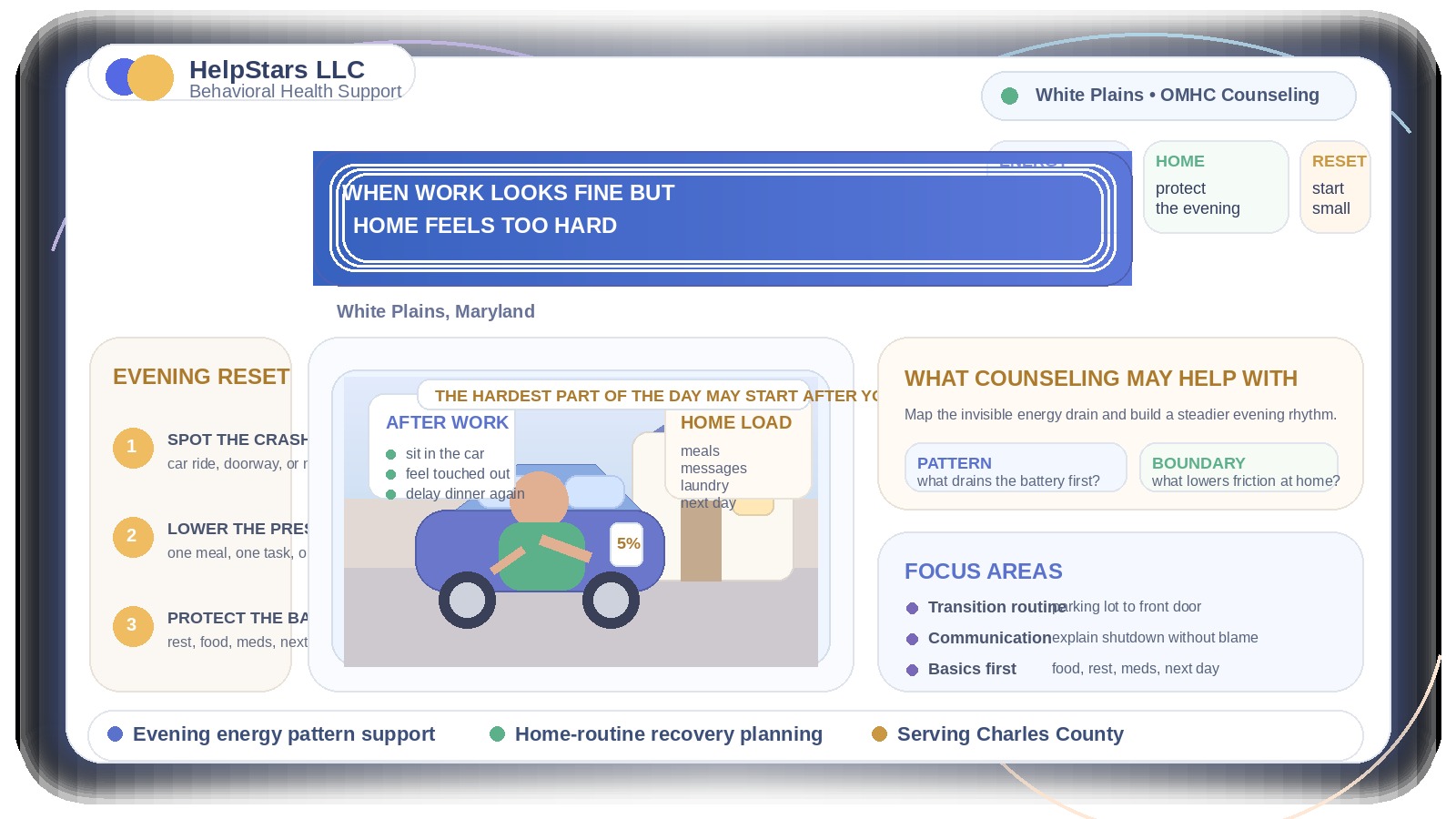
How Outpatient Mental Health Counseling Can Help Adults Who Look Fine at Work but Feel Drained at Home in White Plains, Maryland
Some adults do not look like they are struggling until the workday is over. They answer emails, make it through meetings, help customers, handle school drop-offs, or keep the shift moving. Then they get home and the rest of the evening quietly collapses. Shoes stay by the door. Dinner feels like too much effort. Messages go unanswered. A simple question from a partner, parent, or child can feel harder to tolerate than the busiest hour of the day.
For adults in White Plains, Maryland and nearby Charles County communities, outpatient mental health counseling can help make sense of that pattern. The issue is not always a lack of work ethic or motivation. Often, the person is spending so much energy holding everything together in public that there is very little left once they are home. Counseling can help identify what is driving the exhaustion, how it is affecting relationships and routines, and what support may help the whole week feel more sustainable.
HelpStars LLC provides compassionate behavioral health services for adults and families across Southern Maryland. When someone seems functional on the outside but increasingly depleted behind closed doors, counseling may be a practical next step before the pattern starts straining home life even more.
The Strain Often Shows Up After the Shift Ends
Many adults assume they should not ask for help if they are still technically getting through work. But emotional overload does not always show itself at the job site first. Sometimes it waits until the person is finally somewhere private enough to stop performing steadiness.
That after-work strain may look like:
- coming home and immediately shutting down instead of transitioning into the evening,
- feeling irritated by normal conversation after spending the whole day masking stress,
- losing the energy to cook, clean, return calls, or follow through on small responsibilities,
- scrolling or zoning out for hours because the brain cannot handle one more demand,
- crying, snapping, or withdrawing once the pressure of looking composed wears off, or
- dreading home responsibilities because work already used up the emotional battery.
When this becomes a repeating pattern, home can start feeling less like a place to recover and more like the place where all the unspent stress finally lands.
Looking Capable in Public Can Hide How Hard Evenings Have Become
Adults who are high-functioning on paper are often the ones who delay outpatient counseling the longest. They may think, "I am still showing up, so maybe this is not serious enough." Family members may say, "But you seem fine at work." The trouble is that visible functioning and internal stability are not the same thing.
A person may be compensating all day by over-preparing, staying tense, staying hyperaware, pushing through social contact, or suppressing emotions until they get home. By evening, the cost of that effort can show up as numbness, irritability, avoidance, or complete mental fatigue.
That pattern matters because it can quietly affect:
- partner or family communication,
- sleep and next-day recovery,
- meal planning and medication follow-through,
- patience with children or loved ones,
- household organization, and
- the ability to enjoy any part of the week outside of obligation.
Someone can still be employed, parenting, caregiving, or managing major responsibilities while steadily losing the feeling that life is workable.
Counseling Can Help Translate Invisible Exhaustion Into a Usable Pattern
One benefit of outpatient mental health counseling in Charles County is that it gives adults a place to slow the pattern down. Instead of only describing the problem as "I am exhausted" or "I get home and I am done," counseling can help break down what is happening before, during, and after the crash.
Support may include looking at questions such as:
- What parts of the workday use the most emotional energy?
- Does the crash happen more after noise, conflict, multitasking, long commutes, or people-heavy days?
- Is the main issue anxiety, depression, burnout, trauma-related stress, emotional masking, or a combination of pressures?
- What evening responsibilities become hardest first?
- What helps the person recover, and what actually makes the next day harder?
That kind of pattern-mapping can make the problem more specific and more treatable. The goal is not to shame someone for being tired. The goal is to understand why recovery is not happening the way it needs to.
An Adult in White Plains Example: By 7 PM the Battery Is Gone
Imagine an adult in White Plains working full days while also managing anxiety, low mood, stress sensitivity, or unresolved emotional strain. Coworkers may describe them as dependable. They keep conversations polite. They complete what absolutely has to get done. But once they get home, the mask drops fast. They sit in the car for ten extra minutes before going inside. They have no patience for small talk. Dishes, laundry, or tomorrow's preparation start piling up because there is simply no energy left to begin.
Over time, the household may misread the pattern. A partner may think the person is pulling away. A parent may think they are becoming lazy. The person may start blaming themselves for not being better at "basic life" after work. In counseling, the first useful shift may be realizing that this is not a character flaw. It is a signal that the current stress load and coping system are not working well enough.
From there, treatment can focus on what changes would actually matter: better boundaries during the day, clearer decompression routines, more realistic evening expectations, stronger emotional regulation skills, or a different way of recognizing when overload is building before the crash.
What It Can Help You Rebuild First
Counseling does not have to start with solving every problem in life at once. For many adults, the first gains come from rebuilding just a few pressure points that affect the whole week.
Depending on the situation, outpatient mental health counseling serving White Plains, Maryland may help a person:
- Recognize their early warning signs. Many adults notice the crash only when they are already depleted. Therapy can help them spot the earlier version of the problem.
- Create a transition routine between work and home. The answer is not always doing more. Sometimes it is building a more realistic way to reset before evening demands begin.
- Reduce all-or-nothing thinking. If someone cannot do the full list, they may do nothing. Counseling can help make the evening feel more flexible and less punishing.
- Name what support would actually help. Many adults need better language for asking loved ones for space, patience, or practical help without feeling guilty.
- Protect the basics. Sleep, meals, medication routines, and next-day preparation often improve when the emotional crash becomes more manageable.
Small changes at those pressure points can make a noticeable difference in whether the person keeps reliving the same drained evening or begins to feel more steady across the week.
When Loved Ones Misread the Crash as Distance or Attitude
One painful part of this pattern is that the people at home usually see the worst of the depletion while the people outside the home see the most polished version. That mismatch can create hurt on both sides. Loved ones may wonder why strangers get the patient's patience while the family gets silence, irritability, or shutdown. The adult coming home may feel ashamed that they have nothing left for the people they actually care about most.
Counseling can help adults prepare for those conversations in a less defensive way. Instead of arguing only about tone or effort, support may help the person explain what the evening crash feels like, what makes it worse, and what kind of response would be more useful. In some situations, family therapy or additional services may also be worth discussing, but individual outpatient counseling can still be an important starting place.
Questions Adults in Charles County Often Ask About This Kind of Counseling
If I am still getting through work, is counseling really necessary?
It can still be worth exploring. Many adults seek support because functioning is becoming too expensive to maintain, even if they have not stopped working.
Does this mean I am burned out?
Burnout may be part of the picture, but it is not the only possibility. Anxiety, depression, trauma-related stress, prolonged emotional masking, grief, or ongoing life strain can create a similar crash. Counseling can help clarify the pattern.
What if evenings are my main problem, not work itself?
That still matters. Home routines, relationships, rest, and next-day recovery are major parts of mental health functioning.
Can counseling fit alongside psychiatry, PRP, or other HelpStars services?
Often, yes. Depending on the person's needs, outpatient counseling may complement other behavioral health services as part of a broader treatment plan.
Why White Plains and the Wider Charles County Routine Matter
Adults in White Plains and nearby Charles County communities are often balancing more than one role at a time. The workday may be followed by commuting, caregiving, picking up children, checking on relatives, handling household tasks, or preparing for another early start. When emotional energy runs out, it runs out inside that real-life schedule, not inside an abstract therapy example.
That local context matters. Support works better when it takes seriously the actual pace of life in White Plains, Waldorf, La Plata, Bryans Road, Port Tobacco, and surrounding communities. A treatment plan is more useful when it fits the evening someone is actually walking into.
Support Can Start Before Functioning Drops Further
Many adults wait until a visible crisis develops before they consider behavioral health services in Charles County. But the quieter pattern matters too: the growing dread on the drive home, the disappearing patience, the meals skipped from fatigue, the relationships strained by shutdown, and the feeling that all energy is being spent just to appear okay.
HelpStars LLC supports adults and families across Southern Maryland with compassionate outpatient behavioral health care. For adults in White Plains, Maryland who look composed during the day but feel emotionally drained once they get home, outpatient mental health counseling may be a meaningful way to understand the pattern, protect relationships, and rebuild a steadier life outside of work.