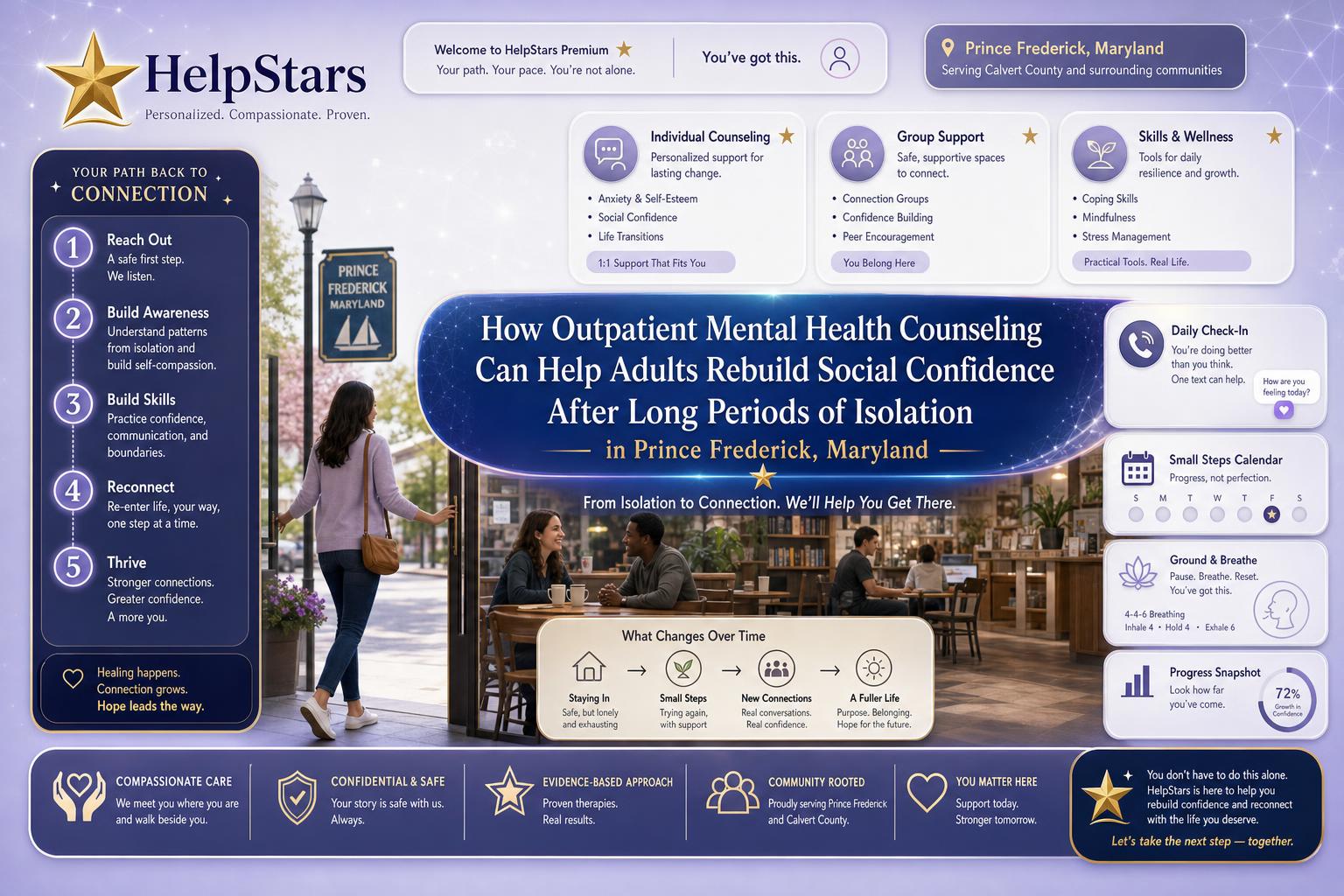
How Outpatient Mental Health Counseling Can Help Adults Rebuild Social Confidence After Long Periods of Isolation in Prince Frederick, Maryland
The first sign of isolation is not always staying home for weeks at a time. Sometimes it starts smaller. A person stops returning texts right away. They say maybe to plans and then cancel the day of. They walk into a store only if they know it will be quiet. Phone calls begin to feel like too much. Even seeing familiar people can create a strange mix of wanting connection and wanting to disappear.
For adults in Prince Frederick, Maryland, outpatient mental health counseling can offer practical support when social confidence has narrowed over time. Counseling is not about forcing someone into a crowded life overnight. It can help people understand what isolation is protecting them from, what it is costing them, and how to re-enter everyday life in manageable steps.
HelpStars LLC provides compassionate behavioral health support for adults and families across Southern Maryland. When isolation starts affecting routines, relationships, work, or confidence in public spaces, professional support may be a useful next step to explore.
When Everyday Interaction Starts Feeling Heavier Than It Used To
Many adults do not describe themselves as isolated at first. They may say they are just tired, keeping to themselves, avoiding drama, or focusing on getting through the week. But over time, more and more situations begin to feel draining or risky.
That shift can look like:
- putting off errands because being around people feels overstimulating,
- canceling plans because it feels easier to stay home than explain a low-energy day,
- avoiding eye contact, conversations, or community activities that once felt ordinary,
- feeling tense before appointments, school events, church, or family gatherings,
- losing confidence in how to restart friendships after a long quiet period, or
- worrying that other people will notice anxiety, sadness, or awkwardness right away.
These patterns do not automatically mean someone lacks interest in people. Often, they mean social life has started to feel unpredictable, emotionally expensive, or harder to recover from.
Why Isolation Often Feels Safer Before It Starts Feeling Smaller
Isolation can be easy to underestimate because it often solves an immediate problem. Staying home can reduce pressure. Canceling can prevent embarrassment. Keeping interactions short can lower anxiety for the moment. In that sense, withdrawal can feel protective.
The problem is that the short-term relief can slowly narrow a person's world. The grocery trip becomes harder because it happens less often. A simple catch-up call feels awkward because too much time has passed. The mind starts treating ordinary public situations as bigger than they are because practice has gone down and self-consciousness has gone up.
Counseling can help adults notice that pattern without shame. That matters because many people are not dealing with a lack of desire for connection. They are dealing with a cycle in which avoiding stress today makes tomorrow feel even harder.
What Counseling Can Support When Reconnection Feels Overwhelming
Outpatient mental health counseling can help adults work on social confidence in a grounded, realistic way. Depending on the person's needs, support may include:
- identifying which situations feel most difficult and why,
- sorting out whether the main driver is anxiety, depression, trauma, grief, shame, burnout, or another stress pattern,
- practicing ways to slow racing thoughts before appointments or social events,
- building a gradual plan for reconnecting instead of expecting a sudden personality change,
- working through self-criticism that shows up after cancellations or quiet periods, and
- rebuilding routines that make getting out of the house feel more possible.
For some adults, the work starts with one phone call a week. For others, it may start with walking into a familiar store, sitting through a family dinner a little longer, or learning how to recover emotionally after a tense interaction instead of disappearing again. The goal is not to become extroverted. The goal is to feel less trapped by avoidance.
A Prince Frederick Example: Wanting Connection but Dreading the Moment It Starts
Imagine an adult in Prince Frederick who misses seeing people but has started turning down invitations almost automatically. They want to go to a community event, meet a relative for coffee, or attend a school-related gathering, but as soon as the time gets close, their body feels tight and their mind starts running through everything that could go wrong. They worry they will have nothing to say, look uncomfortable, or need to leave early.
In counseling, the first step may not be "just go anyway." A more helpful approach may be understanding the exact point where distress spikes. Is it getting ready? Driving there? Walking in alone? Being asked personal questions? Feeling pressure to stay longer than expected? Once the pattern is clearer, support can become more specific. A person may plan shorter visits, create an exit strategy, practice grounding beforehand, or choose lower-pressure settings first.
That kind of structure can make reconnection feel possible again because the task becomes defined. Instead of facing the vague challenge of "being social," the person works on one manageable step at a time.
Social Confidence Usually Returns Through Repetition, Not One Big Leap
Many adults think confidence should come first and action should follow. In real life, the order is often reversed. Confidence often grows after a person has several tolerable experiences in a row.
That is why counseling may focus on repeatable experiments such as:
- choosing one public place that already feels somewhat familiar,
- planning the visit for a manageable time of day,
- keeping the first goal small and clear,
- reviewing what helped and what made the experience harder, and
- building from there instead of judging the entire effort as a success or failure.
This can be especially helpful for adults whose isolation has been shaped by depression, anxiety, trauma-related stress, bipolar disorder, or long stretches of overload. Progress often comes from reducing friction and practicing recovery after discomfort, not from demanding instant ease.
Signs It May Be Time to Ask for Support
Professional support may be worth exploring when isolation is starting to affect more than free time. Adults and families may want to reach out when someone is:
- withdrawing from friends, relatives, or community life more than they want to,
- avoiding errands, appointments, or public places because the social part feels too stressful,
- losing confidence after repeated cancellations or long quiet stretches,
- feeling lonely and shut down at the same time,
- noticing that anxiety or sadness spikes before even routine interactions, or
- finding that isolation is making work, family participation, or daily functioning harder.
Support does not have to wait until a person is fully disconnected. Many adults benefit while the pattern is still changeable.
Why Local Routine and Setting Matter in Calvert County
Re-entering social life is easier when the plan fits the real places a person moves through. Adults in Prince Frederick, Lusby, Huntingtown, Dunkirk, North Beach, Chesapeake Beach, and nearby Calvert County communities may be trying to reconnect through school functions, church, support services, shopping trips, work routines, neighborhood events, or family gatherings that are already part of local life.
That local context matters because rebuilding confidence is rarely abstract. It often happens in ordinary places: walking into a store, sitting in a waiting room, meeting someone for coffee, speaking up during a family visit, or staying a little longer at an event instead of leaving at the first wave of discomfort. A counseling plan tends to work better when it reflects those real-life settings.
Questions Adults Often Ask When Isolation Has Lasted a While
Do I need counseling if I can still leave the house sometimes?
Not necessarily, but counseling can still help if getting out feels harder than it should, if cancellations are increasing, or if social stress is shrinking daily life more than you want.
What if I am embarrassed that it has gotten this difficult?
That embarrassment is common. Many adults wait longer than they need to because they think they should already be able to handle it alone. Counseling can offer a place to talk about the pattern without judgment.
Will counseling push me into things I am not ready for?
Effective support should be paced. The point is usually to build manageable progress, not to overwhelm someone with unrealistic expectations.
Can counseling help if isolation is tied to depression or anxiety?
It often can. Counseling may help adults understand the emotional pattern underneath withdrawal while also practicing more workable routines and responses.
Reconnection Can Start Smaller Than People Expect
Isolation often grows quietly, but social confidence can return quietly too. A person may start by replying to one message, keeping one appointment, walking into one familiar place, or staying present for one conversation longer than usual. Those steps can look modest from the outside, yet they often represent real movement.
HelpStars LLC serves adults and families across Southern Maryland with professional, compassionate behavioral health support. For adults in Prince Frederick and surrounding Calvert County communities who feel their world has become smaller because isolation keeps winning, outpatient mental health counseling may help create a steadier path back toward connection, routine, and everyday confidence.