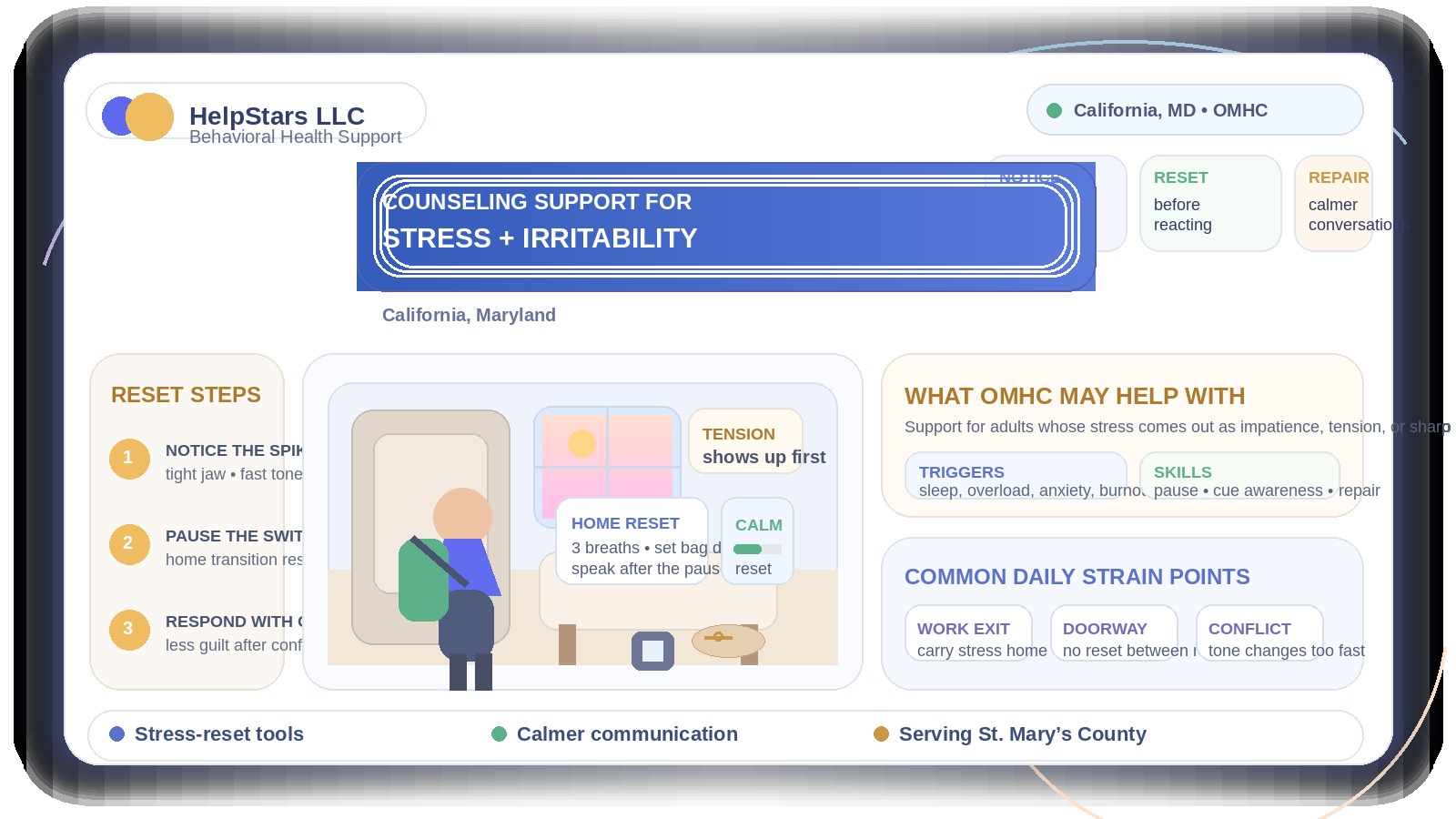
How Outpatient Mental Health Counseling Can Help Adults Manage Irritability Before It Starts Straining Work and Home Life in California, Maryland
Irritability does not always look dramatic from the outside. Sometimes it shows up as a shorter answer than intended, a tone that changes faster than expected, or a sense that every small interruption feels bigger than it should. A person may still be going to work, caring for family, answering messages, and keeping up appearances while quietly noticing that they are much easier to frustrate than they used to be.
For adults in California, Maryland, outpatient mental health counseling can offer practical support when stress, anxiety, depression, trauma, sleep disruption, or emotional overload starts coming out sideways as anger, tension, or reactivity. Irritability is not always a personality issue. In many cases, it is a signal that the nervous system is spending too much time overloaded, guarded, or exhausted.
HelpStars LLC provides compassionate behavioral health support for adults and families across Southern Maryland. When irritability begins affecting communication, home routines, work relationships, or the ability to recover after stress, professional support may be worth exploring before the pattern grows more painful or harder to interrupt.
Irritability Is Often the Clue People Notice First
Many adults do not begin by saying they need help with anxiety, grief, depression, or burnout. They say they feel on edge. They say they are snapping more. They say noises feel too loud, questions feel too constant, and even minor changes can make the whole day feel harder to hold together.
That can look like:
- getting disproportionately frustrated by delays, clutter, or repeated questions,
- feeling tense before coming home, starting work, or walking into family interactions,
- shutting down after an argument because it is hard to calm back down,
- being more impatient with children, partners, parents, or coworkers than usual,
- feeling guilty after sharp reactions but still repeating the pattern the next day, or
- needing more quiet, more space, or more control than usual just to get through ordinary routines.
People often judge themselves harshly for this pattern. But irritability is frequently the visible surface of a deeper strain rather than the whole story by itself.
Why a Short Fuse Can Build Quietly Over Time
Irritability often grows in layers. A person may be sleeping poorly, carrying stress they have not fully processed, managing ongoing family pressure, bracing for the next work demand, or functioning in a constant state of internal tension. None of those factors has to create a crisis on its own. Together, they can shrink emotional margin until ordinary demands start landing like threats.
That is one reason adults can feel confused by their own reactions. They may still be handling responsibilities well enough that other people assume everything is fine. Meanwhile, their patience is thinning, recovery time is getting longer, and the gap between how they want to respond and how they actually respond keeps widening.
Counseling can help make that pattern more understandable. Instead of reducing the issue to "I just need to calm down," support can focus on what is loading the system in the first place and what helps reduce that load in a realistic way.
Counseling Can Help Identify What Is Fueling the Reactivity
Outpatient mental health counseling is not only for moments of visible crisis. It can also help when the main problem is that everyday life feels increasingly harder to tolerate. Depending on the person, counseling may help with:
- identifying whether the irritability is being fueled more by anxiety, depression, trauma stress, grief, burnout, relationship strain, or ongoing overwhelm,
- noticing body cues that show up before a sharp reaction,
- understanding patterns around sleep, overstimulation, hunger, deadlines, conflict, or transitions between work and home,
- practicing ways to slow escalation before an interaction turns into regret,
- building more effective communication for moments when space, support, or a pause is needed, and
- replacing all-or-nothing self-criticism with a more workable recovery plan after hard days.
For some adults, the biggest relief comes from finally seeing that irritability is connected to a pattern that can be understood and addressed. When the pattern becomes clearer, change tends to feel less random and more possible.
A California, Maryland Example: Holding It Together All Day, Then Snapping at Home
Imagine an adult in California, Maryland who spends the workday masking stress well enough that no one realizes how tense they feel. By the time they drive home, their head is full, their body is tight, and even a routine question at the front door can feel like one demand too many. They do not want to react sharply, but it keeps happening. Later, they feel guilty, withdraw, and promise themselves tomorrow will be different.
In counseling, the work may begin by mapping the exact transition points where overload peaks. Is the hardest part the drive home? The shift from silence to noise? Decision fatigue at dinner time? Worry that there will be more needs than energy left to meet them? Once those moments are defined, support can become more useful.
A person may work on decompression routines before entering the house, clearer communication around needing ten minutes to reset, more realistic evening expectations, or better awareness of the stress buildup that began long before the first irritated response. Small adjustments can matter because they interrupt the pattern earlier rather than only apologizing after the fact.
Practical Skills That May Make Workdays and Evenings More Steady
Every person needs a different plan, but counseling often becomes most helpful when it turns insight into repeatable habits. That might include:
- tracking the times of day, settings, or interactions that create the fastest emotional spike,
- building a short reset routine for the transition between one part of the day and the next,
- practicing language for asking for a pause without escalating conflict,
- reducing predictable friction points such as skipped meals, overpacked schedules, or no transition time at all, and
- creating a more compassionate repair plan so one difficult interaction does not turn into a full night of shame or avoidance.
The goal is not perfect emotional control. The goal is more warning, more choice, and more ability to recover before the whole day gets defined by one heated moment.
When It May Be Time to Ask About Outpatient Support
Professional support may be worth considering when irritability is starting to affect daily functioning or important relationships. Adults may want to reach out when they notice that they are:
- snapping more often at people they care about,
- dreading ordinary conversations because they feel too easy to overwhelm,
- carrying tension home from work or into work from home,
- withdrawing after conflict because they do not know how to reset,
- feeling ashamed of their reactions but unable to consistently change them alone, or
- realizing that irritability is becoming one of the main ways distress shows up.
Support does not have to wait until a relationship is in severe trouble or until a person feels out of control. Many adults benefit when the pattern is still early enough to redirect.
Why Local Routine Matters for Adults in California and Across St. Mary’s County
Stress patterns rarely happen in the abstract. They happen in the routines people are already trying to manage: commuting, shift changes, school pickup, shared households, appointments, family obligations, and the everyday back-and-forth that fills a week in California, Lexington Park, Leonardtown, Great Mills, Hollywood, and surrounding St. Mary’s County communities.
That local context matters because a counseling plan works better when it fits real life. The most useful support is often not a generic suggestion to relax. It is a realistic plan for the exact transition, conversation, or environment where a person's patience tends to collapse. When support reflects the actual rhythm of the week, change is more likely to stick.
Questions Adults Often Ask About Counseling for Irritability
Does irritability automatically mean anger management?
Not necessarily. Irritability can be connected to many different underlying stress patterns. Counseling often focuses first on understanding what is driving the reactivity and what helps reduce it.
What if I am mostly short with the people I feel safest around?
That is more common than many adults realize. People often hold themselves together in public and lose emotional margin later in the places where the strain finally comes out. That pattern can still be important to address.
Can counseling help if I do not feel sad, just overloaded?
Yes. Adults do not have to describe themselves as depressed to benefit from counseling. Feeling consistently overloaded, tense, or easily set off can still be a meaningful reason to seek support.
Do I need to wait until work or family relationships are seriously damaged?
No. Many people get more benefit when they ask for help before the pattern becomes deeply entrenched. Earlier support can make it easier to build new habits and reduce repeated conflict.
Support Can Start Before the Pattern Gets Harder to Undo
Irritability is often a signal that something inside the week is costing more than it used to. With the right support, adults can learn how to notice overload earlier, respond more intentionally, and protect the relationships and routines that matter most.
HelpStars LLC serves adults and families across Southern Maryland with professional, compassionate behavioral health services. For adults in California, Maryland and nearby St. Mary’s County communities who feel like stress is coming out as impatience, tension, or reactivity more often than they want, outpatient mental health counseling may be a helpful next step to explore.