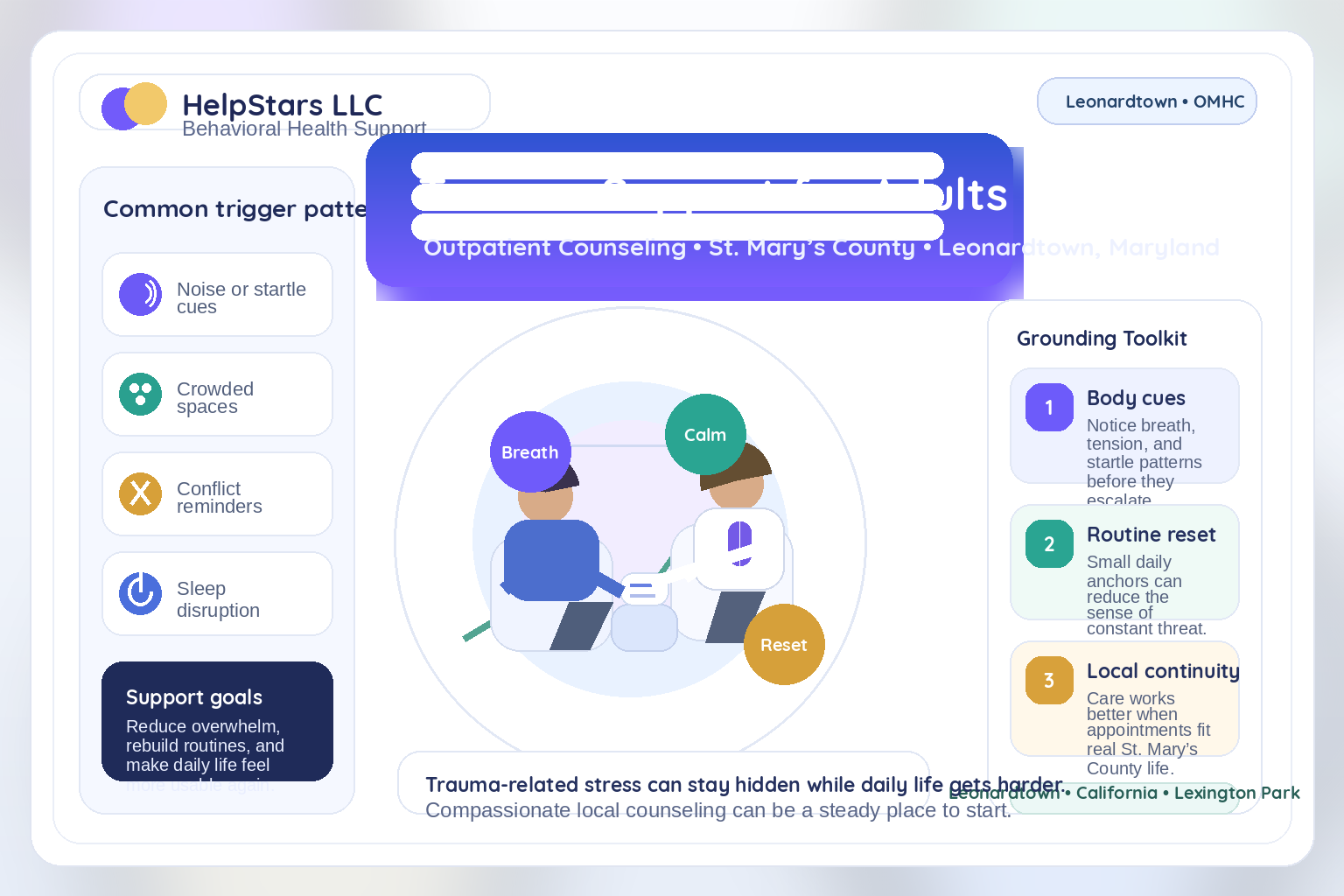
How Outpatient Mental Health Counseling Can Help Adults Cope With Trauma Triggers in Leonardtown, Maryland
A person can look composed in public and still spend the rest of the day bracing for the next reminder of something painful. A crowded store, a certain route home, a sudden noise, or a difficult conversation can pull the body into survival mode before the mind has time to catch up. For adults in Leonardtown and across St. Mary’s County, trauma-related stress can start shaping ordinary routines in ways that are exhausting, isolating, and easy to overlook from the outside.
Outpatient mental health counseling can be a practical place to begin when trauma triggers are affecting sleep, concentration, relationships, work, or the ability to feel steady from one day to the next. At HelpStars LLC, local behavioral health support can help people better understand what they are experiencing, identify patterns, and build a plan for safer, more manageable daily functioning.
Trauma Does Not Always Look Dramatic From the Outside
Not everyone coping with trauma-related stress is in visible crisis. Many adults continue going to work, caring for children, showing up for appointments, or handling daily responsibilities while quietly dealing with flashbacks, hypervigilance, irritability, emotional numbness, panic, or avoidance. Over time, that strain can narrow a person’s world. They may stop going certain places, pull back from relationships, sleep poorly, or stay in a constant state of alertness.
That matters because the impact of trauma is often measured less by how a person appears in a single moment and more by how hard ordinary life has become. When routines keep shrinking, support deserves attention.
Signs Daily Life May Be Getting Harder to Manage
Adults in Leonardtown who start looking for outpatient mental health counseling are often not asking whether stress exists. They are asking whether the stress has started to take over too much of the day. A few common signs include:
- Avoiding places, people, or tasks because they feel emotionally unsafe
- Feeling keyed up, watchful, or easily startled even during routine activities
- Struggling to sleep, focus, or follow through at home or at work
- Shutting down during conflict or feeling reactive in situations that once felt manageable
- Using isolation, overworking, or other coping habits that leave little room for recovery
These patterns do not mean a person has failed to cope. They often mean the nervous system has been carrying too much for too long.
Why Outpatient Counseling Can Be a Practical First Step
One reason outpatient mental health care can be helpful is that it allows support to begin without requiring someone to step out of daily life entirely. Adults can explore what triggers them, how symptoms show up, and what situations feel hardest while still staying connected to work, family, school, or community responsibilities. That can make care feel more realistic and sustainable.
Outpatient counseling can also create space for something many people have not had in a long time: a consistent place to slow down and make sense of what has been happening. For some adults, the first goal is not to talk through every detail of a painful experience. It may simply be to reduce daily overwhelm, improve safety, and regain enough steadiness to function more comfortably.
What Early Support May Focus On
Trauma-informed outpatient care does not need to follow a single script. Depending on the person, early sessions may focus on identifying trigger patterns, building grounding strategies, noticing body-based stress responses, strengthening routines, or clarifying what support is needed at home and in the community. Some adults want help naming what they are feeling. Others want help getting through the workday, sleeping more consistently, or responding differently when stress rises quickly.
A thoughtful counseling plan may also look at how trauma-related symptoms interact with anxiety, depression, grief, substance use, relationship strain, or past behavioral health treatment. That broader view matters because many people are not dealing with one isolated issue. They are managing a layered set of stressors that affect everyday functioning.
Questions Adults Often Ask Before Reaching Out
People considering outpatient mental health support for trauma in St. Mary’s County often have practical concerns before they ever schedule a visit. Common questions include:
- Do I need to share everything right away?
- Can counseling still help if I have been holding this in for years?
- What if certain triggers affect my work schedule or parenting responsibilities?
- How will I know whether standard outpatient care is enough?
Those questions are reasonable. A strong first conversation should help a person understand the pace of care, what goals make sense to start with, and whether outpatient counseling appears to match the level of support they need right now.
Why Local Access Matters in Leonardtown and Nearby Communities
Mental health support is easier to stay engaged with when it fits the realities of local life. Adults in Leonardtown may be balancing commuting demands, caregiving responsibilities, school schedules, court requirements, or transportation limits across St. Mary’s County, Lexington Park, California, Great Mills, and neighboring Southern Maryland communities. If care is too far away or too difficult to coordinate, even a good treatment plan can become hard to maintain.
Local outpatient behavioral health care can make it easier to keep appointments, adjust care planning when daily stress changes, and build continuity over time. For many adults, that consistency is part of what helps support feel usable instead of theoretical.
When It May Be Time to Discuss More Support
Outpatient counseling can be an appropriate starting point for many people, but it is not the only level of care that may be considered. If trauma-related symptoms are severely disrupting functioning, affecting safety, or making weekly counseling too limited, it may be worth discussing whether additional support services should be considered. Depending on the situation, that conversation could include other behavioral health resources such as psychiatric rehabilitation support or a more structured program.
The goal is not to push every person toward a higher level of care. It is to match support to what daily life actually requires.
A Steadier Next Step Still Counts
Adults coping with trauma triggers often wait a long time before asking for help because they believe their symptoms are not serious enough, not recent enough, or not easy enough to explain. In reality, the right time to seek support is often when daily life has started taking more effort than it should. Outpatient mental health counseling can offer a structured, compassionate place to begin sorting through that burden.
HelpStars LLC provides professional behavioral health support for people in Leonardtown, St. Mary’s County, and surrounding Southern Maryland communities. When trauma-related stress is making routines feel harder to manage, a steady local starting point can make the next step feel more possible.