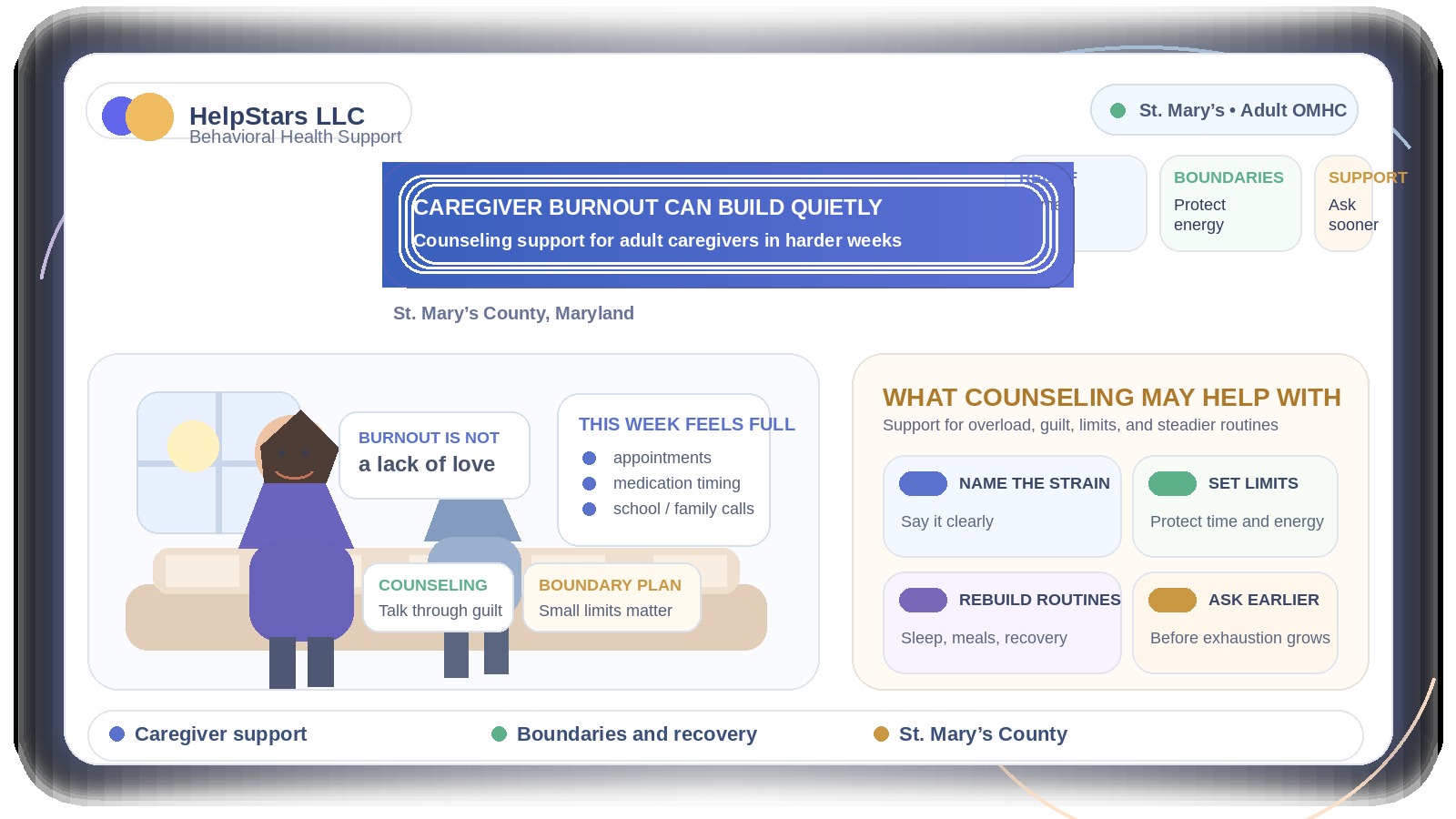
How Outpatient Mental Health Counseling Can Help Adults Cope With Caregiver Burnout in St. Mary’s County, Maryland
Caregiver burnout does not always announce itself with one dramatic moment. More often, it arrives quietly. A person starts answering everyone else’s needs faster than their own. Meals get pushed back. Sleep becomes lighter. The phone never really feels off. The day is organized around reminders, transportation, medications, paperwork, school needs, family check-ins, or one more problem that cannot wait. After a while, even small requests can feel bigger than they should.
For adults in St. Mary’s County, Maryland, outpatient mental health counseling can offer a place to talk about that strain honestly and build a plan that protects both compassion and functioning. Counseling is not about telling caregivers to care less. It can help people understand stress patterns earlier, set healthier limits, process guilt, and rebuild routines before exhaustion starts affecting work, relationships, health habits, or emotional stability.
HelpStars LLC provides compassionate behavioral health support for adults and families across Southern Maryland. When caregiving pressure is becoming difficult to carry alone, professional support may be a practical next step.
When Caring for Someone Else Starts Taking Over Your Whole Week
Many caregivers keep going long after they are overwhelmed because the responsibilities feel real and immediate. A parent may be supporting an adult child through a hard season. An adult daughter may be helping an aging parent manage appointments and daily needs. A spouse may be trying to hold a household together while also responding to mental health, medical, or behavioral concerns at home.
The challenge is that burnout can hide inside competence. Someone may still be getting things done while also noticing that they are:
- snapping more quickly than usual,
- feeling resentful and then guilty about that resentment,
- having trouble concentrating at work or during routine tasks,
- putting off their own appointments and basic self-care,
- feeling constantly “on” and unable to fully rest, or
- starting each day already emotionally tired.
These signs do not mean a person is failing the family member they care about. They often mean the current level of demand is no longer sustainable without support.
Burnout Is Not the Same as Lack of Love
One reason caregiver stress is hard to name is that many adults assume they should be able to handle it if they truly love the person involved. That belief can make honest self-reflection harder. A caregiver may think, “They need me more than I need a break,” or “I should be grateful I can help at all.”
But love and burnout can exist at the same time. A person can care deeply and still be stretched too thin. In fact, burnout often grows in people who are trying hardest to be dependable. When guilt becomes the main reason someone says yes to every request, it becomes harder to notice where emotional depletion, isolation, or stress overload is building.
Outpatient counseling can help separate responsibility from self-erasure. That shift matters because a caregiver usually does not need more pressure. They need a steadier way to carry what is already on them.
What Outpatient Mental Health Counseling May Help With
Counseling for caregiver burnout is not only about venting. It can focus on practical patterns that are affecting daily life and emotional health. For adults in St. Mary’s County, support may include:
- recognizing early signs of overload before they turn into shutdown or conflict,
- identifying which responsibilities truly belong to the caregiver and which need to be shared or reworked,
- processing guilt, grief, frustration, and exhaustion without judgment,
- improving communication around boundaries, expectations, and realistic limits,
- rebuilding routines for sleep, meals, appointments, and recovery time, and
- creating a more manageable plan for the week instead of living in constant reaction mode.
For some adults, the biggest benefit is finally having a space where they do not need to minimize what the role is costing them. For others, counseling becomes useful because it turns vague overwhelm into specific changes that can actually be practiced.
A Realistic Example of What Support Can Look Like
Imagine an adult in St. Mary’s County who is helping an aging parent with transportation, medication reminders, and appointment coordination while also keeping up with work and household responsibilities. On paper, nothing seems completely out of control. In real life, the person is missing lunch, forgetting their own refill, checking texts late into the night, and feeling tense before the day even begins. When family members ask for “just one more thing,” the caregiver says yes and then feels angry, guilty, and exhausted all at once.
In counseling, the first goal may not be a major life change. It may be identifying the pressure points that keep repeating: which calls cause the most stress, which tasks create bottlenecks, where communication breaks down, and what parts of the week never allow recovery. From there, support can focus on small but meaningful adjustments such as clearer handoffs, a better planning routine, stronger boundary language, or protected time for the caregiver’s own health needs.
The point is not perfection. The point is making caregiving more survivable and less isolating.
Signs It May Be Time to Reach Out for Support
An adult caregiver in Southern Maryland may want to explore outpatient counseling if caregiving stress is:
- regularly affecting sleep, appetite, patience, or concentration,
- creating tension in a marriage, family, or workplace,
- leading to frequent guilt, resentment, or emotional numbness,
- causing the caregiver to neglect their own medical or behavioral health needs,
- making everyday tasks feel harder to manage, or
- starting to feel nonstop, even during moments that should allow rest.
Support does not have to wait until a caregiver is in crisis. Many people benefit most when they ask for help while the strain is growing, not only after everything has already fallen apart.
Why Boundaries Can Feel So Hard for Caregivers
Many caregivers already know they need limits. The problem is that boundaries can feel emotionally expensive. A delayed response may trigger worry. A “not tonight” may feel selfish. A request for help from siblings or other relatives may bring disappointment or conflict. Because of that, caregivers often choose the immediate relief of handling the task themselves, even when it costs them later.
Counseling can help adults practice a different pattern. That may include preparing language for hard conversations, deciding what an actual emergency is, noticing when guilt is distorting decision-making, and learning how to make room for care without saying yes to every demand. Healthy boundaries are not about withdrawing support. They are about making support more sustainable.
Questions Caregivers in St. Mary’s County Often Ask
Do I need counseling if I am still managing everything?
Not being fully collapsed does not mean the stress is manageable. Many caregivers seek support because they can feel the strain building and do not want to wait until their health, work, or relationships are affected more seriously.
What if I feel guilty even thinking about taking care of myself?
That is a common reason people reach out. Counseling can help explore that guilt and build a more balanced view of care, responsibility, and personal limits.
Can counseling help if the person I care for is the one with the main problem?
Yes. A caregiver can still benefit from support even if they are not the identified patient in the family. Their stress, routines, and emotional health matter too.
What if I do not know where to start changing things?
That is exactly where counseling can be useful. The first step is often understanding the pattern more clearly, not solving every problem immediately.
Why Local Support Matters in St. Mary’s County
Caregiving pressure is shaped by real local routines. Adults in Leonardtown, Lexington Park, California, Great Mills, Mechanicsville, and nearby communities may be balancing school schedules, long drives, specialist appointments, work demands, military-family routines, or multi-generational household responsibilities all at once. Support is more realistic when it understands that stress is happening inside an actual weekly schedule, not in the abstract.
Local outpatient mental health counseling can make it easier to stay engaged with help while juggling the same responsibilities that made support necessary in the first place. That practical fit often matters because a good plan has to work in real life, not only sound good in theory.
Caring for Others Works Better When the Caregiver Has Support Too
Burnout can make even loving caregiving feel brittle. A person may still be showing up every day while quietly losing sleep, patience, energy, and emotional steadiness. That does not mean they are weak. It may mean they have been carrying too much for too long without enough room to recover.
HelpStars LLC provides professional and compassionate behavioral health support for adults and families across Southern Maryland. For caregivers in St. Mary’s County who feel stretched thin, outpatient mental health counseling may be a helpful place to regain balance, protect daily functioning, and keep care from costing more than it should.