How Outpatient Mental Health Counseling Can Help Adults Break the Cycle of Overthinking and Avoidance in Mechanicsville, Maryland
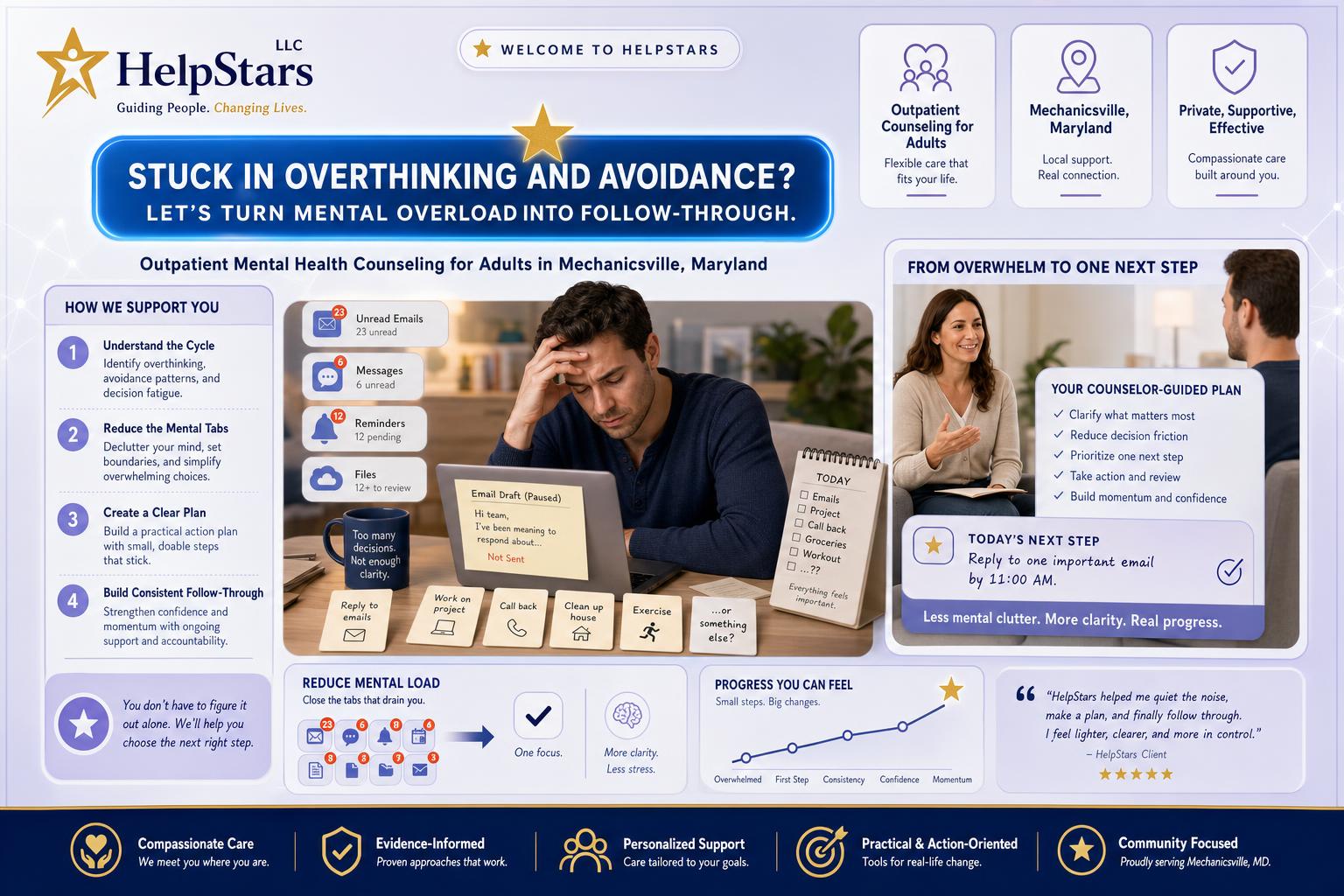
Some weeks do not fall apart because of one dramatic event. They slip away through hesitation. A simple email stays open in draft form. A call that should take five minutes gets postponed for three days. Groceries, paperwork, and one personal decision after another start to feel oddly high-stakes, so nothing moves. From the outside, it can look like procrastination. From the inside, it can feel like carrying too many tabs open in the mind at once.
For adults in Mechanicsville, Maryland, outpatient mental health counseling can help when overthinking and avoidance begin interfering with daily functioning, work responsibilities, relationships, or follow-through at home. Counseling is not about telling someone to just be more disciplined. It can help identify what is making ordinary decisions feel so mentally expensive and build a steadier way to respond.
HelpStars LLC provides compassionate behavioral health support for adults and families across Southern Maryland. When daily life keeps slowing down under the weight of indecision, emotional overload, or repeated avoidance, professional support may be a practical next step.
Overthinking Can Look Like Responsibility Until It Starts Blocking Action
Many adults who overthink are not careless people. In fact, they are often trying very hard to make the right choice, avoid mistakes, prevent conflict, or prepare for every possible outcome. The problem is that the mind can become so busy scanning for the best answer that even manageable tasks start feeling difficult to begin.
That pattern may sound like:
- "I need a little more time before I answer that,"
- "I should wait until I can do this properly,"
- "If I start now, I might do it wrong,"
- "I have too many things to sort out before I can choose," or
- "If I cannot finish it all today, there is no point starting."
Those thoughts can create gridlock. A person may care deeply about the task in front of them and still feel unable to move because every option seems to carry too much pressure.
Why Avoidance Often Follows Mental Overload
Avoidance is often misunderstood as not caring. More often, it is a short-term way of getting relief from internal pressure. When one text, one form, or one conversation already feels loaded with tension, putting it off may briefly feel safer than facing it.
The difficulty is that avoidance usually adds more stress later. The message still needs a reply. The appointment still has to be scheduled. The stack of decisions gets taller, and the person begins to dread the whole list instead of one item at a time. That cycle can show up alongside anxiety, depression, trauma-related stress, burnout, grief, perfectionism, low confidence, or prolonged emotional exhaustion.
Counseling can help adults slow that pattern down before more parts of life start revolving around delay, guilt, and mental clutter.
What Outpatient Mental Health Counseling May Help Untangle
Outpatient support can be useful when the issue is not a lack of intelligence or insight, but difficulty converting thought into action. Depending on the person’s needs, counseling may help with:
- identifying which situations trigger the most rumination or shutdown,
- sorting out whether the main driver is anxiety, depression, self-criticism, trauma, or overwhelm,
- learning how to break large tasks into smaller decisions,
- reducing all-or-nothing thinking that makes ordinary choices feel risky,
- building routines for responding to tasks before they become emotionally heavier, and
- practicing ways to recover after avoidance without turning one delay into a week-long spiral.
The goal is not to remove all uncertainty from life. The goal is to help a person tolerate enough uncertainty to keep moving.
A Mechanicsville Example: The To-Do List Keeps Growing Because Every Choice Feels Loaded
Imagine an adult in Mechanicsville who knows exactly what needs attention. They need to answer a work message, decide whether to keep an appointment, make a call about a bill, and talk with a family member about an upcoming responsibility. None of these tasks is impossible. But each one starts to feel bigger the longer it sits. By afternoon, the person has spent hours thinking about the list, avoiding the list, and feeling worse about the list without actually finishing much on it.
In counseling, the focus may not be on productivity alone. A more useful starting point might be understanding what happens in the minutes right before avoidance begins. Does the person fear choosing wrong? Do they feel flooded when too many tasks compete for attention? Are they already running on low energy and low self-trust? Once that pattern is clearer, support can become more specific and more workable.
That might include simplifying the first step, narrowing choices, using time-limited decisions, noticing harsh internal language, or creating a repeatable plan for what to do when the mind starts stalling out again.
Progress Often Starts by Reducing Friction, Not By Forcing Perfection
Many adults try to solve overthinking by demanding certainty from themselves. That usually backfires. A more realistic approach is reducing the friction around action so decisions stop feeling as heavy as they did before.
Early counseling work may focus on practical shifts such as:
- making the next step visible: choosing one clearly defined action instead of staring at the whole problem,
- using limits on decision time: preventing one small choice from taking over the hour,
- separating urgent tasks from emotionally loud tasks: not everything that feels intense is actually most important,
- building a restart plan: knowing how to re-enter the day after freezing or delaying, and
- practicing self-correction without self-attack: reducing the shame that often keeps avoidance going.
These adjustments can matter because people often function better when the task feels clearer, not when they are blamed harder.
How This Pattern Can Affect Work, Home, and Relationships
Overthinking is rarely confined to one corner of life. At work, it may look like delayed replies, trouble prioritizing, or spending too long trying to perfect a task before sending it. At home, it may show up as unopened mail, postponed errands, repeated indecision, or difficulty planning ordinary routines. In relationships, it can lead to canceled plans, avoided conversations, mixed signals, or silence that others misread.
Because the pattern often happens privately, other people may only see the outer result. They may not realize how much mental effort went into one unsent message or one postponed phone call. Counseling can help adults explain the pattern more clearly, respond to it earlier, and build more trust in their own ability to act before stress piles higher.
When It May Be Worth Asking About Outpatient Support
Adults and families in Mechanicsville or the surrounding St. Mary’s County area may want to explore counseling when someone is:
- spending so much time thinking through decisions that daily tasks keep getting delayed,
- avoiding conversations, forms, calls, or responsibilities that feel emotionally overloaded,
- getting stuck between wanting to do things well and not being able to begin,
- feeling ashamed of procrastination that seems to be getting worse,
- noticing that indecision is interfering with work, family life, or personal routines, or
- finding that stress rises every time unfinished tasks start accumulating.
Support does not have to wait until life is in full crisis. Many adults benefit when the pattern is frustrating and disruptive, even if they are still managing to keep some parts of life going.
Why Local Routine Matters in Mechanicsville and Across St. Mary’s County
Mental overload happens inside real schedules. Adults in Mechanicsville, Charlotte Hall, Leonardtown, California, Great Mills, Hollywood, and nearby St. Mary’s County communities may be balancing work, caregiving, appointments, school routines, financial responsibilities, and long lists of small decisions that never seem fully done. Support is often more useful when it respects those everyday pressures instead of treating avoidance like a personality flaw.
That local context matters because the most effective plan is usually not the most ambitious one. It is the one a person can actually use during a normal week in their real environment.
Common Questions About Counseling for Overthinking and Avoidance
Does overthinking mean I have an anxiety disorder?
Not always. Overthinking can happen for many reasons, including anxiety, depression, trauma-related stress, burnout, grief, or long periods of emotional strain. Counseling can help clarify what is driving the pattern.
What if I know what to do and still cannot make myself do it?
That is a common reason people seek support. The gap between understanding and action is real, and it often responds better to practical tools and emotional insight than to self-criticism.
Is avoidance just another word for laziness?
No. Avoidance often reflects overwhelm, fear of getting something wrong, shame, or difficulty regulating stress around a task. Understanding that pattern can make change more possible.
Can counseling help if I am still functioning most of the time?
Yes. Many adults reach out before the pattern becomes more disruptive. Counseling can be helpful when life still looks mostly intact from the outside but feels increasingly difficult to manage from the inside.
It Can Help to Interrupt the Cycle Earlier
When overthinking and avoidance become familiar, people often assume they need to simply push harder. In many cases, what helps more is understanding the pattern sooner, reducing the emotional pressure around ordinary decisions, and building a steadier system for action.
HelpStars LLC serves adults and families across Southern Maryland with compassionate behavioral health services. For adults in Mechanicsville, Maryland who feel stuck in a loop of rumination, delay, and mounting stress, outpatient mental health counseling may offer a practical path toward clearer follow-through, less mental gridlock, and a more manageable week.