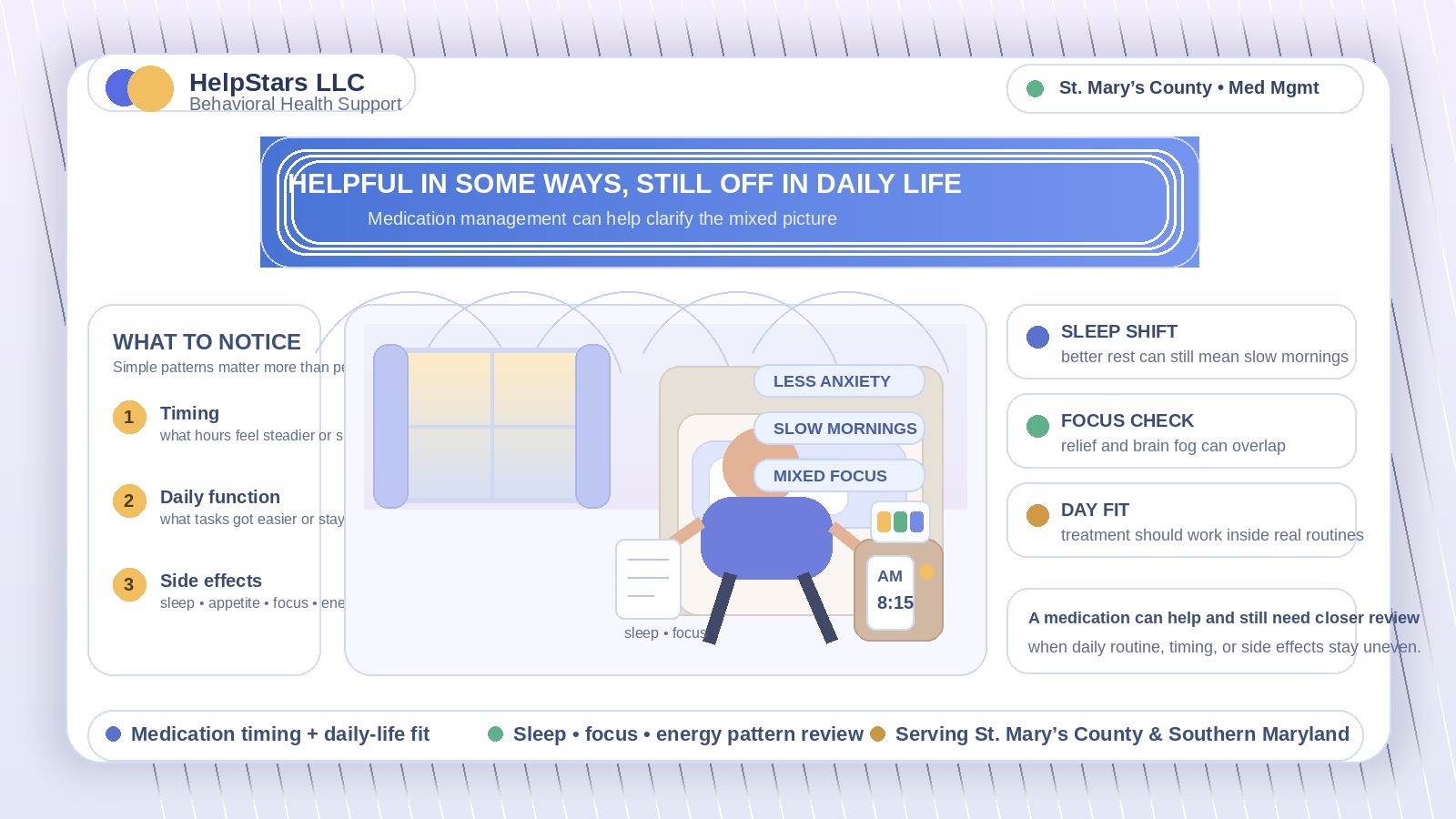
How Medication Management Can Help Adults in St. Mary’s County When a Prescription Is Helping in Some Areas but Daily Life Still Feels Off
Sometimes the question is not whether something is helping. It is whether it is helping enough, helping in the right places, or helping in a way that actually fits daily life. Maybe sleep is a little better, but mornings still feel impossible. Maybe anxiety is less sharp, but focus is still scattered. Maybe emotions feel steadier, yet work, errands, or household follow-through still feel harder than expected.
For adults in St. Mary’s County, Maryland, that in-between experience can be confusing. It may be hard to tell whether the current plan simply needs more time, whether a side effect is getting in the way, or whether another adjustment should be discussed. Medication management can help adults look more closely at how treatment is affecting mood, energy, sleep, concentration, and daily functioning as a whole.
HelpStars LLC provides compassionate behavioral health support for adults and families across Southern Maryland. When a prescription seems partly helpful but daily life still feels uneven, medication-management support may help make the next step clearer.
Improvement and Frustration Can Exist at the Same Time
Many adults assume treatment should feel obviously successful or obviously unsuccessful. Real life is usually messier than that. A person may notice fewer panic spikes and still feel mentally slow by midafternoon. Someone may be less tearful but still unable to get moving in the morning. Another person may sleep longer but wake up foggy, unmotivated, or disconnected from the day.
That can sound like:
- “I think it is doing something, but I do not feel like myself yet,”
- “One part of the day feels better than the rest,”
- “I am not as overwhelmed, but I still cannot get traction,”
- “The symptoms shifted, but the routine is still hard,” or
- “I do not know whether this is progress, a side effect, or both.”
That middle ground matters. It often gives useful information about what may need to be reviewed rather than ignored.
Why a Prescription Can Feel Useful but Still Not Feel Well-Matched
Mental health treatment affects more than one symptom at a time. A medication may support sleep while making mornings slower. It may reduce intensity without restoring concentration. It may help one kind of anxiety while leaving motivation, appetite, timing, or emotional range feeling different than expected.
That does not automatically mean the medication is wrong. It does mean the full day matters. Adults and prescribers often need a clearer picture of questions such as:
- When during the day does the person feel most steady?
- What tasks still feel unusually difficult even if mood is somewhat better?
- Are sleep, appetite, focus, or energy changing in ways that affect routine?
- Does the benefit seem to fade at certain hours?
- Is the person feeling calmer, flatter, more tired, or simply different?
Medication management can help organize those observations so the conversation is based on real patterns instead of one vague sense that something is still off.
What Medication Management Can Help Clarify
Medication-management support is often most useful when adults can tell that something has shifted but cannot yet tell how to describe it. The work is not only about asking whether the prescription should stay the same. It is also about identifying which parts of daily life have improved, which remain disrupted, and what questions should guide the next appointment.
Depending on the person’s needs, that may include:
- tracking whether the current routine feels better, worse, or mixed across different times of day,
- noticing if side effects are interfering with work, driving, sleep, meals, or concentration,
- separating symptom relief from functional improvement,
- identifying patterns the person may forget by the time an appointment arrives,
- building clearer language for describing changes to a prescriber, and
- deciding whether a medication question, counseling issue, sleep issue, or stress-pattern issue needs more attention next.
The goal is not to turn a person’s whole week into constant self-monitoring. The goal is to make treatment decisions more informed and more usable.
A St. Mary’s County Example: Less Anxious at Night, Still Struggling To Start the Morning
Imagine an adult in St. Mary’s County who recently started feeling a little calmer in the evenings. Racing thoughts are not hitting as hard before bed, and there are fewer emotional spikes during late-night conversations. On paper, that sounds encouraging. But the mornings still tell a different story.
The person wakes up heavy, moves slowly, forgets small tasks, and feels mentally behind before the day fully begins. They cannot tell whether the issue is lingering depression, medication timing, poor sleep quality, a side effect, or ordinary stress. Because some things are better, they hesitate to bring up what is not.
That is exactly the kind of situation where medication management can help. Instead of treating the experience as a confusing blur, the pattern becomes more specific: What feels better? What still feels stuck? What times of day seem most affected? What daily demands are still falling apart? Once the picture is clearer, the next treatment conversation often becomes more productive.
Four Signs the “Middle Picture” Deserves Attention
- You can name partial improvement, but not functional stability. Feeling somewhat better is important, but it is not the same as being able to move through work, home, or appointments more consistently.
- The benefit seems uneven across the day. Some adults feel fine for a few hours and then hit a wall that affects mood, focus, or patience later.
- You are unsure whether the problem is the symptom or the side effect. Fogginess, slowed mornings, reduced appetite, restlessness, or sleep disruption can be hard to sort out alone.
- You keep minimizing what still feels hard. Adults often say, “At least it is helping a little,” while avoiding the fact that daily functioning still feels off-balance.
These signs do not mean a person should jump to conclusions. They do mean the remaining friction is worth naming clearly.
How Adults Can Notice Patterns Without Turning Life Into a Spreadsheet
People sometimes avoid medication conversations because they think they need perfect notes. Most do not. A few simple observations are often more helpful than an overloaded symptom journal that nobody wants to maintain.
Useful questions may be:
- What part of the day feels most manageable right now?
- What part still feels the most off?
- What changed in sleep, appetite, motivation, or concentration after starting or adjusting the medication?
- Which real-life tasks are easier, and which still keep slipping?
- If you had to describe the current plan in one sentence, would you say it feels steadier, flatter, slower, sharper, or mixed?
That level of detail can help a provider understand the lived experience more accurately than a simple “I guess it’s okay.”
Why Daily Function Matters as Much as Symptom Language
Adults are not only trying to reduce symptoms in the abstract. They are trying to get through mornings, hold conversations, stay organized enough for appointments, think clearly at work, manage family responsibilities, and feel more present in ordinary life. A treatment plan works best when it supports those daily realities, not only a number on an internal scale.
That is one reason local routine matters in St. Mary’s County. Real progress has to fit commuting, caregiving, meals, errands, and other pressures that shape the day. Medication management becomes more useful when the conversation includes how treatment feels inside an actual week, not just inside a brief appointment window.
Questions Adults Often Ask About Mixed Medication Results
Does partial improvement still count as progress?
Yes. Partial improvement can be meaningful. It also does not mean the conversation is over if daily life still feels uneven or harder than it should.
What if I cannot tell whether I feel better or just different?
That uncertainty is common. Medication-management support can help adults describe the difference more clearly by looking at timing, daily function, and specific routine changes.
Should I stay quiet because I do not want to sound ungrateful for some improvement?
No. It is reasonable to appreciate progress and still talk honestly about what remains difficult. That kind of detail can help guide better treatment decisions.
Can medication management fit alongside counseling or other behavioral health support?
Often, yes. Depending on the person’s needs, medication-management conversations may work alongside outpatient counseling or other behavioral health services as part of a broader support plan.
Clearer Treatment Decisions Usually Start With a More Honest Picture of the Day
Not every medication question is about a complete failure or a perfect success. Sometimes the real issue is that life feels partly better and partly harder, and nobody has named the pattern clearly yet. That is worth attention.
HelpStars LLC serves adults and families across Southern Maryland with compassionate behavioral health support. For adults in St. Mary’s County who feel some benefit from treatment but still do not feel fully steady in daily life, medication management may help create a clearer next step.