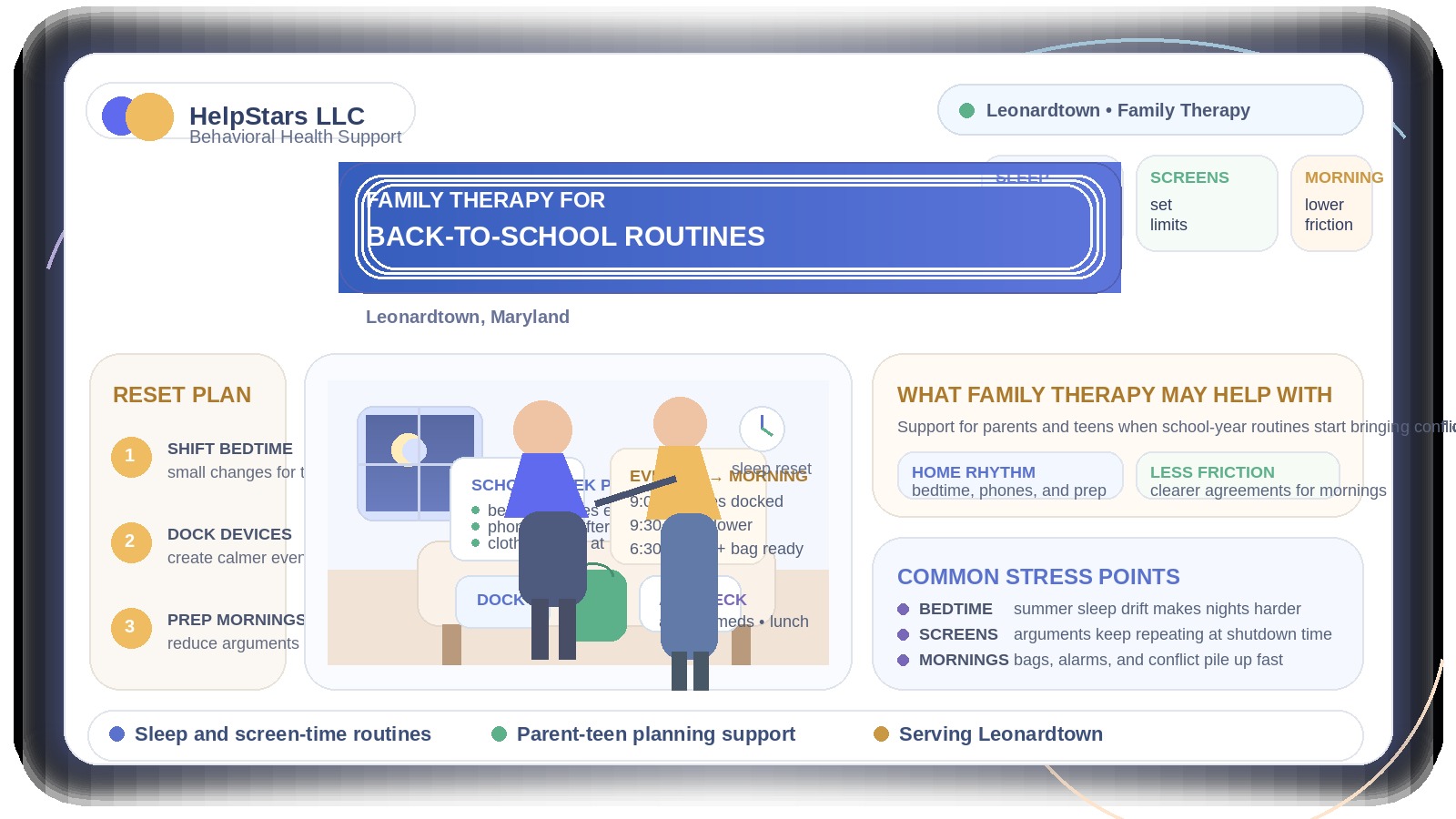
How Family Therapy Can Help Parents and Teens Reset Sleep, Screen Time, and Morning Routines Before the School Year Starts in Leonardtown, Maryland
For many families, school stress does not begin on the first day back. It starts in the evening, when one person says it is time to get off the phone, someone else remembers a form that still is not signed, and a simple reminder about bedtime suddenly turns into a long argument. By late summer, parents and teens may already be slipping into a pattern where every conversation about sleep, screens, school expectations, or morning follow-through feels loaded.
For families in Leonardtown, Maryland, family therapy can offer more than a place to talk about conflict after it happens. It can help parents and teens understand what keeps the same arguments repeating, reduce blame, and build more workable routines before the school year puts even more pressure on the household. Instead of deciding who is the problem, therapy can help the family create a clearer system for communication, expectations, and repair.
HelpStars LLC provides compassionate behavioral health support for adults, teens, and families across Southern Maryland. When a household wants a calmer start to the school year, family therapy may be a helpful step.
The Tension Often Builds the Night Before, Not Only in the Morning
School-year conflict is often described as a morning problem. In many homes, though, the real strain begins the night before. A teen may be tired but still scrolling. A parent may already be thinking about work, transportation, younger siblings, or the next day's schedule. By the time a conversation starts about showers, chargers, homework, lunch, or lights out, both people may already feel irritated.
That pressure can show up as:
- repeated arguments about when devices should be put away,
- bedtime routines that keep getting delayed until everyone is frustrated,
- morning preparation that depends on last-minute reminders,
- parents feeling like they have to supervise every step,
- teens feeling controlled even when parents are trying to prevent chaos, or
- small school-related tasks turning into much bigger emotional standoffs.
When that cycle repeats, families often stop hearing the concern underneath the conflict. The conversation becomes about tone, resistance, or who started it rather than about what support the teen actually needs and what kind of structure the household can realistically maintain.
Family Therapy Can Shift the Focus From Repeated Fights to Shared Patterns
One reason family therapy can be useful is that it helps families look at the whole interaction pattern instead of treating one person as the only issue. A parent may feel they are carrying the entire routine alone. A teen may feel they are being corrected all evening. Both experiences can be real at the same time.
In therapy, support may focus on questions such as:
- What part of the evening reliably sets conflict in motion?
- Which reminders are necessary, and which ones are arriving too late to help?
- Where does communication break down first?
- What expectations are clear in one person's mind but vague in the other person's?
- How can the household respond when a routine slips without turning the whole night into a battle?
That kind of work can lower defensiveness. Instead of repeating the same argument about attitude or responsibility, families can start building a plan that is specific enough to use on ordinary weeknights.
Three Pressure Points Families Often Need To Reset Before School Starts
Not every family needs the same solution. Still, there are a few pressure points that often shape whether the school year begins with steadier communication or immediate strain.
- Sleep drift. Summer schedules can slowly move later and later. If everyone waits until the week before school to fix sleep, the reset often feels abrupt and conflict-heavy.
- Screen-time transitions. Many families are not arguing about devices in general so much as when device use ends, how reminders are delivered, and what happens if the limit is ignored.
- Morning responsibility handoffs. Parents and teens may need clearer agreements around backpacks, clothes, alarms, medications, breakfast, rides, and what is expected to be done the night before.
Family therapy can help parents and teens talk through those pressure points without turning every concern into a lecture or every limit into a power struggle. The goal is not rigid perfection. The goal is a more predictable rhythm.
A Leonardtown Example: Every Reminder Turns Into an Argument by 9:15 PM
Imagine a parent in Leonardtown trying to get a teen back onto a school-year schedule in late July or early August. The teen says they will get ready in a minute, but the backpack is still empty, the phone is still active, and nobody has agreed on when the night is supposed to wind down. By 9:15 PM, the parent feels ignored, the teen feels nagged, and both of them are reacting to each other instead of solving the actual routine problem.
In family therapy, the first task may not be revisiting every old argument. It may be mapping the sequence that keeps repeating: what time tension starts, which reminders escalate things, where expectations are unclear, and what changes might actually make the evening easier to complete. A plan might include earlier transition cues, one agreed-on device cutoff, a short checklist for the night before, and a calmer repair script for nights that do not go well.
That approach can be especially helpful when the family is not dealing with one dramatic crisis but with steady friction that is wearing everyone down.
What Sessions May Actually Help Parents and Teens Practice
Families sometimes avoid therapy because they imagine it will stay too general to help with real home stress. In practice, family therapy may be most useful when it becomes concrete. Depending on the family's needs, sessions may help with:
- creating realistic evening and morning expectations,
- finding language that sounds firm without sounding attacking,
- helping teens express what makes transitions harder for them,
- reducing all-or-nothing reactions after one rough night,
- building a repair routine after arguments so resentment does not carry into the next day, and
- figuring out when the family needs more structure, more flexibility, or both.
That practical focus matters. Many families do not need another lecture about communication. They need help using communication differently when stress is already active.
Reaching Out Early Can Be Easier Than Repairing Months of Escalation Later
Some families wait until school absences, shutdowns, major blowups, or constant refusal have already taken hold. Support can still matter then, but it may be harder because everyone is already discouraged. Family therapy can be worth asking about earlier, especially when a family notices that the same school-year arguments are returning before the year has even fully begun.
Parents and caregivers may want to explore support when:
- every conversation about school preparation quickly becomes tense,
- a teen and parent are both bracing for conflict around bedtime or mornings,
- the family keeps having the same screen-time argument without a workable resolution,
- school-year expectations are unclear or constantly renegotiated under stress, or
- home communication is becoming more brittle than the family wants it to be.
Questions Families in St. Mary’s County Often Ask
Does family therapy mean the teen is being blamed?
No. Family therapy is meant to look at interaction patterns, stress points, and communication habits across the household rather than treating one person as the whole problem.
Can family therapy help if the issue is mostly about routines and arguments at home?
Yes. Support can still be useful when the main strain involves transitions, expectations, and repeated conflict around daily functioning.
What if a parent and teen remember the same argument very differently?
That is common. Therapy can help slow the conversation down enough to understand both experiences and build a plan that does not depend on winning the argument first.
Can family therapy fit alongside other outpatient mental health services?
Often, yes. Depending on the situation, family therapy may complement individual counseling, psychiatry, PRP, supported employment, or other behavioral health services.
Why Local Context Matters for Leonardtown Families
Family routines do not happen in a vacuum. Parents and teens in Leonardtown and the wider St. Mary’s County area may be balancing commuting, younger siblings, sports, changing school demands, custody transitions, work schedules, and transportation logistics at the same time. A plan works better when it reflects the family's actual week rather than an ideal one.
That local context is one reason nearby support can matter. A family is more likely to keep using new communication tools and routines when those tools make sense inside real Southern Maryland life.
A Calmer School Year Usually Starts With a More Predictable Home Rhythm
Many parents and teens care about the same thing more than either side realizes: they want mornings to feel less chaotic and home to feel less tense. The trouble is that good intentions alone do not always create a workable routine. Sometimes a family needs structured help to turn repeated conflict into clearer expectations, steadier communication, and better recovery after a hard night.
HelpStars LLC supports families across Southern Maryland with compassionate behavioral health care. For families in Leonardtown, Maryland who want to reset sleep, screen-time expectations, and school-year communication before the pressure grows, family therapy may be a supportive next step.