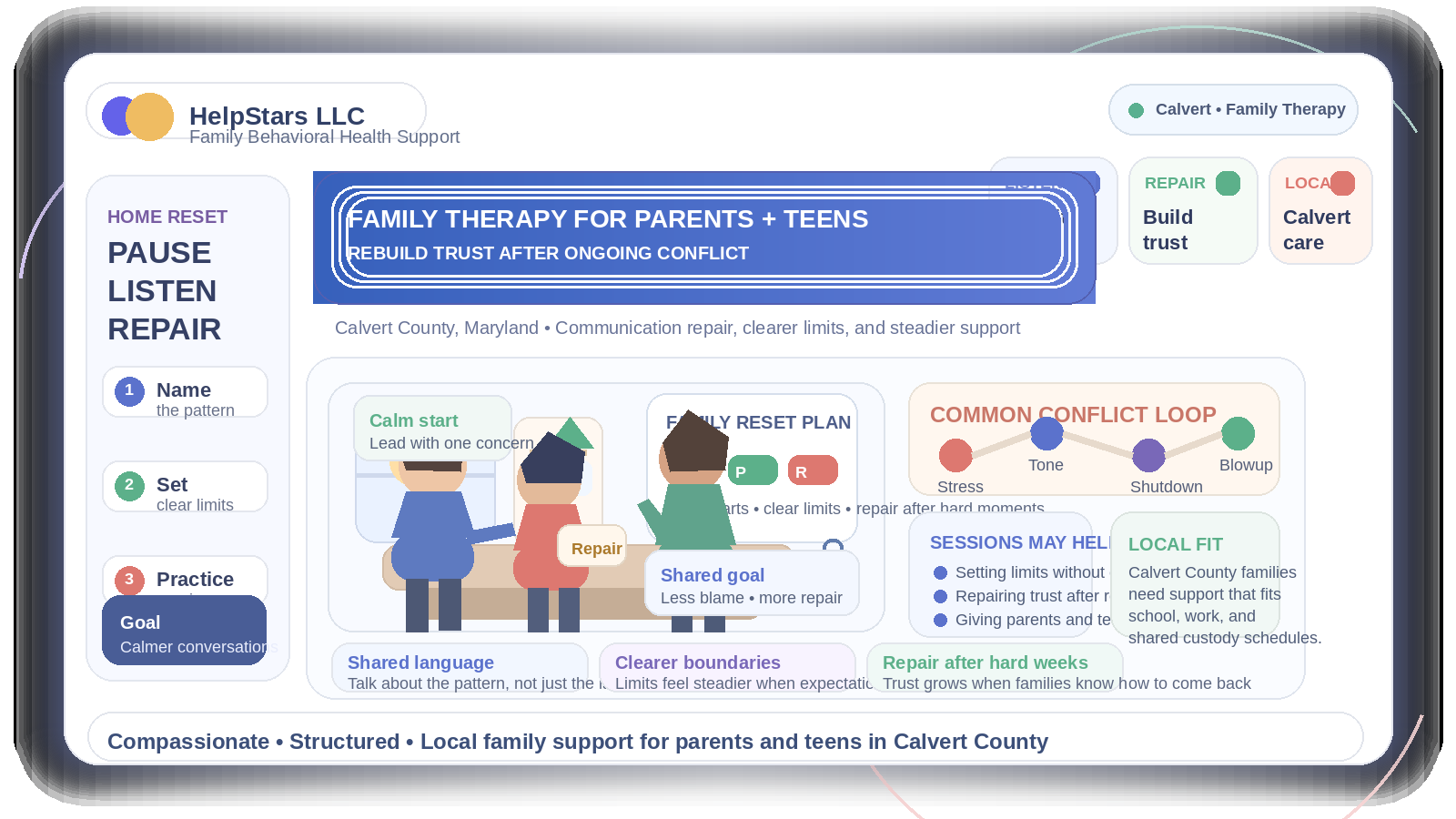
How Family Therapy Can Help Parents and Teens Rebuild Trust After Ongoing Conflict in Calvert County, Maryland
After enough hard evenings, a family can start to feel like it is always bracing for the next argument. A simple reminder about homework, curfew, chores, a phone, or who is coming home when can turn into slammed doors, silence, raised voices, or days of distance afterward. In many Calvert County homes, the most painful part is not one disagreement. It is the growing feeling that every conversation is becoming a fight.
Family therapy can offer a different kind of space. Instead of deciding who is right, it helps families slow the pattern down, understand what keeps escalating it, and practice more useful ways to talk, listen, and repair trust. For parents and teens, that can make the home feel less reactive and more workable again.
HelpStars LLC provides compassionate behavioral health support for families in Calvert County and nearby Southern Maryland communities.
When Conflict Starts Becoming the Family Routine
Most families argue sometimes. Ongoing conflict usually feels different. The same subjects keep exploding. Everyone starts expecting the worst before the conversation even begins. A parent may feel ignored or shut out. A teen may feel watched, corrected, or misunderstood. Over time, even small requests can carry the weight of older hurt.
Families often start looking for support when they notice patterns like these:
- Arguments that escalate quickly over everyday expectations
- Long stretches of silence after conflict instead of repair
- Frequent tension around school, friends, rules, or independence
- A teen who withdraws, refuses to talk, or assumes every question is criticism
- Parents who feel stuck between setting limits and keeping the peace
- Siblings or other caregivers getting pulled into the same conflict cycle
These moments do not automatically mean a family is failing. They often mean the current communication pattern is no longer working and needs more support.
Family Therapy Is Not About Picking a Winner
Many parents hesitate because they worry therapy will turn into a debate about blame. Many teens worry they are being taken somewhere just to be told they are the problem. A strong family therapy process is more practical than that. It looks at how the family system is functioning, where people stop hearing each other, and what helps conversations stay safer and more productive.
That can include naming triggers, clarifying expectations, reducing misinterpretations, and building ways to pause before a conflict gets bigger. The goal is not to make every family member agree on everything. The goal is to create more understanding, more consistency, and a better path back after hard moments.
What Sessions May Focus On
Depending on the family, therapy may focus on one immediate problem or a broader pattern that has been building for months. Common areas of focus can include:
- Improving how parents and teens bring up difficult topics
- Setting clearer boundaries without turning every limit into a standoff
- Practicing ways to de-escalate tense conversations earlier
- Rebuilding trust after lying, rule-breaking, repeated conflict, or emotional distance
- Making space for both accountability and emotional support
- Helping caregivers present a steadier, more consistent approach at home
In some cases, therapy may also help a family talk through stress connected to social pressures, schedule changes, grief, mood concerns, or other life disruptions that are showing up through conflict at home.
Why It Can Help to Start Before Everyone Stops Trying
Families do not need to wait until a situation feels unmanageable. In fact, support can be especially useful while people are still willing to re-engage but no longer know how to do it well. The longer a family lives inside a conflict loop, the easier it becomes for each person to assume the next conversation will go badly too.
Starting earlier can create room to interrupt that pattern before mistrust grows deeper. It can also help parents and teens move away from constant reaction and toward more predictable routines, clearer expectations, and more repair after stressful weeks.
Real-Life Reasons Families in Calvert County Reach Out
Some families seek therapy because arguments now happen several times a week. Others reach out because the house has gone quiet and no one knows how to reopen communication without another blowup. Sometimes the concern is not one big event, but a steady buildup around grades, curfew, peer relationships, chores, or changing independence as a teen gets older.
Family therapy can be useful in each of those situations because it gives everyone a structured place to talk about the pattern itself, not only the latest incident. That shift often matters. When the family stops focusing only on the last argument, it becomes easier to see the cycle underneath it.
Questions Parents Often Ask
Does my teen have to do all the talking?
No. Family therapy is not designed to put one person on the spot. The conversation is shared, and the process can support quieter teens as well as parents who are unsure how to begin.
Can family therapy help if school is not the main issue?
Yes. School stress can be one factor, but many families come in because of communication breakdown, trust issues, boundary struggles, or tension around growing independence at home.
What if one caregiver cannot attend every session?
Consistency is helpful, but therapy can still begin with the people who are able to participate. A clinician can help clarify what involvement may be useful as the process moves forward.
Why Local Support Matters for Calvert County Families
Families in Prince Frederick, Huntingtown, Lusby, Dunkirk, and nearby Calvert County communities are often balancing work schedules, commutes, school demands, shared custody arrangements, and caregiving responsibilities at the same time. Support is more realistic when it is local enough to fit actual family life.
Having access to behavioral health care closer to home can make it easier to stay engaged, keep appointments, and continue the work long enough for new communication habits to take hold.
Conflict Does Not Have to Stay the Family Language
Repeated arguments can make a family feel exhausted, defensive, and far apart. That does not mean the relationship is beyond repair. With structure, support, and a chance to understand the pattern more clearly, many families can begin building calmer conversations and more trust again.
HelpStars LLC supports families across Calvert County and Southern Maryland with compassionate behavioral health care. When conflict, shutdowns, or mistrust are becoming the normal rhythm at home, family therapy may offer a steadier way forward.