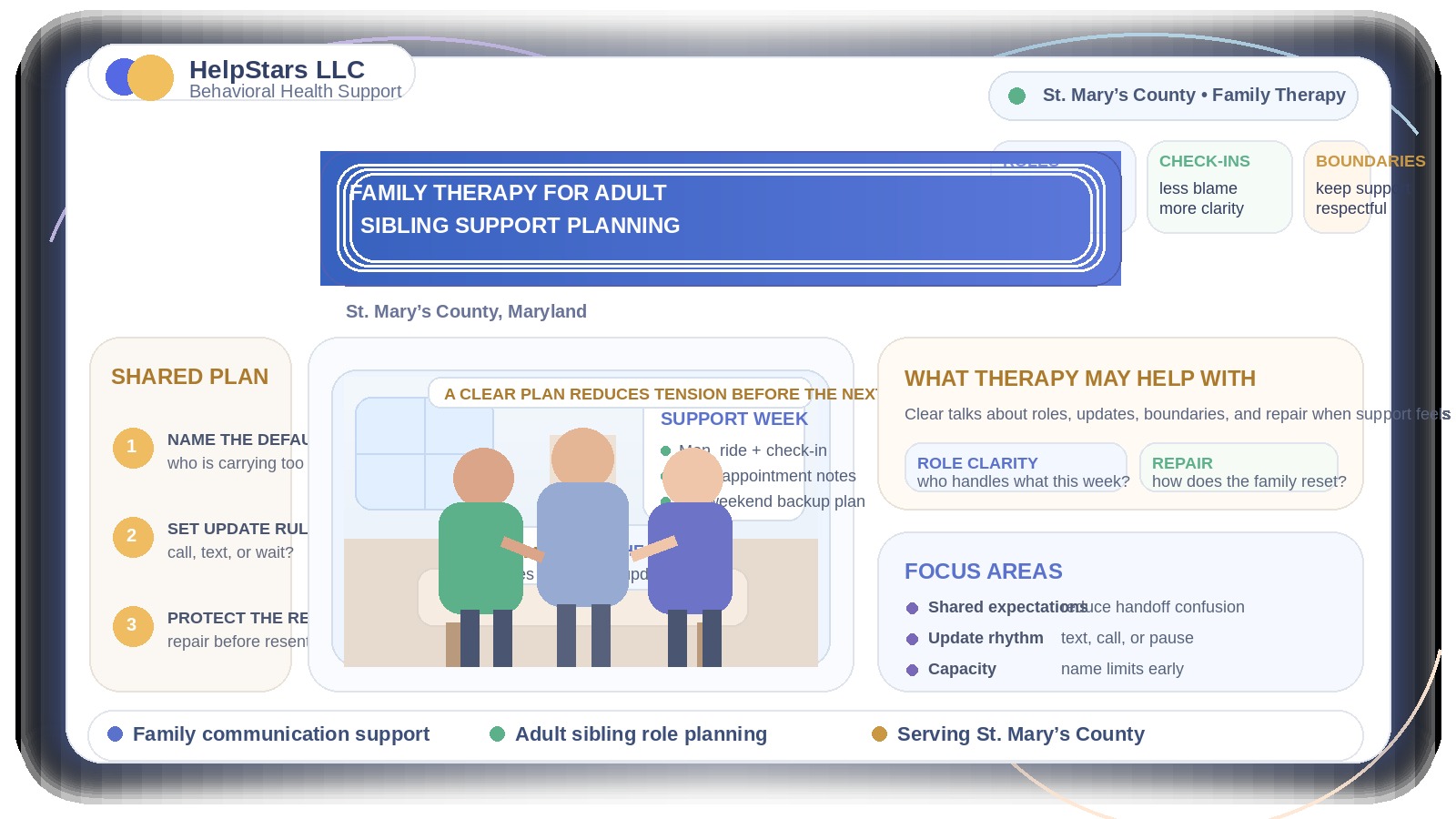
How Family Therapy Can Help Adult Siblings Share Mental Health Support Responsibilities Without Constant Conflict in St. Mary’s County, Maryland
In many families, the tension does not begin with one huge argument. It begins with a practical question that should take twenty seconds to answer. Who is calling back the provider? Who is checking whether the paperwork got finished? Who is driving to the appointment? Who is stepping in this weekend if stress gets worse again? When those answers stay unclear, adult siblings can start sounding impatient long before anyone says they are overwhelmed.
For families in St. Mary’s County, Maryland, family therapy can help adult siblings move from reactive coordination to a clearer support plan. The goal is not to decide which sibling cares more. The goal is to reduce resentment, improve communication, and build a more realistic way to share mental health support responsibilities when one loved one’s needs are affecting the whole family.
HelpStars LLC provides compassionate behavioral health services for adults and families across Southern Maryland. When family support keeps turning into confusion, tension, or uneven responsibility, family therapy may offer a steadier path forward.
When Shared Concern Turns Into Role Confusion
Adult siblings often love the same family member and still respond to stress in very different ways. One person may become highly involved right away. Another may pull back until there is a clear task. One may want daily updates. Another may only want the essentials. Problems begin when those differences stay unspoken and the family starts operating on assumptions.
That can sound like:
- “I thought you were handling that call,”
- “Why am I always the one who notices things first?”
- “You only step in when it becomes urgent,”
- “I need less criticism and more actual help,” or
- “Every group text turns into blame before we solve anything.”
These patterns do not necessarily mean a family is uncaring. More often, they mean support responsibilities have grown faster than the family’s communication plan.
Why Adult Sibling Support Can Become So Emotionally Loaded
Family coordination around mental health rarely stays purely logistical. Old roles can reappear quickly. One sibling may feel cast as the responsible one. Another may feel judged as unreliable even when they are trying. A brother or sister who lives closer may resent becoming the default responder. A sibling farther away may feel guilty, defensive, or shut out. Even well-meant suggestions can land like criticism when everyone is already carrying worry.
That emotional load can create problems such as:
- repeating the same arguments about effort instead of solving the immediate issue,
- keeping score about who did more last week,
- mixing urgent concerns with years of unresolved family frustration,
- avoiding communication until a situation becomes harder to manage, and
- protecting the relationship less because the logistics feel more urgent in the moment.
Family therapy can help because it gives the family a place to separate the practical problem from the emotional history that keeps intensifying it.
Family Therapy Can Create a Shared Support Map
When adult siblings are strained, families often try to fix everything through more texting, more reminders, or more last-minute problem-solving. That usually adds noise without creating clarity. Family therapy can slow the process down and help the family define what support is actually needed, who can reasonably provide it, and how the household will communicate when something changes.
Instead of circling around vague complaints, therapy may help families build agreements around:
- which responsibilities belong to which person,
- what updates need to be shared and what can stay simple,
- how to ask for backup before resentment builds,
- what to do when one sibling cannot carry their part that week, and
- how to discuss concern without turning every conversation into a critique.
This kind of structure matters because many adult families do not need a bigger lecture about teamwork. They need a usable plan for the next real week.
Four Decisions Families Often Need To Make Together
- Who is the point person for what? Families often function better when transportation, reminders, check-ins, paperwork, or updates are divided clearly instead of assumed.
- What counts as routine versus urgent? Not every concern requires the same level of response. A family may need shared language for what deserves an immediate call and what can wait until the next planned update.
- How much information should be shared? Adult siblings may need to agree on privacy, boundaries, and what kind of communication feels respectful rather than intrusive.
- How will the family repair after a tense exchange? Coordination gets harder when one difficult conversation poisons the next several days. A repair plan can matter as much as the original plan.
Therapy can make these conversations more productive because the focus stays on the pattern and the plan, not just on who is most frustrated that day.
A St. Mary’s County Example: The Group Text Only Comes Alive When Something Goes Wrong
Imagine two adult siblings in St. Mary’s County trying to support a loved one whose mental health needs have been affecting appointments, daily consistency, and follow-through. One sibling lives in Leonardtown and handles most of the in-person tasks because they are nearby. The other lives across the county, works long hours, and steps in mainly when the situation becomes urgent. Neither role feels good for long.
Over time, their group text thread develops a pattern. It stays quiet when things are stable, then suddenly fills with stressed messages when a ride falls through, an appointment changes, or the loved one becomes harder to reach. One sibling feels abandoned. The other feels contacted only when there is a problem. Both leave the conversation feeling less willing to engage the next time.
In family therapy, the work may begin with defining where the pattern actually breaks: Is the issue late communication? Undefined responsibilities? Too much emotional history packed into task-based conversations? No clear threshold for when backup is needed? Once the pattern is named, the family can start building a steadier communication system instead of reliving the same frustration in a slightly different form.
The Goal Is Not Just Better Logistics — It Is a Better Relationship While Doing the Logistics
Adult siblings often tell themselves the conflict will calm down once the practical stress decreases. Sometimes the opposite happens. The practical strain exposes how brittle the communication has already become. Family therapy can help protect the relationship while the family is still dealing with real responsibilities.
That may include learning how to:
- bring up concern without sounding accusatory,
- name limits before they turn into resentment,
- stop assuming that different coping styles mean different levels of love,
- hold shorter, clearer update conversations, and
- keep problem-solving from turning into a character judgment.
For many families, that shift is the real relief. The tasks may still exist, but they stop damaging the relationship quite as quickly.
When It May Be Time To Ask About Family Therapy
Support may be worth exploring when the family’s communication problems are starting to make the actual mental health support harder to maintain. Adult siblings and relatives may want to ask about help when they notice:
- the same coordination problem keeps repeating without a stable fix,
- one sibling has quietly become the default responder for everything,
- group messages or calls regularly turn tense, avoidant, or passive-aggressive,
- the family cannot agree on roles, boundaries, or what counts as urgent,
- old family frustrations keep getting pulled into present-day support decisions, or
- everyone cares, but nobody feels the current system is sustainable.
Family therapy is not only for major blowups. It can also help when the family is functioning just well enough to keep going, but not well enough to keep going without damage.
Questions Adult Families Often Ask
Will therapy force siblings to agree on everything?
No. The goal is usually not perfect agreement. It is clearer communication, more workable expectations, and less reactive conflict around shared responsibilities.
What if one sibling is doing much more than the others right now?
That imbalance is often exactly why support can help. Therapy can create space to talk honestly about capacity, limits, and what a fairer plan might look like.
Can family therapy help even if the loved one’s treatment already includes other services?
Yes. Depending on the situation, family therapy may complement outpatient counseling, psychiatric care, PRP, IOP, or other behavioral health services by addressing what happens between family members outside of those appointments.
What if the family’s biggest problem is resentment, not one recent crisis?
That still matters. Many families seek therapy because support has become tense, uneven, or emotionally expensive over time rather than because of one single event.
Why Local Routine Matters in St. Mary’s County
Family coordination happens inside real life, not in a vacuum. Adult siblings in St. Mary’s County may be balancing work schedules, child care, commuting across Leonardtown, California, Lexington Park, Great Mills, Hollywood, and nearby communities, plus their own households and appointments. A support plan that sounds simple on paper can fail quickly if it ignores distance, availability, and how much one person can realistically absorb.
That local reality is one reason structured family support can be useful. Plans are easier to follow when they fit the week a family is actually living, not the week they wish they had.
A More Sustainable Family Plan Can Start Before the Next Blowup
Many adult siblings do not need to care more. They need a clearer way to carry concern together without damaging the relationship each time stress rises. Family therapy can help families in St. Mary’s County step out of repetitive coordination conflict and into a more honest, practical support structure.
HelpStars LLC serves adults and families across Southern Maryland with professional, compassionate behavioral health support. When mental health support responsibilities keep straining sibling communication, family therapy may be a helpful next step to explore.