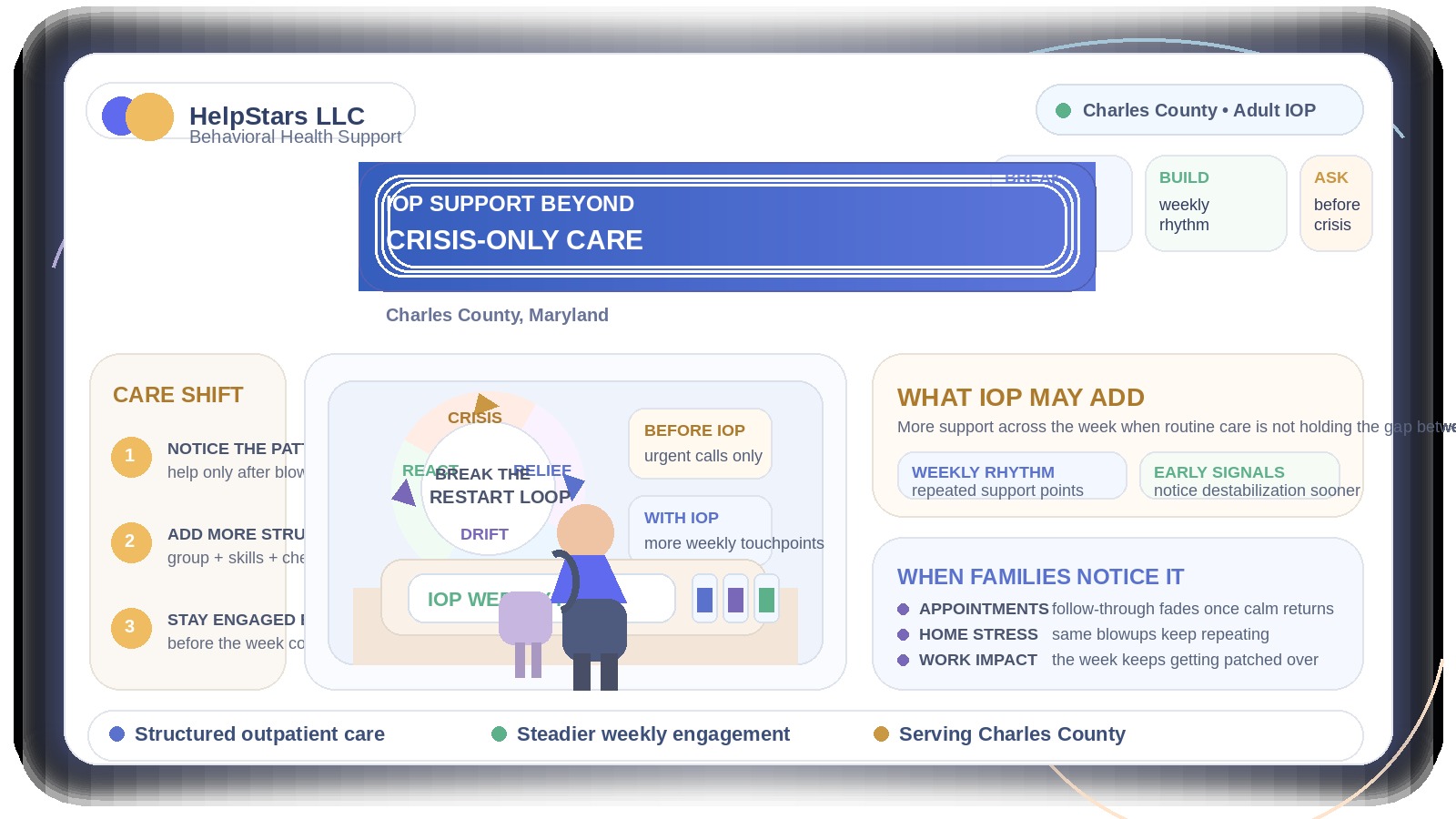
How an Intensive Outpatient Program Can Help Adults in Charles County Move Beyond Crisis-Only Mental Health Care
Some adults do not avoid mental health care because they do not care about getting better. They avoid it because life settles down just enough between hard stretches to make support feel optional again. A frightening weekend passes. A blowup at home cools off. A missed workday gets patched over. For a little while, it seems possible to just push through. Then the next spiral comes, and the family is back to making urgent calls, searching for fast answers, and trying to hold together another unstable week.
That crisis-only pattern is exhausting. It can also hide the fact that a person may need more structured support than occasional appointments or emergency problem-solving can provide. For some adults in Charles County, Maryland, an Intensive Outpatient Program (IOP) may be worth exploring when mental health care keeps happening only after things have already become unmanageable.
IOP is not about labeling someone as a failure or assuming they need inpatient care. It is a structured outpatient option that can offer more consistent therapeutic contact across the week while an adult continues living at home. When the main problem is repeated destabilization, that added rhythm can matter.
What Crisis-Only Mental Health Care Often Looks Like
Many families know this cycle well even if they do not call it that. Things become tense, disorganized, or emotionally intense. Someone talks about needing help, but once the immediate pressure drops, follow-through becomes harder. Days pass. Appointments get postponed. Coping plans fade. Then another difficult stretch hits and everyone is back in emergency mode.
That pattern may look like:
- only reaching out for help after a major argument, shutdown, or overwhelming day,
- missing routine therapy or psychiatry visits during calmer periods,
- cycling between "I am okay now" and "everything is falling apart again,"
- waiting until work, sleep, family life, or daily responsibilities are already unraveling,
- using short-term crisis support without building enough ongoing structure afterward, or
- feeling relieved after each hard episode ends, but never truly stabilized between them.
Adults living in this pattern are not necessarily refusing help. Often, they are trying to recover in the long gaps between touchpoints while also managing stress, transportation, family obligations, finances, or the emotional crash that follows a hard week.
Why the Time Between Crises Can Be the Most Misleading Part
One reason this cycle is so difficult is that the quieter periods can create false confidence. An adult may seem calmer for a few days and assume they can manage without additional support. Loved ones may want to avoid pushing too hard after a conflict. Providers may only see one part of the pattern if care remains inconsistent.
But the question is not only whether the crisis has passed. The question is whether the person has enough support to get through the next several weeks with more stability than the last several weeks. When the answer keeps turning out to be no, a higher level of outpatient structure may be worth discussing.
This is where an IOP can feel different from crisis-only care. Instead of waiting for the next serious disruption, treatment becomes active before the next disruption takes over.
How an Intensive Outpatient Program Changes the Treatment Rhythm
An intensive outpatient program is designed for adults who may need more support than standard weekly care is currently providing, without needing inpatient hospitalization. While each program is structured differently, the core value is usually the same: more consistent therapeutic engagement across the week.
That added structure may help an adult by:
- creating more regular points of contact instead of relying on one appointment to carry the whole week,
- offering repeated opportunities to practice coping skills while stress is building,
- making it easier to notice early warning signs before they become a full crisis,
- reducing the gap between insight and action, and
- bringing more accountability to routines that tend to disappear during hard stretches.
For some adults, the difference is not that they suddenly know something brand new. The difference is that support shows up often enough to help them use what they already know before the week gets away from them again.
A Charles County Example: Help Is Requested Every Time Things Boil Over
Imagine an adult in Charles County who does reasonably well for short periods, but every few weeks the same pattern returns. They stop answering messages, sleep becomes erratic, basic responsibilities pile up, and tension at home rises quickly. A loved one urges them to call their therapist. They agree in the moment, but once the worst part passes, they pull back and say they can handle it. Then another stressful stretch leads to another shutdown, argument, or missed responsibility.
In that situation, the problem may not be lack of concern. It may be that the current level of support is too easy to lose contact with. An IOP can create a steadier container around the week so the person is not rebuilding from near-zero every time stress spikes.
That can be especially relevant for adults who are trying to balance recovery with family demands, work pressure, transportation issues, or the embarrassment that often follows repeated setbacks.
When It May Be Reasonable to Ask About IOP
An intensive outpatient program may be worth asking about when a person does not seem to need inpatient care, but clearly needs more structure than occasional outpatient visits are providing. Families and adults may want to explore the option when they notice:
- repeated emotional destabilization between routine appointments,
- mental health support being used mostly in reactive, last-minute ways,
- difficulty staying engaged with treatment during non-crisis periods,
- ongoing disruption to work, home responsibilities, or relationships,
- multiple short-lived recoveries without lasting weekly stability, or
- a need for more consistent therapeutic structure before the pattern escalates further.
IOP is not only for one type of diagnosis or one kind of story. It may be a practical option whenever the main concern is that weekly support no longer seems strong enough to interrupt a repeating cycle.
Why Local Logistics Matter for Adults in Charles County
Treatment plans work better when they fit the realities of everyday life. Adults in Waldorf, La Plata, White Plains, Bryans Road, Indian Head, and nearby Charles County communities may be trying to keep up with work schedules, child care, transportation, court obligations, or family responsibilities while their mental health is already under strain.
That local context matters because follow-through is not just emotional. It is practical. A person may need a care plan that accounts for commuting time, household pressure, and the fact that stress often rises long before anyone calls it a crisis. Structured outpatient care is easier to use when it is discussed in terms of the week a person is actually living, not an ideal week they never seem to have.
HelpStars LLC supports adults and families across Southern Maryland with compassionate behavioral health services. For Charles County residents who may need more consistent support, the right next step is often the one that reduces repeated emergency scrambling and increases steadier engagement.
Questions Adults and Families Often Ask
Does asking about IOP mean things are severe enough for the hospital?
Not necessarily. IOP may be considered when someone needs more outpatient structure than weekly care is providing, even if inpatient care does not appear necessary.
What if the person seems better after each crisis passes?
That is often when the pattern becomes hardest to judge. Temporary relief does not always mean the overall level of support is enough to prevent the next destabilizing stretch.
Is IOP only for people leaving the hospital?
No. Some adults explore IOP because they keep cycling through high-stress periods and need more treatment contact before problems become emergencies.
What if the family is tired of reacting but does not want to pressure their loved one?
That concern is common. A helpful conversation can focus less on blame and more on whether a steadier support structure could make the next month less chaotic than the last one.
Steadier Support Can Be a Turning Point
Many adults do not need a bigger speech about taking mental health seriously. They need a care structure that does not disappear as soon as the hardest day is over. When care only happens during emergencies, recovery often stays stuck in restart mode.
For some adults in Charles County, an intensive outpatient program may offer a more dependable path forward: not because everything is falling apart, but because repeated near-crises are already taking too much out of the person and the people around them. A steadier week can begin before the next emergency forces it.