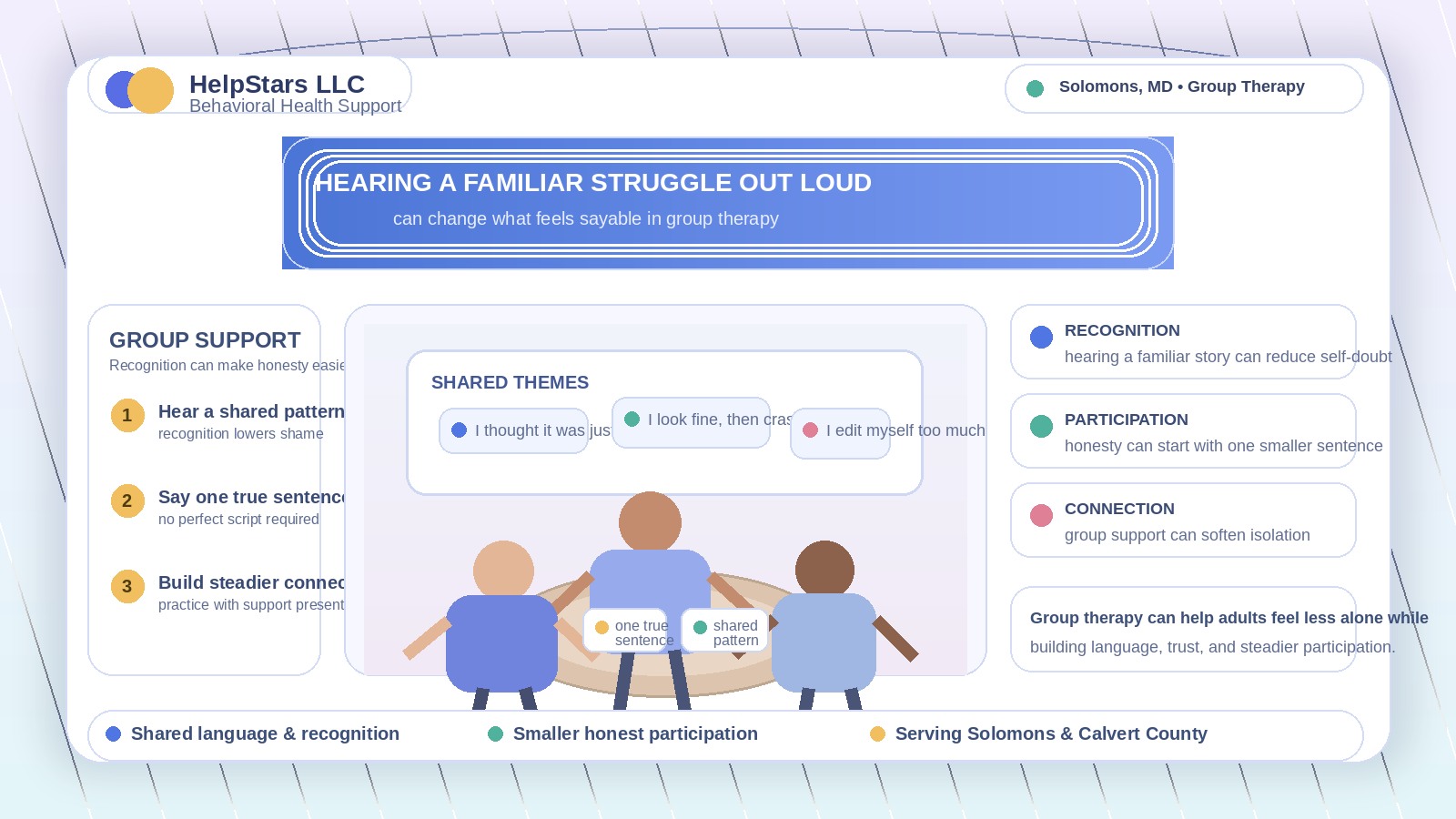
Hearing a Familiar Struggle Out Loud Can Change What Feels Sayable: Group Therapy for Adults Serving Solomons, Maryland
Recognition can lower the pressure faster than advice sometimes. A person may spend weeks trying to explain their own stress, numbness, shutdown, or social strain and still come up blank when the moment arrives. Then someone else describes a similar pattern in plain language, and suddenly the internal fog shifts. The issue does not disappear, but it becomes easier to admit, easier to name, and easier to discuss without starting from zero.
For adults looking for group therapy serving Solomons, Maryland, that kind of recognition can matter. The benefit is not only that other people are present. It is that a supported group can help adults notice their own experiences sooner, feel less alone in them, and practice saying one honest thing before the whole conversation starts feeling too exposed.
HelpStars LLC supports adults across Southern Maryland with practical behavioral health services, including group-based care. When private reflection keeps going in circles but hearing a shared pattern helps something click, group therapy may offer a steadier place to build language, connection, and follow-through.
Why Familiarity Can Make Hard Things Easier To Say
Many adults do not stay quiet because they have nothing going on. They stay quiet because their own experience feels too tangled, too personal, or too easy to dismiss when they are carrying it alone. It can be hard to trust your words when every explanation sounds either too dramatic or not important enough.
In a group setting, that changes. Another person may describe pulling away from texts, losing energy after ordinary errands, replaying small conversations for hours, or looking fine in public and then crashing later. Hearing that pattern out loud can reduce shame and self-doubt. The person listening may think, "That is closer to what I have been trying to explain."
That moment of recognition matters because it helps turn vague distress into something more speakable. Group therapy can create repeated opportunities for that shift.
What This Kind of Isolation Often Looks Like
Isolation is not always about being physically alone. Many adults are around family, coworkers, neighbors, or providers and still feel strangely unreachable. The pattern may look like:
- listening well to other people while staying overly edited about your own experience,
- thinking, "other people probably have a clearer reason to need help than I do,"
- starting to explain something and then backing off because it sounds messy out loud,
- feeling relieved when someone else names a struggle you thought only you handled that way, or
- doing most of your emotional processing after the conversation is already over.
That does not mean the person is unwilling. It often means they need a setting where emotional honesty feels more shared and less exposed.
A Solomons Example: Other People’s Words Keep Opening the Door First
Imagine an adult serving Solomons, Maryland who keeps showing up for life in a capable-looking way. They get through work, answer practical questions, and even support other people reasonably well. But when it is time to describe their own stress, the words narrow fast. They say they are tired, busy, or just off. None of those answers really cover it.
Later, in a structured group setting, another adult talks about dreading ordinary plans because the emotional recovery afterward feels longer than it should. Someone else mentions staying quiet in relationships until resentment comes out sideways. A third person describes feeling disconnected even in rooms full of people. Suddenly the first adult does not have to invent a perfect explanation alone. They can begin with recognition: "Parts of that sound familiar to me."
That kind of starting point can be powerful. Group therapy may help the person move from internal over-editing toward more direct participation, one clear sentence at a time.
What Group Therapy Can Offer That Private Rehearsing Often Cannot
Private reflection has value, but it can also become repetitive. A person keeps turning the same thoughts over without testing them in a real conversation. Group therapy adds something different: a supported social space where patterns become easier to notice in real time.
Depending on the group and the person’s needs, support may help with:
- hearing shared experiences that reduce the feeling of being uniquely stuck,
- practicing shorter, more honest statements instead of waiting for a perfect explanation,
- noticing how the body reacts when vulnerability starts to feel risky,
- building tolerance for being seen without rushing, oversharing, or shutting down, and
- learning from other adults’ coping patterns, insights, and recovery language.
The goal is not to make everyone speak the same way. The goal is to make communication feel more possible, more grounded, and less all-or-nothing.
Four Signs Group Therapy May Be a Good Fit
- You often understand yourself better after hearing someone else describe a similar pattern. Recognition helps you get closer to your own words.
- You keep minimizing what is hard because it sounds vague in your head. A shared setting may make the issue easier to name honestly.
- You want connection, but one-on-one conversation can feel too intense or too exposed. A structured group may offer a different kind of support.
- You leave too many conversations feeling unfinished. The need may not be more thinking alone. It may be more supported practice with real-time expression.
Participation Can Start Smaller Than People Expect
Some adults avoid group therapy because they imagine immediate pressure to speak at length or reveal everything quickly. In practice, meaningful participation can begin much smaller than that. Listening carefully is part of the work. Noticing what resonates is part of the work. Saying one direct sentence can be part of the work.
For adults who feel disconnected, self-conscious, or slow to open up, that matters. Group therapy does not have to begin with a perfectly organized story. It can begin with a smaller truth that is finally said out loud in a room built to hold it.
Why This Matters in Calvert County
Adults serving Solomons, Lusby, Prince Frederick, Huntingtown, Chesapeake Beach, North Beach, and nearby Calvert County communities often balance work strain, family demands, transportation, appointments, and private mental fatigue at the same time. When those pressures build, isolation can become harder to spot because life still looks busy from the outside.
That is part of why group therapy serving Solomons, Maryland can matter. For some adults, the missing piece is not more effort in private. It is a steadier place to hear shared patterns, respond more honestly, and feel less alone while working toward better mental health support.
Questions Adults Often Ask About Group Therapy
What if I am not ready to share everything right away?
You do not need to begin with everything. Group therapy can still be meaningful when participation starts with listening, noticing, and speaking in smaller pieces.
Can group therapy help if I usually understand other people better than I understand myself?
Yes. Hearing shared patterns can help some adults recognize their own experience with more clarity and less shame.
What if I worry my problem is too vague to explain well?
That can be one reason a group setting helps. Adults often find that what felt too vague alone becomes easier to describe after hearing familiar experiences from others.
Is group therapy only for people who are naturally comfortable talking in front of others?
No. Many adults benefit precisely because speaking around others feels hard and they want a more supported place to practice it.
Sometimes Feeling Less Alone Is What Makes Honesty Possible
Adults do not always need a better speech. Sometimes they need a safer starting point. When hearing a familiar struggle out loud makes your own experience easier to name, that recognition is worth paying attention to.
HelpStars LLC supports adults across Southern Maryland with practical behavioral health services, including group therapy. For adults seeking group therapy serving Solomons, Maryland, support may help turn private overthinking into more honest participation, steadier connection, and a clearer next step.