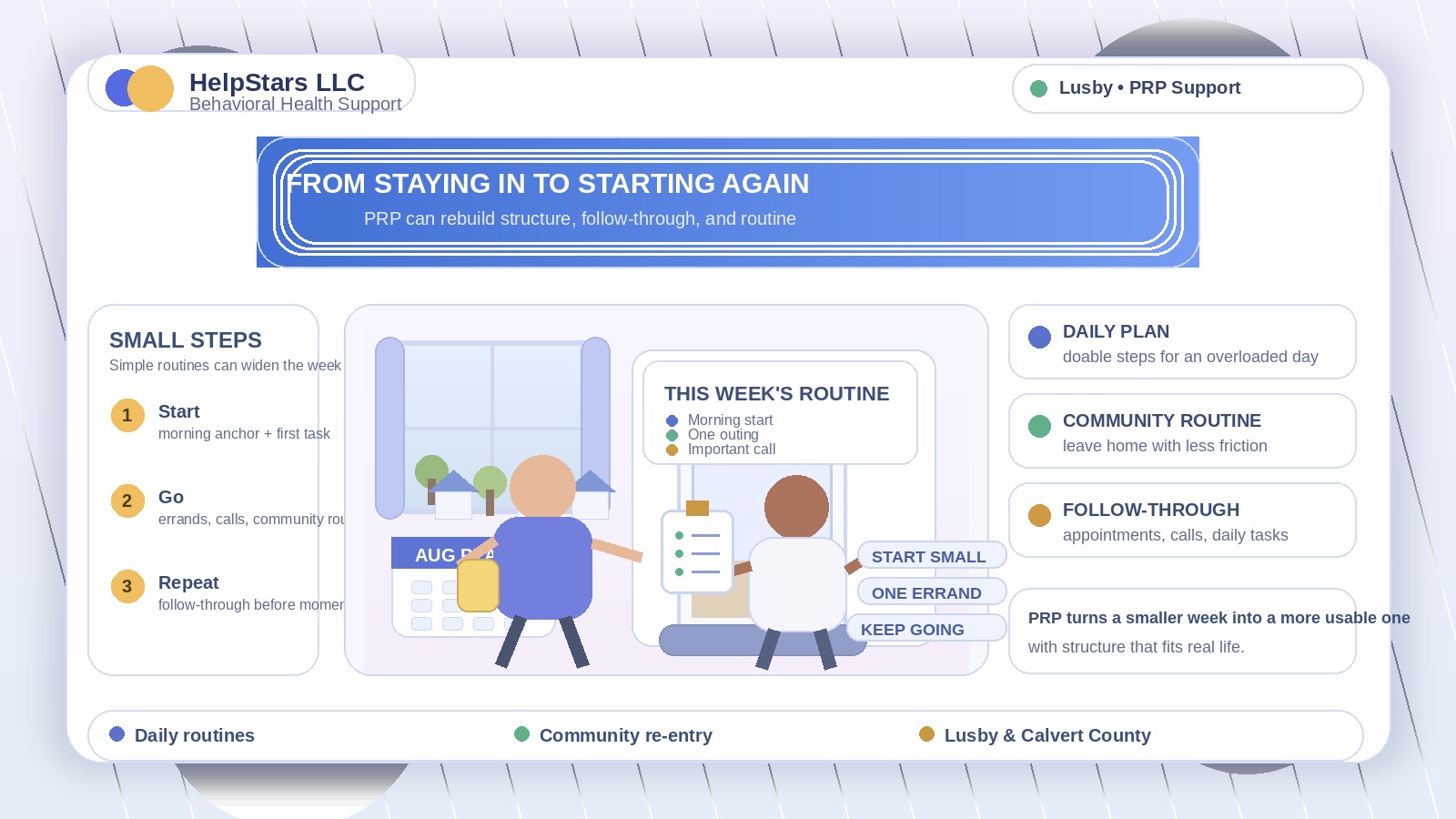
From Staying In to Starting Again: How PRP Services Can Help Adults Serving Lusby, Maryland Rebuild Daily Structure and Community Routine
Sometimes progress does not stall in one dramatic moment. It shrinks quietly. A person stops going out unless something feels absolutely necessary. Simple errands start sliding to tomorrow. Phone calls wait. Laundry sits longer. Meals get more improvised. The week begins to revolve around getting through the day with as little friction as possible, even though that smaller life does not actually feel good.
For adults serving Lusby, Maryland and nearby Calvert County communities, PRP services can help rebuild the practical side of recovery when mental health symptoms have started narrowing routine, confidence, and follow-through. A psychiatric rehabilitation program is not only about talking through stress. It focuses on daily-functioning goals that make life easier to re-enter: keeping a plan, showing up more consistently, managing community tasks, and creating a steadier structure outside of appointments.
HelpStars LLC serves adults and families across Southern Maryland with compassionate behavioral health support. When too much time at home has started turning into lost routine, unfinished responsibilities, and less connection to daily life, PRP may be a helpful level of support to explore.
The World Can Get Smaller Before Anyone Calls It a Problem
Many adults do not immediately describe themselves as needing more support. They may say they are tired, overwhelmed, burned out, discouraged, or trying to keep their stress low. Those explanations can be true. But they can also hide a change in daily functioning that deserves attention.
That change may look like:
- leaving the house only for the most urgent needs,
- putting off forms, refills, or basic scheduling because starting feels heavy,
- losing momentum after one disrupted morning,
- withdrawing from ordinary community routines that once felt manageable,
- finding it harder to restart after a difficult week, or
- watching small responsibilities pile up until they begin shaping the whole week.
None of those patterns automatically mean someone is unwilling or unmotivated. More often, they suggest that symptoms, stress, low energy, anxiety, or disorganization are affecting the practical side of life more than the person can easily correct alone.
What PRP Adds When Daily Life Has Started Slipping Out of Shape
PRP stands for Psychiatric Rehabilitation Program. It is designed to help adults build or rebuild the functional routines that support long-term stability. That can include planning, community participation, communication, appointment follow-through, independent living habits, and other everyday skills that become harder when mental health symptoms interfere.
This matters because insight and follow-through are not always the same thing. A person may understand that they need more structure and still feel unable to create it consistently. They may know which tasks matter and still freeze at the starting point. They may want a fuller life and still keep retreating into a smaller routine because it feels less demanding in the short term.
PRP helps translate good intentions into workable steps. Instead of only asking, “Why is this happening?” support can also ask, “What would make tomorrow easier to carry out?”
Five Areas PRP Can Help Rebuild
- A steadier morning starting point. Many routines fall apart early. PRP can help adults create more usable wake-up, preparation, and first-task habits so the day does not feel lost by midmorning.
- Community re-entry in manageable steps. That may include preparing for errands, appointments, support meetings, or other regular responsibilities that have started feeling harder to approach.
- Task initiation and follow-through. A plan is more useful when it is broken into specific, realistic steps. PRP can help reduce the gap between knowing and doing.
- Routine around appointments, medications, or important paperwork. Recovery often gets shakier when the surrounding structure disappears. Small systems can protect consistency.
- Confidence with independent daily living. Many adults need support not because they lack ability, but because symptoms have made ordinary tasks feel less organized, less predictable, or more draining than they used to.
These goals are practical on purpose. For someone whose week has been shrinking, practical support is often where momentum starts returning.
A Lusby Example: Home Starts Feeling Easier Than Everything Else
Imagine an adult serving Lusby who has slowly begun avoiding anything that takes extra activation. They still care about getting back on track, but each day now requires too much effort to get moving. A grocery run feels bigger than it should. Returning a call gets delayed until the office closes. An appointment stays on the calendar, but the preparation never fully happens. By the weekend, the person is frustrated with themselves and even less willing to start again on Monday.
In that situation, generic encouragement may not be enough. The problem is no longer just mood. The problem is that daily life has lost shape. PRP can help identify where the pattern actually breaks. Is it getting started in the morning? Remembering the sequence of tasks? Managing anxiety before leaving the house? Recovering after one plan changes? Once the friction point is clearer, support becomes more concrete.
That might mean building a smaller outing plan, setting up a realistic weekly checklist, practicing what needs to happen before an appointment, or breaking one overloaded responsibility into parts that finally feel doable. The work is less about perfection and more about making daily life easier to rejoin.
The Goal Is Not a Busy Schedule. It Is a More Usable Life.
Some adults hear “rehabilitation” and imagine pressure to become highly productive all at once. In reality, the first wins are often modest and important:
- getting out on time twice this week instead of not at all,
- keeping one appointment without scrambling at the last minute,
- following through on a refill, call, or form that has been hanging over the week,
- re-entering one community routine without shutting down afterward, or
- feeling less defeated by ordinary tasks.
Those shifts matter because they make the next step easier. A more usable routine often begins before confidence fully returns. Repetition creates traction first, then confidence grows from having more steady days in a row.
What Support May Focus On Over the Course of a Week
Depending on a person’s needs, PRP support may center on questions like:
- What part of the day keeps unraveling first?
- Which tasks are essential, and which ones are currently crowding the plan?
- What community responsibilities feel most avoidable right now?
- What reminders, checklists, or routines would actually be realistic?
- What tends to knock the person off track after a decent day?
- How can the next outing, appointment, or errand feel less complicated before it starts?
That kind of structure can be especially helpful for adults living with depression, anxiety, bipolar disorder, schizophrenia, trauma-related stress, or other behavioral health challenges that affect energy, organization, motivation, or community participation.
When PRP May Be Worth Asking About
Adults and families may want to look into PRP when:
- counseling alone is not fully improving day-to-day follow-through,
- the person understands what needs to happen but still struggles to carry it out,
- community routines have narrowed more than the person wants to admit,
- small tasks are repeatedly turning into bigger weekly problems,
- appointments, paperwork, or daily responsibilities are harder to manage consistently, or
- life at home has become easier to tolerate than life outside the door.
PRP can be valuable before the situation turns into a crisis. For many adults, it helps at the stage where functioning is still recoverable but no longer feels reliably self-correcting.
Why Local Routine Matters in Calvert County
Daily structure is always local. Adults serving Lusby, Solomons, Prince Frederick, Huntingtown, North Beach, Chesapeake Beach, and nearby Calvert County communities are balancing real roads, errands, household responsibilities, appointments, family roles, and community expectations. A plan that sounds easy in theory can break down quickly if it does not fit the actual rhythm of the person’s week.
That is one reason psychiatric rehabilitation can be so useful. It keeps recovery tied to real life instead of abstract goals. Support works better when it reflects the places someone actually goes, the tasks that repeatedly stall out, and the amount of activation daily life is asking for right now.
Questions People Often Ask About PRP
Is PRP only for people coming out of a hospital stay?
No. Some adults use PRP after higher levels of care, but others benefit because daily structure, community functioning, or independent living skills have become harder to maintain over time.
Can PRP help if the biggest issue is follow-through, not motivation?
Yes. Many adults care deeply about improving their routine and still struggle to organize, initiate, or repeat the steps needed to make the week work better.
Does PRP replace therapy?
Not necessarily. Depending on the situation, PRP may complement outpatient counseling, medication management, or other behavioral health services by focusing more directly on practical daily-functioning goals.
What if leaving the house has just gotten harder lately?
That still matters. Support does not have to wait until someone is fully disconnected from the community. Early practical help can keep a smaller pattern from becoming a much harder one to reverse.
Recovery Can Look Like Rejoining Ordinary Life
Sometimes the most meaningful progress is not dramatic. It is being able to start the day with less resistance, keep a few promises to yourself, and return to parts of community life that have started feeling farther away than they used to. PRP is built for that kind of progress.
HelpStars LLC serves adults and families across Southern Maryland with compassionate behavioral health support. For adults serving Lusby, Maryland who feel like daily life has quietly narrowed around staying in, avoiding tasks, and trying to conserve energy, PRP services may offer the practical structure needed to start moving outward again.