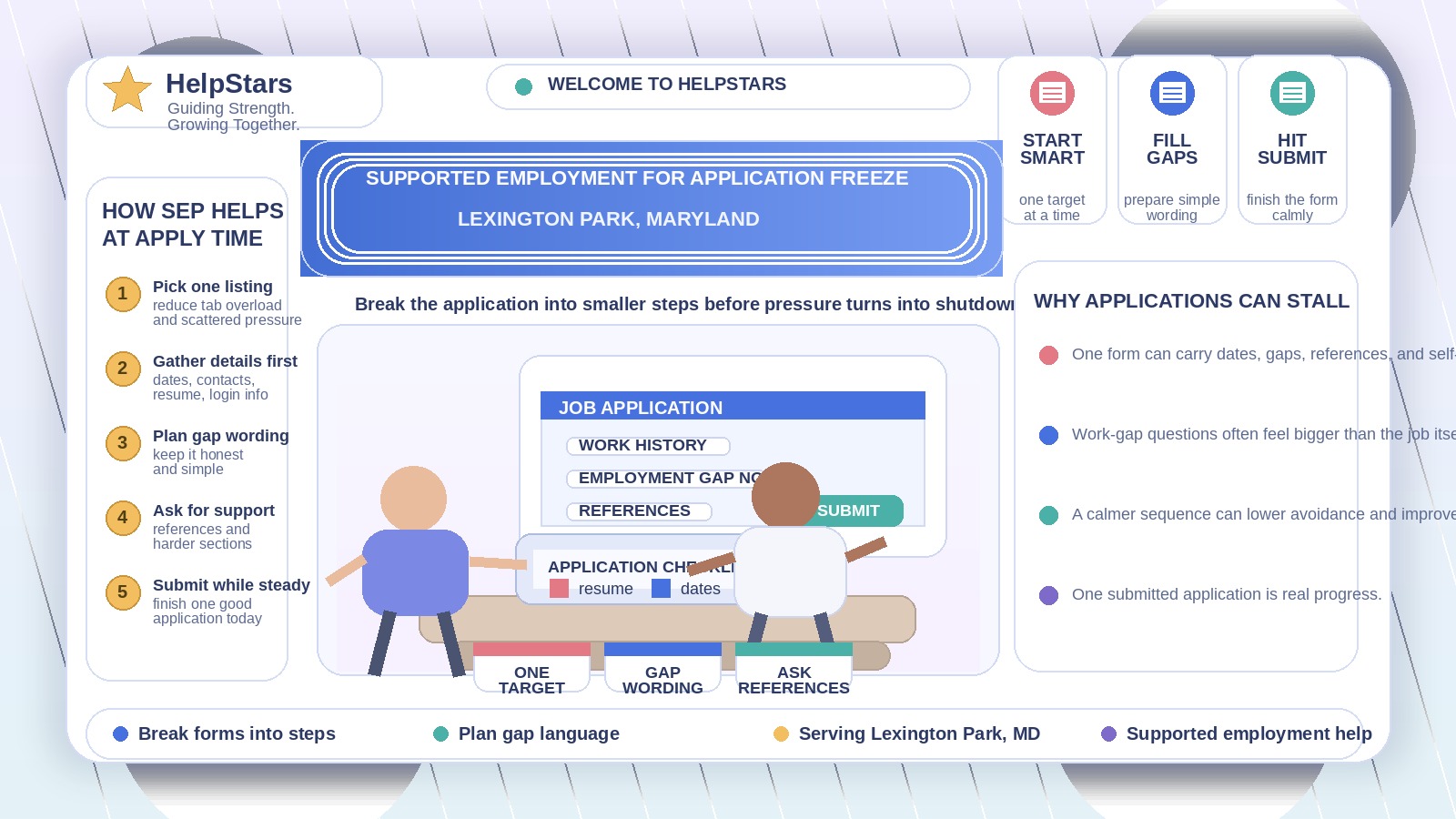
Clicking Apply Should Not Feel Like Explaining Your Whole Life: Supported Employment for Adults in Lexington Park, Maryland
Some adults can picture working again more easily than they can finish one job application. The desire is there. The need for structure, income, or a steadier routine may be there too. But once the screen opens, everything starts feeling heavier than it looked a minute before. Old job dates have to be remembered. Gaps have to be named. References have to be considered. One short form begins to feel like a full explanation of the hardest stretch of someone’s life.
For adults in Lexington Park, Maryland, supported employment can help when job interest keeps stalling at the application stage. The barrier is not always a lack of motivation. Sometimes it is the pressure of trying to organize work history, confidence, memory, stress tolerance, and self-protection all at once while a clock seems to be ticking in the background.
HelpStars LLC supports adults and families across Southern Maryland with compassionate behavioral health services. When every application starts to feel too loaded to finish, supported employment can offer a steadier way to break the process down and keep moving without forcing everything into one perfect sitting.
The Application Screen Can Feel Bigger Than the Job Itself
Adults often get blamed for “not following through” when the real problem is that the application phase quietly combines several difficult tasks into one moment. A person may be trying to search for work while also managing anxiety, depression, attention problems, burnout, low confidence, or the mental strain of being out of work longer than expected.
That can sound like:
- “I was ready to apply until it asked for every date and I shut down,”
- “I do not know what to say about the years that do not fit neatly,”
- “I keep starting forms and abandoning them halfway through,”
- “I can think about working, but I freeze when I have to write it all out,” or
- “Once it asks for references, my brain acts like the whole plan is impossible.”
Those reactions are more common than they look from the outside. Applications ask for details, confidence, sequencing, and emotional steadiness at the same time. For some adults, that combination is the exact point where momentum drops.
The Hardest Part Is Often Not the Blank Field
Sometimes the stressful part is not the form itself. It is what the form seems to imply. A work gap may feel like a judgment. A question about previous positions may bring up a period of instability or illness. A request for references may trigger worry about who still remembers the person positively. Even a simple upload button can feel charged if the resume no longer matches the life someone hoped they would already have rebuilt.
That is one reason supported employment Lexington Park MD searches are not only about finding openings. They are often about finding help with the part that comes before the interview: translating a messy real-life recovery path into an application that is honest, practical, and submit-ready.
Without support, adults may end up repeating the same cycle:
- they search jobs when they are feeling motivated,
- they open two or three applications,
- they hit one emotionally loaded section,
- they tell themselves they will come back later, and
- the whole search starts feeling bad enough to avoid for several more days.
That cycle can look like procrastination from the outside. In reality, it is often a sign that the process needs more structure and less pressure.
How Supported Employment Can Help at the Application Stage
Supported employment is not only for the moment someone gets hired. It can also help much earlier, when the main barrier is getting an application from half-started to actually submitted.
Depending on the person’s needs, support may help with:
- breaking one application into smaller sections instead of treating it like one giant task,
- sorting out which work history details need to be gathered before applying,
- creating simple language for gaps, transitions, or role changes without overexplaining,
- deciding which jobs are realistic enough to pursue now rather than opening every listing at once,
- building a calmer plan for references, resume updates, and follow-up tasks, and
- turning “I need to apply for jobs” into a repeatable session that the person can actually tolerate.
The goal is not to make the process artificial. The goal is to make it workable enough that progress can continue.
A Lexington Park Example: Three Open Tabs and Nothing Submitted
Imagine an adult in Lexington Park, Maryland who wants to get back to work after a difficult stretch of mental health symptoms, disrupted routine, and inconsistent energy. They find two jobs that seem possible. One is close enough to reach. One seems less overwhelming than the last position they held. For a moment, the search feels hopeful.
Then the application asks for exact employment dates, supervisor information, a short summary of duties, and an explanation for an unfinished period between jobs. The person opens an old resume, realizes it is outdated, and starts worrying that none of the information looks strong enough anymore. By the time they reach the references section, their shoulders are tight, their thoughts are jumping, and the original goal of applying for one position has turned into a much bigger internal argument about whether they are employable at all.
Nothing dramatic happens. The tabs just stay open. Later that evening the person closes the laptop and tells themselves they will do it when they feel more prepared. A week passes, then another. The problem is no longer only finding work. The problem is getting past the part of the process that keeps turning possibility into shutdown.
That is a place where job coaching in St. Mary’s County can matter. The task may need a better sequence, more support, and less emotional load per sitting.
Four Places People Commonly Get Stuck Before They Ever Hit Submit
- Employment dates and gaps. Many adults can describe what was happening in their lives more easily than they can reconstruct exact timelines under pressure.
- Reference anxiety. The question is not always “Do I know anyone?” It may be “Who feels safe to ask, and what if I do not want to explain everything?”
- Open-ended self-description. A short prompt like “tell us about yourself” can feel huge when confidence is already low or recent work history feels complicated.
- Application overload. Opening too many listings at once can make every task feel equally urgent, which often means none of them get finished.
These obstacles do not mean someone is not ready to work in any form. They may simply mean the application stage needs its own support plan.
What a More Workable Application Plan Can Include
A better job-search routine often starts by lowering the amount of pressure packed into one sitting. Instead of demanding confidence, perfect memory, and polished wording all at once, the process can be separated into tasks that are easier to complete in order.
That may include:
- collecting dates, contacts, and prior job details before opening a new form,
- drafting two or three short explanation options for work gaps or role transitions,
- choosing one application target instead of bouncing among several openings at once,
- using a checklist for resume, references, login details, and follow-up steps,
- saving harder writing sections for a time of day when attention is stronger, and
- stopping after one completed application if that is the realistic win for the day.
For many adults, this kind of structure lowers shame as much as it improves follow-through. Progress becomes easier to see when the task is no longer disguised as “fix your whole work life right now.”
Why Local Routine Still Matters Around Lexington Park
Adults in Lexington Park and nearby St. Mary’s County communities are often balancing more than job searching. They may be managing transportation, appointments, child care, household recovery tasks, paperwork, family expectations, and the emotional fatigue that comes from trying to rebuild stability while still needing income. A work plan has to fit that real week.
That is one reason mental health vocational services in Southern Maryland can be useful. A person may not need more generic encouragement. They may need help organizing the exact point where job interest keeps collapsing into application avoidance.
Questions Adults Often Ask About Application Freeze
Do I need a perfect resume before I start looking?
No. Waiting for everything to feel perfect can keep the search stalled longer. Many adults do better when they improve materials in stages while still keeping the process moving.
What if my work gaps feel too hard to explain?
That does not make employment impossible. It usually means the wording needs to be simple, respectful, and prepared ahead of time rather than invented while stressed.
Can supported employment help before interviews happen?
Yes. Some people need the most help before the interview stage, especially if applications, references, timelines, or follow-through are where the search keeps stopping.
What if I can do the application tasks mentally but lose steam halfway through?
That still matters. The issue may be stamina, concentration, emotional load, or task sequencing rather than knowledge alone. A smaller application routine may help more than more self-criticism.
Getting Past “Apply” Can Be a Real Recovery Step
Some adults do not need to be convinced that work matters. They need help making the first practical step feel survivable again. If every application starts feeling like a full defense of the hardest years of your life, supported employment can help make the process smaller, steadier, and more usable.
HelpStars LLC serves adults and families across Southern Maryland with compassionate behavioral health support. For adults in Lexington Park, Maryland who keep opening job applications and freezing before submission, supported employment can help turn that stalled point into a more workable path forward.