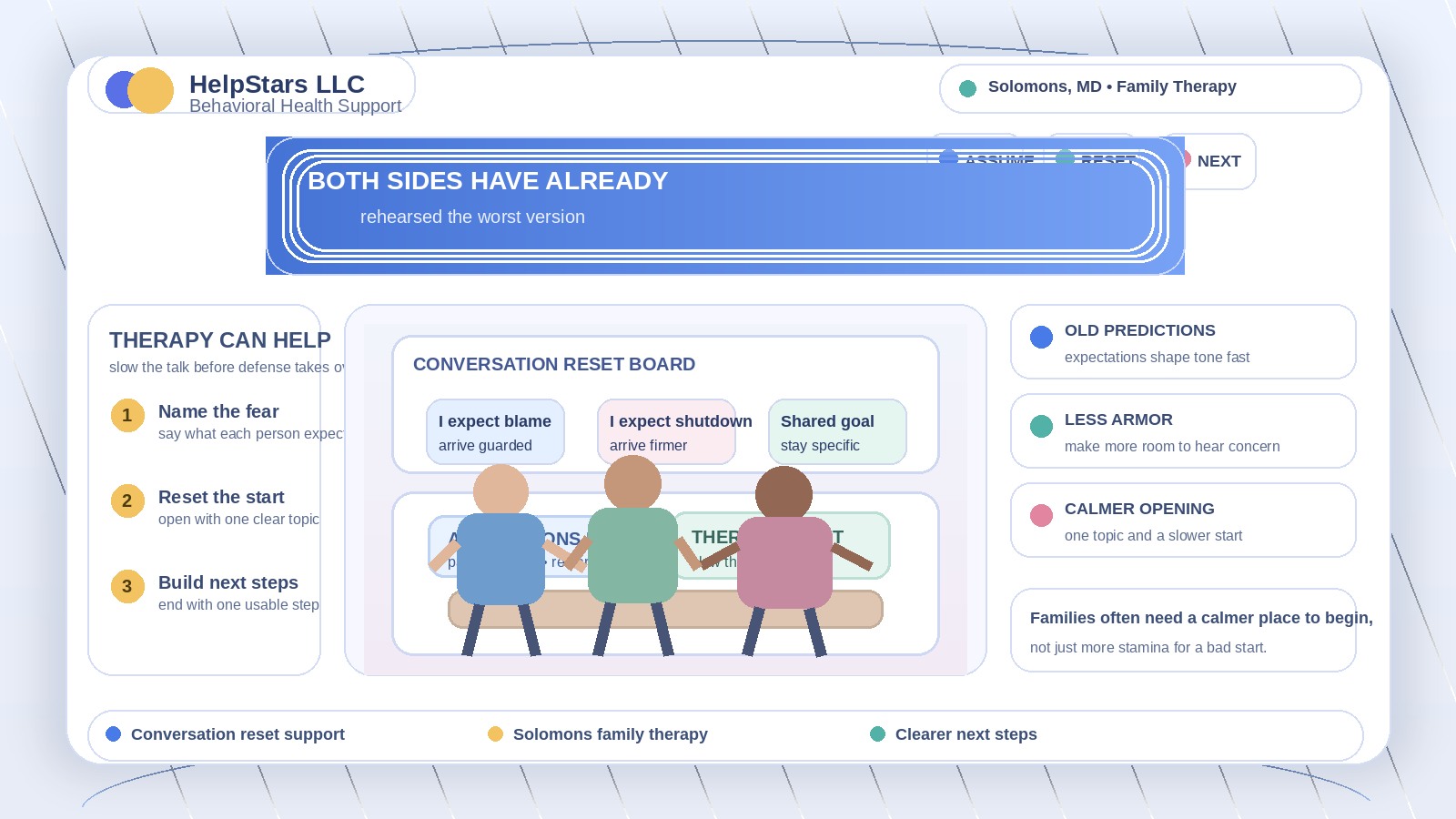
By the Time the Talk Starts, Both Sides Have Already Rehearsed the Worst Version: Family Therapy for Adults Serving Solomons, Maryland
Some family conversations go wrong before anyone actually says the first sentence. One person has already spent the afternoon rehearsing how they will defend themselves. Another has already decided they are about to be ignored, blamed, or shut down again. Someone else is walking into the room prepared to keep the peace, rescue the tone, or end the talk early before it spirals. By the time the conversation begins, each person may be responding as much to the version they feared in advance as to the words that are being spoken right now.
For adults seeking family therapy serving Solomons, Maryland, that pattern can make even ordinary check-ins feel exhausting. The issue is not only what families argue about. It is also how much emotional bracing happens before the conversation starts. Family therapy can help households slow that pattern down, notice the assumptions everyone is bringing in with them, and build a steadier way to talk about treatment, routines, independence, and concern without arriving already half-defended.
HelpStars LLC supports adults and families across Southern Maryland with compassionate behavioral health services. When the hardest part of a family conversation is that everyone has already prepared for it to go badly, structured support may help create a calmer place to begin.
Why Conversations Often Start With Old Predictions Instead of the Present Moment
Families do not walk into difficult discussions as blank slates. They bring memory, expectation, and self-protection with them. If earlier talks felt critical, dismissive, controlling, or emotionally chaotic, the body and mind often start preparing for a repeat long before the current conversation has a chance to show what it actually is.
That can sound like:
- “I already know how this is going to go,”
- “If I do not explain myself fast, I will be misunderstood,”
- “If I bring this up gently, nobody will take it seriously,”
- “I need to be ready for them to get defensive,” or
- “I should probably stay guarded because this never ends well.”
Once those predictions take over, people stop listening for what is actually happening and start reacting to what they are afraid will happen next. A neutral question can sound loaded. A worried reminder can sound like a verdict. A pause can sound like rejection. Everyone becomes quicker to brace and slower to hear.
A Solomons Example: The Problem Is Not Only the Topic. It Is the Setup.
Imagine an adult serving Solomons, Maryland who is trying to manage mental health treatment, home responsibilities, and family relationships at the same time. A parent or partner wants to talk about missed follow-through, recent stress, or the need for more consistency. The adult already expects the conversation to become criticism. Meanwhile, the family member already expects the adult to shut down or turn the concern back on them.
By the time they sit down, both sides are preparing for impact. One speaks too quickly because they want to get their explanation out before being judged. The other comes in firmer than they meant to because they are trying to prevent the discussion from slipping away. A third relative tries to soften the exchange before either person feels fully heard. The room becomes tense almost immediately.
Nothing about that scene means the family does not care. Often it means the conversation is starting under the weight of earlier disappointments and defensive rehearsal. That is where family therapy in Calvert County can help. The goal is not simply to find kinder words. It is to change the emotional setup so people are no longer beginning from the assumption that the worst version is already on its way.
How Family Therapy Can Help Lower the Emotional Armor
Family therapy can help families understand what happens before the argument becomes visible. Depending on the situation, support may help with:
- identifying the assumptions each person brings into difficult conversations,
- separating today’s topic from older interactions that still shape tone and expectation,
- making room for concern without packaging it as control or accusation,
- helping the person who feels cornered stay present longer without going fully defensive,
- reducing the pressure on other relatives to manage or rescue the exchange, and
- building clearer conversation openings that do not begin with immediate escalation.
The benefit is often practical as well as emotional. When people stop spending the first five minutes protecting themselves from the anticipated version of the talk, there is more room for the actual issue to get addressed.
Four Signs the Family May Be Arguing With Predictions More Than With Each Other
- People become defensive unusually fast. The reaction seems too strong for the first sentence because the person is reacting to a feared pattern, not only the present remark.
- Each side comes prepared with a full case before the conversation begins. Nobody is entering with curiosity; everyone is entering with evidence and protection.
- Old disappointment shapes the tone immediately. Even a calm opening lands inside a relationship that already feels braced.
- Someone keeps stepping in to manage the exchange. The conversation is so expected to go badly that another person feels responsible for controlling the damage in real time.
These patterns do not mean the family is beyond repair. They usually mean the family needs help resetting how difficult conversations begin and how people interpret each other once they do.
What a Better Start to a Hard Conversation Can Include
Families often need more than a reminder to “communicate better.” A more workable start may involve:
- naming one topic instead of five layered frustrations,
- checking what each person is assuming before the discussion moves further,
- slowing the opening enough that clarification can happen before defense hardens,
- using concern language that stays specific rather than global, and
- ending with one usable next step instead of leaving everyone with the same dread about the next conversation.
Those shifts can sound small, but they often change whether a discussion becomes another reenactment or an actual chance to understand each other more accurately.
Questions Families Often Ask
What if we already know the topic that always goes badly?
That can be useful information. Therapy may help the family look not only at the topic itself, but at the assumptions, tone, pacing, and protective habits that keep showing up around it.
Does this mean one person is just too sensitive or too defensive?
Not necessarily. Defensiveness often makes more sense when the family looks at the history each person is bringing into the room and the expectations formed by earlier conversations.
Can family therapy help if everyone cares but nobody feels safe in the conversation?
Yes. That is often exactly when structured support is useful. Caring is important, but families also need a process that helps concern land in a workable way.
What if another relative always jumps in to keep the peace?
That may be a sign the family already expects the conversation to go badly. Therapy can help reduce the need for that rescue role and make direct conversation more stable.
A Family Usually Needs a Better Starting Place, Not Just Better Endurance
When both sides arrive already rehearsing the worst version of the talk, the family may not need more courage alone. It may need a different setup, slower openings, and a steadier process for hearing concern without immediately translating it into threat.
HelpStars LLC supports adults and families across Southern Maryland with compassionate behavioral health services. For adults seeking family therapy serving Solomons, Maryland, structured support may help difficult conversations start with less armor, more clarity, and a better chance of becoming useful.