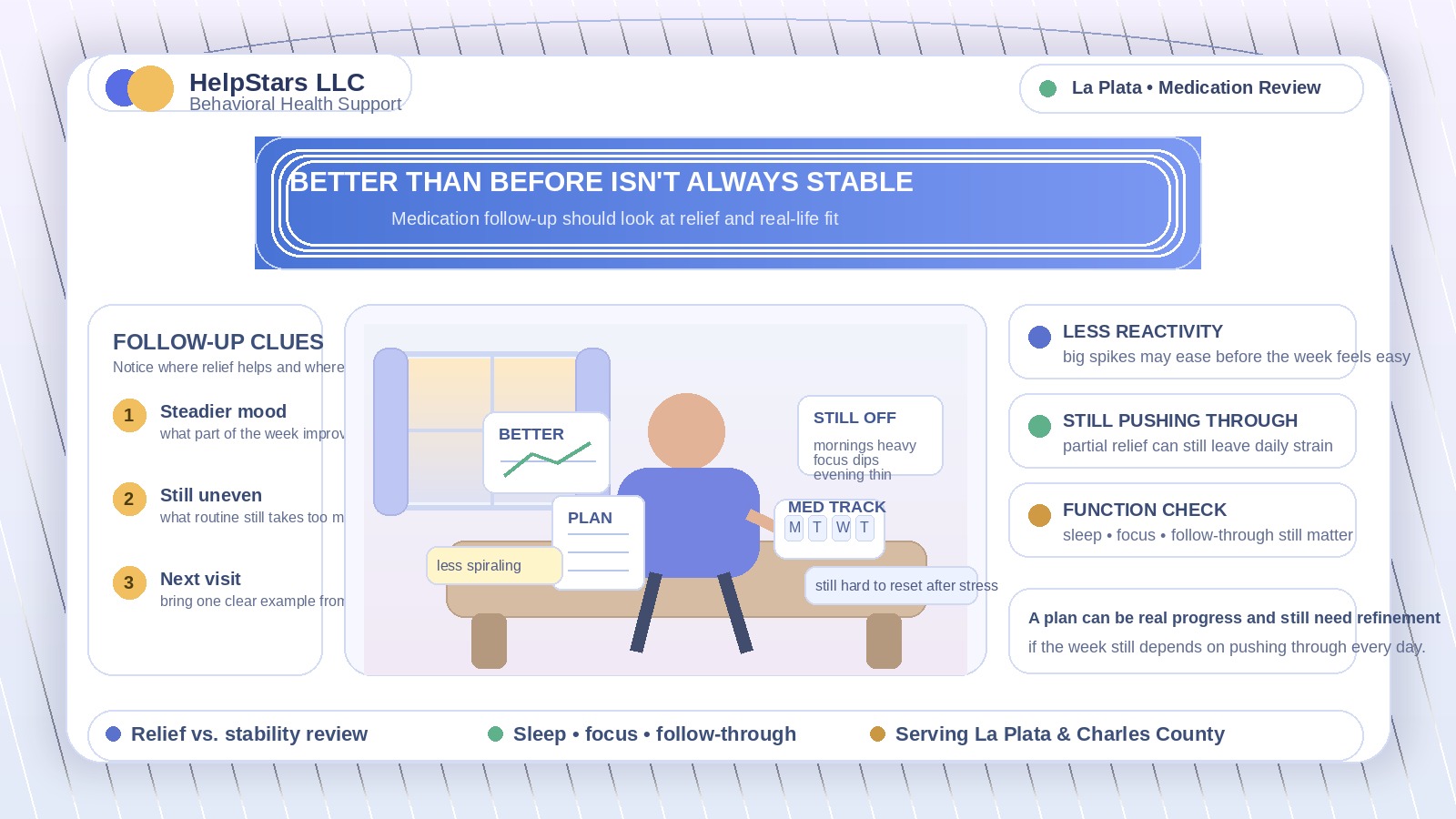
Better Than Before Is Not Always the Same as Stable: Medication Management for Adults Serving La Plata, Maryland
Not every medication question starts with a bad reaction. Sometimes the harder situation is more ambiguous than that. A person can look back and honestly say things are better than they were a few weeks ago, yet still feel that daily life is not working the way it should. The biggest emotional spikes may be softer. Patience may last longer. Sleep may be less chaotic. And still, the week does not feel reliably manageable.
For adults seeking medication management serving La Plata, Maryland, that in-between picture matters. A prescription does not have to be a total failure to deserve a closer look. If the person is getting partial relief but still spending too much effort pushing through mornings, regaining focus, recovering from stress, or holding the evening together, the next follow-up conversation can be about fit, not just crisis.
HelpStars LLC supports adults across Southern Maryland with practical behavioral health care, including medication-management follow-up. When the current plan is helping enough to notice but not enough to trust, clearer review may help turn a vague “maybe better” into a more useful treatment decision.
Why Partial Relief Can Still Feel Hard To Live With
People often think they should feel grateful the moment a medication helps at all. That reaction is understandable, but it can make honest follow-up harder. If the worst part improved, the person may minimize the rest. They may tell themselves they should stop questioning things because the situation is not as bad as it was before.
But partial benefit can still leave real strain in place. A person may cry less often but still struggle to get started each day. They may feel less keyed up socially but still lose momentum after one stressful interaction. They may have fewer racing thoughts but still find planning, follow-through, or emotional steadiness harder than expected.
Medication management is often most useful in this middle zone. The question is no longer only whether something changed. The question becomes whether the change is strong enough, consistent enough, and functional enough to support real life.
The Difference Between Symptom Improvement and Everyday Stability
Feeling somewhat better is not always the same as functioning well. A treatment plan may reduce one painful symptom while leaving other parts of the day unusually fragile. That difference matters because adults do not live inside symptom checklists alone. They live inside routines, work demands, home responsibilities, transportation stress, and conversations that still require patience and mental energy.
It may help to ask:
- Is the morning easier to begin, or does it still feel heavy every day?
- Can the person recover from stress faster, or does one disruption still throw off the next several hours?
- Are focus and follow-through actually improving, or is the improvement mostly internal and harder to translate into action?
- Does the evening still leave enough capacity for family life, appointments, and preparation for tomorrow?
Those questions often reveal whether “better” is becoming stable or simply becoming more tolerable.
A La Plata Example: Less Intense, Still Not Steady
Imagine an adult serving La Plata, Maryland who recently started a medication or adjusted an existing one. The first comparison is encouraging. They are not spiraling as fast. Their reactions feel a little less sharp. They may even notice that work conversations are easier than they were during the worst stretch.
At the same time, the day still needs too much management. They wake up unsure how much energy they will have. One unexpected demand can still flatten the rest of the afternoon. The prescription may be reducing distress without creating enough steadiness to support consistent planning, household tasks, or emotional follow-through at home.
That does not mean the medication failed. It means the current picture deserves better language. Instead of saying only “I guess it helps,” the person may need a follow-up conversation that separates relief from reliability.
What Can Make the Next Medication Follow-Up More Useful
A stronger follow-up does not require perfect notes. It helps to bring a few concrete observations tied to daily life. Examples include:
- one part of the week that feels clearly easier,
- one part that still breaks down too easily,
- changes in motivation, sleep, appetite, focus, or irritability,
- whether the person can bounce back after stress any faster than before, and
- which routine still feels harder than it should despite the improvement.
These details matter because they move the conversation beyond a vague thumbs-up or thumbs-down. Treatment choices are usually stronger when they reflect how the medication is landing inside real responsibilities.
Three Signs the Current Plan May Need Another Look
- The person keeps saying “it is better, but…” That repeated qualifier often contains the real clinical question.
- Function is lagging behind mood relief. The emotional edge may be softer while everyday follow-through remains too inconsistent.
- Too much of the week still depends on pushing through. If the plan only works when the person overcompensates, the fit may still need refinement.
These signs do not automatically mean something is wrong with the medication. They do suggest that the current level of help may not yet match the person’s actual needs.
Why This Matters for Adults Serving Charles County
Adults serving La Plata, Waldorf, White Plains, Bryans Road, Hughesville, Port Tobacco, and nearby Charles County communities are often trying to stay steady across work, commuting, parenting, paperwork, household demands, and treatment follow-through all at once. In that kind of week, a medication does not need to create perfection. It does need to support a life that feels more sustainable than before.
That is why medication management serving La Plata, Maryland can be important even when the situation sounds “not terrible.” A plan may be noticeably better than the old one and still deserve adjustment, closer tracking, or a more careful conversation about what stable functioning should actually feel like.
Questions People Often Bring to Follow-Up
If the medication is helping some, should I just give it more time?
Sometimes more time is part of the answer, but partial improvement should still be described clearly. Follow-up is more useful when the person explains what improved and what still feels too uneven.
What if I cannot tell whether the problem is the medication or just normal life stress?
That uncertainty is common. Medication management can help sort out whether the remaining strain looks more like an adjustment issue, a timing issue, an incomplete response, or life pressure that still needs broader support.
Do I need dramatic side effects before mentioning concerns?
No. A plan can deserve review even without a dramatic reaction if the person is still working too hard just to stay basically on track.
What if I am afraid I will sound ungrateful because things are not as bad as before?
Describing incomplete relief is not being ungrateful. It is useful clinical information. The goal is not to complain. The goal is to help the treatment plan fit daily life more accurately.
A Better Plan Should Help the Whole Week Feel More Workable
For many adults, the hardest medication conversation is not “this is making everything worse.” It is “this is helping, but I still do not feel steady.” That middle ground deserves attention. Better than before can be real progress and still leave room for a more workable plan.
HelpStars LLC supports adults across Southern Maryland with practical behavioral health care, including medication management. For adults seeking medication management serving La Plata, Maryland, a closer review of partial relief, daily function, and week-to-week steadiness may help turn uncertainty into a clearer next step.