Behavioral Health Services in St. Mary’s County: How to Tell Whether Counseling, PRP, IOP, or Supported Employment Fits Best
A lot of adults and families do not get stuck because they are unwilling to ask for help. They get stuck because every service name starts sounding interchangeable. Counseling, PRP, IOP, supported employment, psychiatric evaluation — all of it can blur together when the real question is simpler: What kind of support actually matches what keeps falling apart in daily life?
For people looking for behavioral health services in St. Mary’s County, that confusion can delay care. One person mainly needs a place to work through anxiety, grief, trauma, or relationship strain. Another needs hands-on support with routines, appointments, paperwork, and community stability. Someone else may need a more structured level of care because symptoms are disrupting daily functioning more often than weekly therapy can realistically address. And for some adults, the biggest recovery goal is getting back to work or keeping a job that already feels fragile.
HelpStars LLC supports adults across Southern Maryland through several service lines, including an outpatient mental health clinic in St. Mary’s County, a psychiatric rehabilitation program, an intensive outpatient program, and supported employment. The goal is not to force everyone into the same path. The goal is to match support to the pressure point that is actually driving the struggle.
Start With the Problem That Keeps Repeating
When people search for a mental health clinic in St. Mary’s County, they often begin by naming symptoms: stress, depression, anxiety, mood swings, burnout, panic, isolation, or feeling overwhelmed. That matters, but it is also useful to ask a second question: What keeps breaking down because of those symptoms?
That answer often points toward the right service:
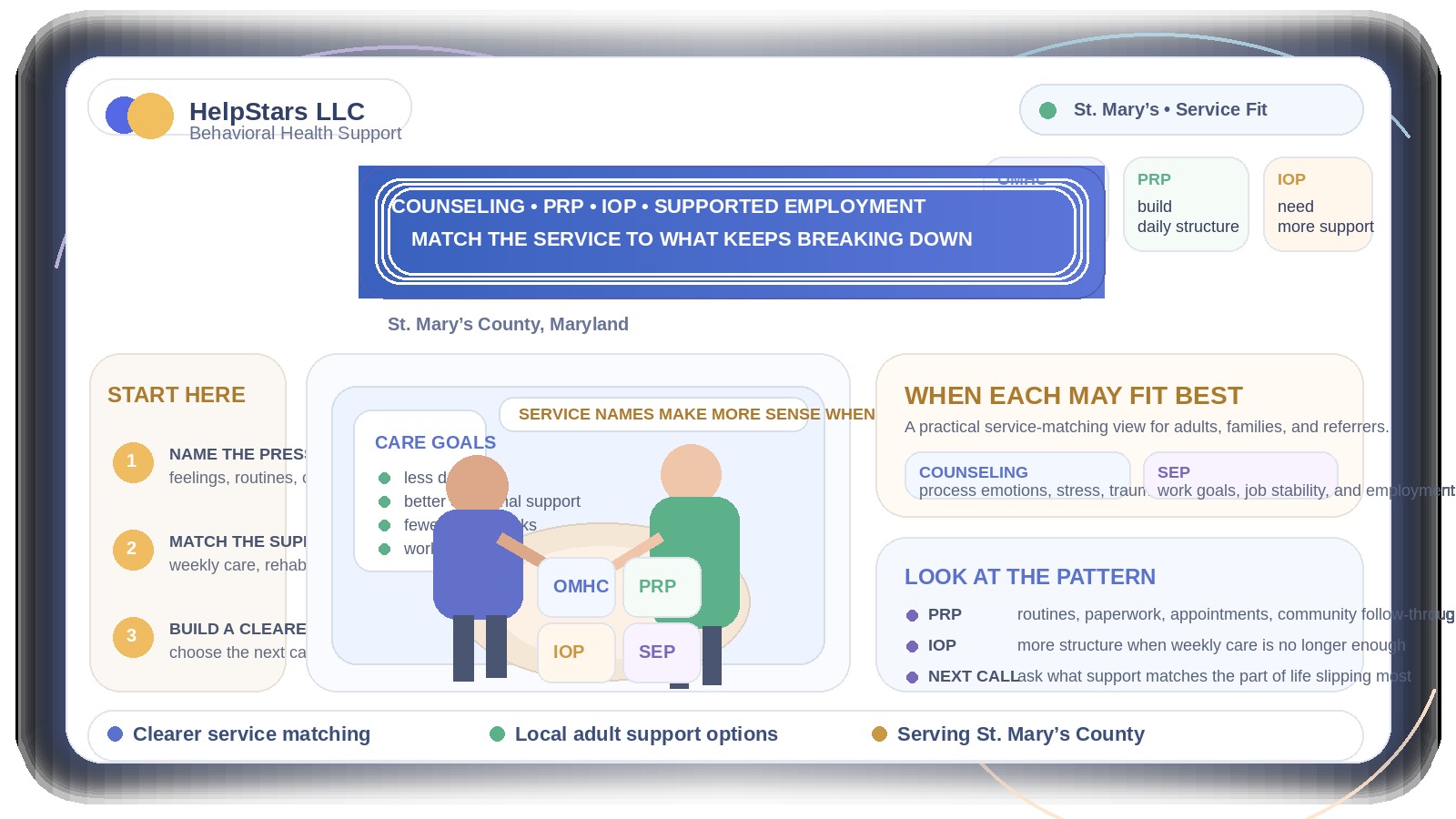
- If the main need is processing emotions, thoughts, conflicts, or symptom patterns, counseling may be the best starting point.
- If the main need is rebuilding day-to-day follow-through with routines, appointments, forms, household tasks, or community functioning, PRP may fit better.
- If symptoms are becoming more disruptive, repeated crises are happening, or weekly support no longer feels like enough structure, IOP may be worth discussing.
- If the main recovery goal involves finding work, returning to work, or keeping a job stable, supported employment may belong in the plan.
The clearest path is not always one service forever. Sometimes it is one service first, then another. Sometimes two services work alongside each other because emotional recovery and practical recovery do not always move at the same speed.
When Outpatient Mental Health Counseling Usually Makes the Most Sense
An OMHC in St. Mary’s County, Maryland is often a strong fit when the central issue is internal distress or relationship strain. A person may be dealing with persistent anxiety, depressed mood, grief, trauma responses, irritability, low motivation, or conflicts at home that keep escalating. The person might still be going to work, showing up for responsibilities, and keeping basic routines together, but emotionally they feel less steady than they used to.
Outpatient counseling may help when someone needs support with:
- understanding emotional triggers,
- building coping skills,
- improving communication in relationships,
- working through grief, trauma, or stress, or
- recognizing patterns in mood, avoidance, or self-criticism.
In other words, counseling often fits best when the person can still participate in weekly treatment and use that space to make sense of what they are feeling, why they are reacting the way they are, and what changes may help life feel more manageable.
When PRP Is Often the Better Match
A psychiatric rehabilitation program in St. Mary’s County becomes especially relevant when the problem is not only emotional pain, but also repeated difficulty carrying daily life all the way through. Someone may know what they need to do and still struggle to execute it consistently. Laundry piles up. Grocery planning falls apart. Appointment reminders get missed. Paperwork sits unopened. Transportation becomes a barrier. Medication routines drift. Recovery goals stay vague because the week keeps getting away.
PRP can be a practical fit when a person needs structured support around:
- daily living routines,
- community-based recovery skills,
- appointment and benefit follow-through,
- household organization and planning,
- independence goals, and
- staying connected to treatment in a more usable way.
This matters because many adults are not failing due to lack of effort. They are running into functional bottlenecks. PRP is often the better answer when someone needs recovery support that reaches into real-life structure, not only a once-a-week conversation.
When an Intensive Outpatient Program May Be Worth Discussing
An intensive outpatient program in St. Mary’s County MD may be appropriate when symptoms are disrupting life at a level that feels too big for ordinary weekly care, but the person does not need inpatient hospitalization. This can include more frequent emotional escalation, repeated instability, or difficulty holding daily life together between appointments.
IOP is often considered when a person needs:
- more structure than standard outpatient care,
- support several times per week rather than once per week,
- a more consistent treatment rhythm,
- help rebuilding stability after a recent decline, or
- a step between crisis-driven care and everyday outpatient follow-up.
The question is not whether someone is “sick enough.” The better question is whether the current level of support is matching the intensity of what the person is dealing with. If the answer is no, a higher level of outpatient structure may be worth exploring.
When Supported Employment Belongs in the Plan
A supported employment program in St. Mary’s County is often the right fit when work is the recovery goal that keeps getting interrupted. Some adults want help searching for a job after time away from the workforce. Others are already employed but need more structure around communication, confidence, schedules, follow-through, or how mental health symptoms affect job performance.
Supported employment may be useful when a person needs help with:
- job search planning,
- interview preparation,
- workplace communication,
- building reliability on the job,
- problem-solving barriers that affect employment, or
- staying connected to recovery while returning to work.
This service is especially important when employment is not just an economic goal, but also part of identity, confidence, structure, and long-term recovery.
A St. Mary’s County Matching Example
Imagine an adult in Hollywood, Lexington Park, or Leonardtown who says, “Everything feels off lately.” That sentence could mean several different things.
- If the biggest issue is panic, sadness, conflict, or unresolved trauma, counseling may be the better starting point.
- If the biggest issue is that bills, appointments, meals, medication routines, and errands keep slipping, PRP may be the more practical match.
- If the person is cycling through repeated destabilization and ordinary weekly care no longer seems to hold enough structure, IOP may deserve a closer look.
- If the person’s main goal is getting back to work or staying employed without losing stability, supported employment may be the most relevant service.
That is why the best mental health support plan is rarely built around a vague label like “I just need therapy.” It is built around the part of life that keeps absorbing the impact of the symptoms.
These Services Can Work Together
Another reason people get confused is that they assume choosing one service means ruling out the others. In reality, behavioral health services in Southern Maryland often work best when they are coordinated thoughtfully. A person might receive counseling for emotional insight while also using PRP for routines and community stability. Someone in supported employment may also need outpatient counseling to manage anxiety, grief, or low confidence connected to work. A person stepping down from IOP may still need lower-intensity ongoing services to maintain progress.
The important thing is not to collect services. It is to make sure each service has a clear job. Emotional processing, practical daily-life support, treatment intensity, and employment recovery are related, but they are not identical needs.
Three Questions Worth Asking Before the First Call
- What part of life is becoming hardest to hold together right now? Think beyond symptoms alone and name the area of daily functioning that is slipping most.
- How much structure feels necessary? Weekly support, community-based skill support, or a more intensive schedule can each make sense depending on the pattern.
- What would meaningful progress look like over the next month? Feeling calmer, managing routines, stabilizing after a decline, or getting back to work can each point toward a different level of care.
Those questions can make it easier to talk with a provider and easier to identify whether an outpatient mental health clinic, PRP, IOP, or supported employment is the better fit.
Finding the Right Behavioral Health Support in St. Mary’s County
If you are comparing behavioral health services in St. Mary’s County, the most helpful next step is often matching the service to the real-world problem instead of picking whichever program name sounds familiar. HelpStars LLC serves adults across Southern Maryland with compassionate support that can address emotional care, daily-life stability, structured treatment needs, and employment-related recovery goals.
The right question is not simply, “What service do you offer?” The better question is, “What kind of support fits the way this is affecting daily life?” That question usually leads to a better plan.