After the Move, the Boxes Are Gone but the Routine Still Has Not Come Back: PRP Support for Adults Serving Port Tobacco, Maryland
Sometimes the hardest part of a move begins after the obvious work is over. The boxes are mostly unpacked. The key is in the new place. People around you may assume the transition is finished. But daily life can still feel scrambled long after the furniture is in position. Meals are off, papers are hard to find, reminders get lost, errands take longer than they should, and the new space still does not feel organized enough to support a steady week.
For adults seeking PRP support serving Port Tobacco, Maryland, that kind of after-the-move disruption can be more serious than it looks from the outside. A change in living space can interrupt medication habits, transportation flow, household systems, sleep, budgeting, and follow-through all at once. Psychiatric rehabilitation support can help adults rebuild the practical routines that make a home feel usable again.
HelpStars LLC supports adults and families across Southern Maryland with compassionate behavioral health care. When a move has technically happened but daily living still feels scattered, PRP services may help create a steadier reset.
Why Moving Can Break More Routines Than People Expect
A move rarely affects only one task. The kitchen works differently. The laundry flow changes. The drive to the store is new. Important papers end up in unfamiliar places. A person may need to learn new timing around trash pickup, parking, neighbors, bus stops, pharmacy runs, or the simple order of getting out the door in the morning.
For someone already managing anxiety, depression, executive-function strain, trauma-related stress, or recovery fatigue, that disruption can pile up fast. The person may not be refusing responsibility. They may be trying to live inside a system that no longer runs on habit.
What the Problem Can Look Like in Real Life
After a move, the struggle often sounds practical before it sounds emotional. It may show up as:
- knowing important items are somewhere in the home but not being able to find them when needed,
- putting off paperwork because there is no clear place to handle it,
- missing small deadlines while trying to set up the new routine,
- eating irregularly because the kitchen setup still feels chaotic,
- falling behind on phone calls, refills, or forms during the transition, and
- feeling ashamed that the move is “done” even though life still does not feel stable.
That last part matters. A person may feel pressure to act as if everything should be settled already. The shame can make it harder to ask for practical support at the exact time practical support would help most.
How PRP Support Can Help After Housing Change
PRP services focus on daily living and recovery-supporting structure. After a move, that can be especially useful because the challenge is often not insight. It is rebuilding function.
Depending on the person’s needs, PRP support may help with:
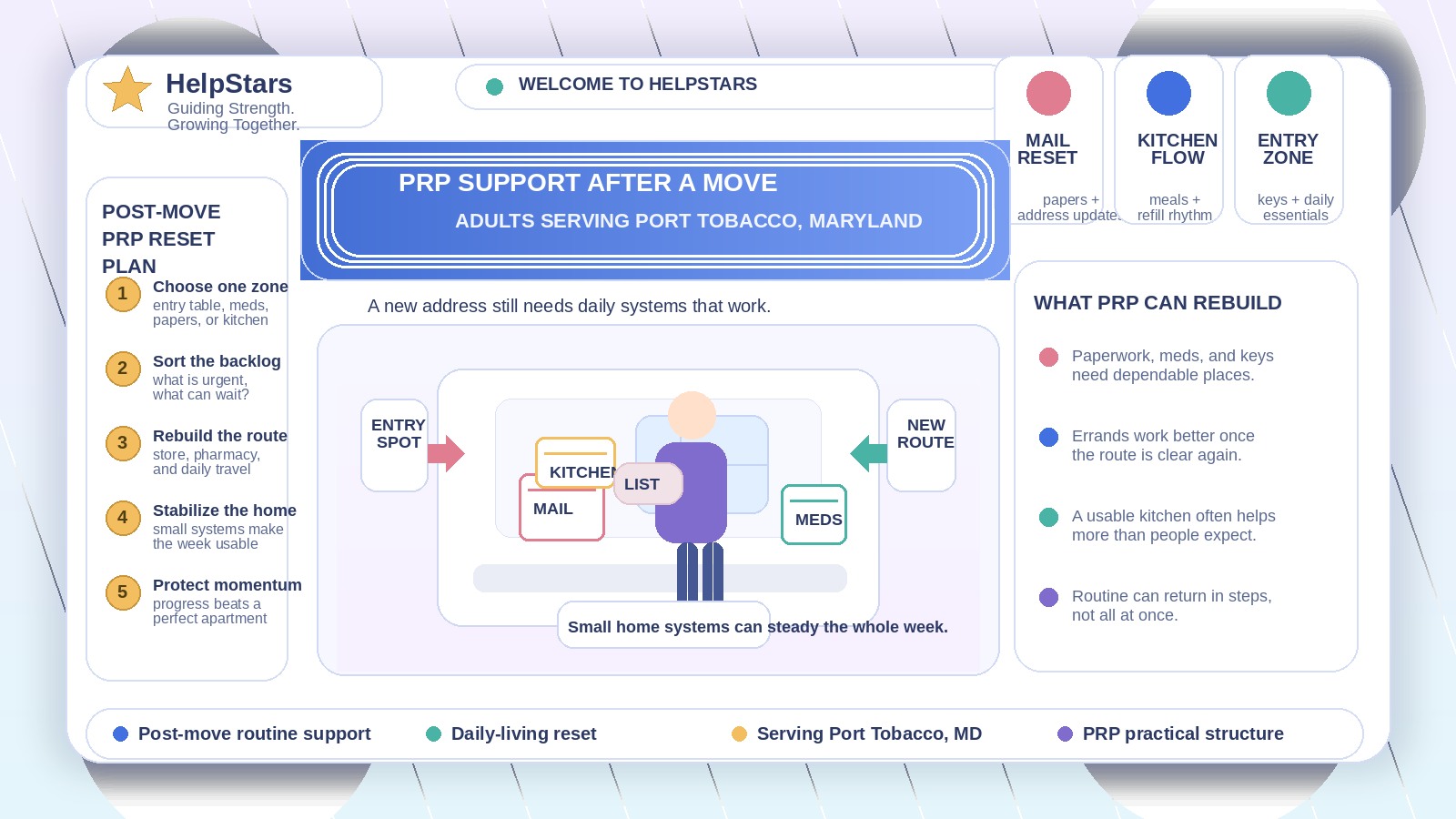
- creating new household zones for papers, medications, keys, and everyday essentials,
- rebuilding shopping, meal, laundry, and cleaning routines around the new space,
- organizing follow-up tasks such as address changes, benefits mail, refills, or provider updates,
- breaking the post-move backlog into smaller steps that feel finishable,
- planning transportation and errand timing from the new location, and
- reducing the all-or-nothing thinking that can turn one messy week into a longer spiral.
The goal is not to make the home perfect. The goal is to make daily life workable again.
A Port Tobacco Example: Settled on Paper, Unsettled in Practice
Imagine an adult serving Port Tobacco, Maryland and nearby Charles County communities who has recently moved into a new place after a stressful stretch. On paper, the hardest part is over. The lease is handled. The heavy items are inside. Family members think the person should now be able to “just settle in.”
But the person keeps losing track of the practical basics. Mail is piling up on a counter because there is no system yet. Medication supplies are split between bags. The new grocery route takes longer than expected. Sleep feels off because the evening routine has not settled. The person knows what needs to happen, but every task seems to depend on three others getting handled first.
That is where PRP support can be helpful. Instead of treating the stress as laziness or disorganization, the work can focus on building a livable rhythm: where essentials belong, what order tasks should happen in, which errands matter first, and how to turn the new space into a place that supports recovery rather than destabilizing it.
Four Areas That Often Need a Reset After a Move
- Entry-point organization. Keys, wallet, paperwork, medication items, and appointment reminders need a dependable home.
- Food and refill rhythm. A working kitchen and a reliable store or pharmacy plan can stabilize more of the week than people expect.
- Task sequencing. Many adults need help deciding what has to happen first instead of carrying twenty half-started post-move tasks at once.
- Emotional re-entry. A new space may bring relief, but it can also bring overstimulation, grief, loneliness, or fear about falling behind again.
These are not side issues. They are the structure underneath daily functioning.
How Supporters Can Help Without Adding More Pressure
Loved ones often mean well when they say, “At least the move is over.” But that can make the person feel even more alone if the day still feels chaotic. Support is usually more helpful when it sounds like:
- “What part of the new setup is making the week hardest right now?”
- “Which two tasks would make the place feel more usable first?”
- “Do you need help creating a routine, not just finishing boxes?”
That language respects the fact that housing change is not only about physical relocation. It is also about functional adjustment.
Why This Matters for Adults in Charles County
For adults serving Port Tobacco, La Plata, White Plains, Waldorf, Indian Head, Bryans Road, Hughesville, and nearby Charles County communities, daily stability depends on real-world logistics. Commutes, local errand routes, treatment follow-up, public-benefits mail, family schedules, and access to essentials all get reshuffled by a move. A support plan works better when it addresses the new geography of everyday life rather than assuming routine will rebuild itself automatically.
Questions Adults Often Ask After a Move
Does needing help after a move mean I am not coping well enough?
No. A move can disrupt multiple daily-living systems at once. Needing structured support does not mean the person is failing. It may mean the transition needs more practical rebuilding than other people can see.
Can PRP help if the main problem is routine, not mood?
Yes. PRP support often focuses on the practical side of stability, especially when daily tasks, follow-through, and household organization are the main pressure points.
What if I feel embarrassed that the place still does not work well for me?
That embarrassment is common. It can also delay exactly the kind of support that would make the space easier to use. Naming the problem earlier often makes recovery smoother.
Can support help me prioritize instead of trying to fix everything at once?
Often, yes. Breaking the reset into a better order is one of the most helpful parts of practical rehabilitation support.
A New Address Does Not Automatically Create a Working Routine
People sometimes assume a completed move means stability has already returned. In real life, a new address can still leave a person feeling scattered until the day-to-day systems underneath that address start working again. That practical rebuild matters.
HelpStars LLC supports adults and families across Southern Maryland with compassionate behavioral health care. For adults seeking PRP support serving Port Tobacco, Maryland, help with post-move routine rebuilding may be a meaningful next step toward steadier daily living.