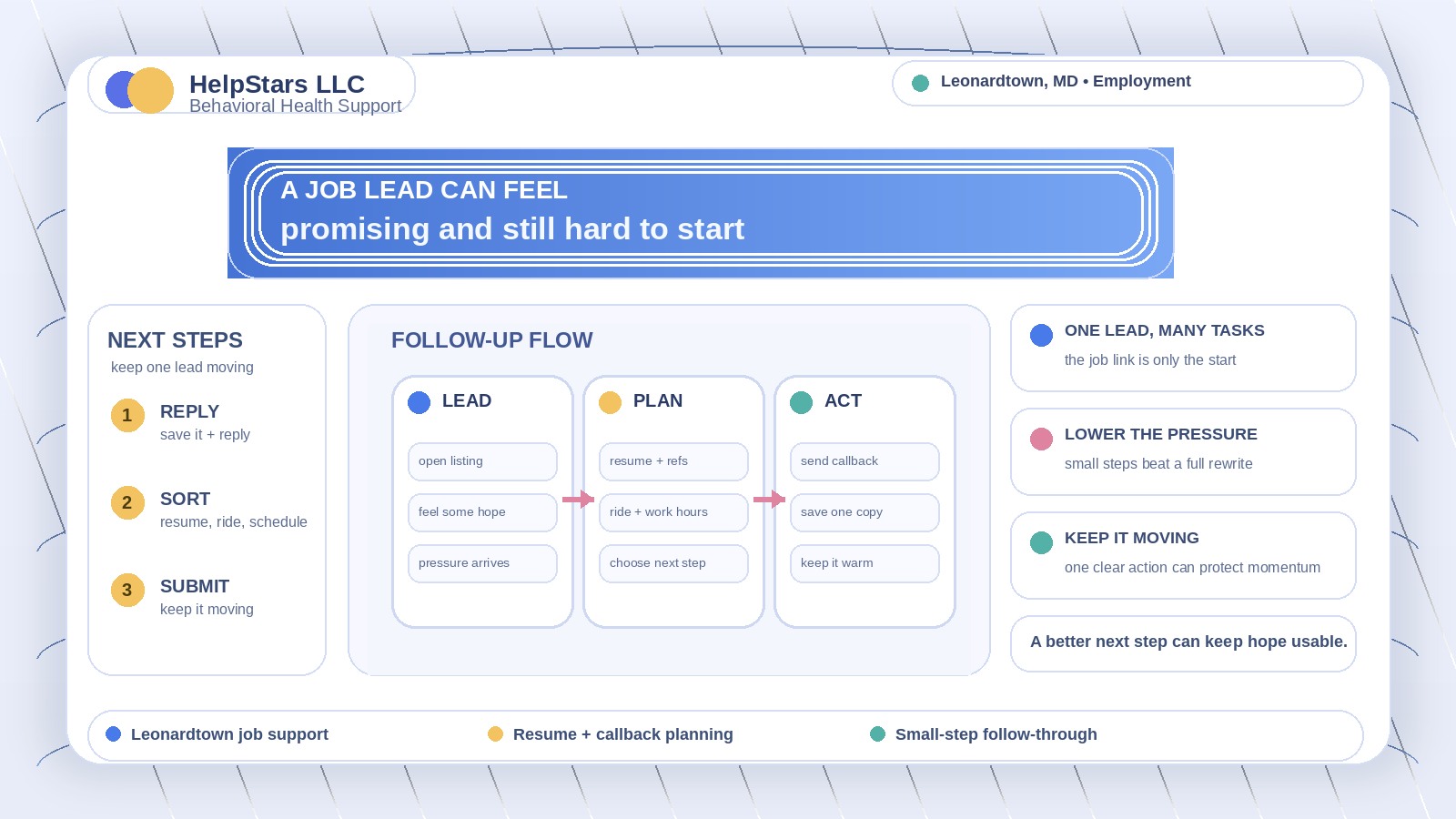
A Job Lead Can Sound Promising and Still Be Hard To Turn Into Action: Supported Employment for Adults Serving Leonardtown, Maryland
A good job lead does not always create relief. Sometimes it creates pressure. A text from a family member, a link from a friend, a supervisor who says “you should apply,” or a posting that finally looks realistic can all bring a short burst of hope. Then the follow-up tasks arrive all at once. Should you call today? Do you have the right resume version? What should you say about availability? Is transportation workable? Who can be listed as a reference? What if the lead is better than the last one, but your week still does not feel steady enough to hold it?
For adults seeking supported employment serving Leonardtown, Maryland, this moment can be more complicated than it looks from the outside. The problem is not always finding an opportunity. Sometimes the harder part is turning one promising lead into a sequence of manageable next steps before anxiety, overload, or self-doubt shuts the process back down. Supported employment can help make that handoff more practical.
HelpStars LLC supports adults and families across Southern Maryland with compassionate behavioral health services. When a realistic job opportunity still feels strangely hard to act on, structured employment support may help reduce the pressure around the next move.
Why a “Good Opportunity” Can Still Feel Heavy
People often talk as if motivation should automatically appear once a decent lead comes along. Real life is usually messier. A person may want the job and still feel flooded by everything attached to it. A promising listing can bring up fears about work pace, communication, transportation, schedule changes, benefits questions, concentration, stamina, or how to explain an uneven recent history. What looks like a simple next step may actually be a stack of smaller decisions arriving at once.
That can sound like:
- “I liked the lead until I started thinking about all the follow-up pieces,”
- “I do want work, but one email back feels weirdly hard to send,”
- “I keep opening the listing without moving it forward,”
- “It is not that I am saying no. I just cannot get the next step to feel simple,” or
- “Once the lead feels important, I get more careful and less able to act.”
That pattern is not laziness. Often it is what happens when hope and pressure arrive together. The more meaningful the opportunity seems, the more loaded each small response can start to feel.
The Job Lead Is Only the Start of the Work
A lead may look like one task on paper, but it often opens several at once. There may be a resume to update, an account password to find, a voicemail to return, a shift schedule to think through, clothes or transportation to plan for, and questions about whether the role is actually sustainable in the current season of life. Even deciding whether to apply can require more organizing than other people see.
For some adults, the hardest part is not interest. It is sequencing. If every task connected to the lead feels equally urgent, the process can become noisy fast. People may bounce between updating a resume, rereading the posting, checking commute time, rewriting one short message, and imagining worst-case outcomes instead of finishing the first practical step. That is often the point where the lead starts to cool off—not because the person stopped caring, but because the path from interest to action lost its shape.
How Supported Employment Can Help at This Stage
Supported employment is not only about getting hired after everything is already organized. It can also help earlier, when the obstacle is turning a possible opening into follow-through that feels doable. Depending on the person’s needs, support may help with:
- sorting the lead into concrete next steps instead of one oversized task,
- deciding whether the role is realistic for current energy, schedule, and transportation needs,
- updating one resume version for the job instead of restarting from scratch,
- preparing a short callback, email, or follow-up message,
- making a plan for references, work history, or availability questions before the pressure spikes, and
- keeping one promising lead from turning into a week of avoidance and self-criticism.
The goal is not to make the process feel risk-free. The goal is to make it organized enough that progress can continue.
A Leonardtown Example: The Link Is Open, but Nothing Else Is Moving
Imagine an adult serving Leonardtown, Maryland and nearby St. Mary’s County communities who gets sent a lead that actually fits. The hours seem possible. The location looks manageable. The work sounds more realistic than the last few jobs they considered. At first, that should feel encouraging.
Instead, the listing becomes the center of an internal traffic jam. The person wonders whether their resume still reflects who they are now. They think about how to explain a recent gap without overexplaining. They are not sure whether to apply immediately or wait until they have rewritten a few sections. Then they start worrying about whether the start time will collide with appointments or whether the commute will feel harder on low-energy days. By evening, the lead is still open in the browser, but the real movement never started.
In that situation, supported employment serving Leonardtown, Maryland may help by shrinking the process into steps that can actually be completed in order. The lead may be good. What is missing is not desire. What is missing is a steadier bridge from possibility to action.
Three Places Promising Leads Often Stall
- The first response step. Replying, calling back, or choosing to apply can feel bigger once the opportunity matters.
- The support tasks around the lead. Resume edits, references, availability, transportation, and schedule questions can pile up quickly.
- The pressure to get it right. Adults may slow down because they want this lead to work, which can make every small choice feel unusually high-stakes.
Knowing where the stall happens can make support much more targeted.
Small Structure Can Keep the Lead From Going Cold
Many adults do not need a dramatic career overhaul in this moment. They need the next forty-eight hours to feel more workable. Sometimes that means choosing one action before anything else, such as sending the callback, saving the posting, or updating one resume section. Sometimes it means writing a short script for the first phone contact. Sometimes it means deciding in advance that “good enough to submit” matters more than endlessly reopening the same document.
Structure helps because it lowers the emotional cost of beginning. The brain usually manages “update availability, send the email, and set out tomorrow’s notes” better than “turn this whole opportunity into a new future right now.” Supported employment can help adults build a process that stays usable even when confidence is uneven.
Why This Matters in Everyday St. Mary’s County Life
Adults serving Leonardtown, California, Great Mills, Lexington Park, Hollywood, Mechanicsville, and nearby St. Mary’s County communities are often balancing job goals alongside treatment, family responsibilities, transportation planning, household tasks, and the emotional work of staying stable week to week. A job lead does not arrive in empty space. It lands inside the life the person is already trying to manage.
That is one reason employment support can matter. The challenge may not be willingness. The challenge may be turning interest into steps that fit real routines, real energy, and real follow-through. When that bridge is missing, even a good lead can disappear under the weight of its own possibilities.
Questions Adults Often Ask About Job Leads
What if I want the opportunity but keep freezing at the next step?
That still matters. Many adults do not need help generating interest. They need help reducing the pressure and sequencing the tasks around one meaningful lead.
Do I need to wait until my resume and schedule feel perfect?
No. Waiting for everything to feel fully settled can let realistic opportunities pass by. It is often more helpful to improve materials in steps while still moving the process forward.
Can supported employment help before I even submit the application?
Yes. Some people need the most support before the application is sent, especially when follow-up, decision-making, and practical organization are where the stall keeps happening.
What if the lead is good, but I am not sure my week can support the job yet?
That uncertainty is worth looking at directly. Employment planning is often strongest when it considers schedule, stamina, transportation, and routine support—not only job interest by itself.
One Good Lead Deserves a Better Next Step
Some adults are not missing opportunities because they do not care about work. They are missing them because the shift from “this could work” to “here is what I do next” keeps getting overloaded. When that happens, practical employment support can help make the next move clearer and more repeatable.
HelpStars LLC supports adults and families across Southern Maryland with compassionate behavioral health services. For adults seeking supported employment serving Leonardtown, Maryland, structured support may help turn one promising job lead into a realistic path forward.