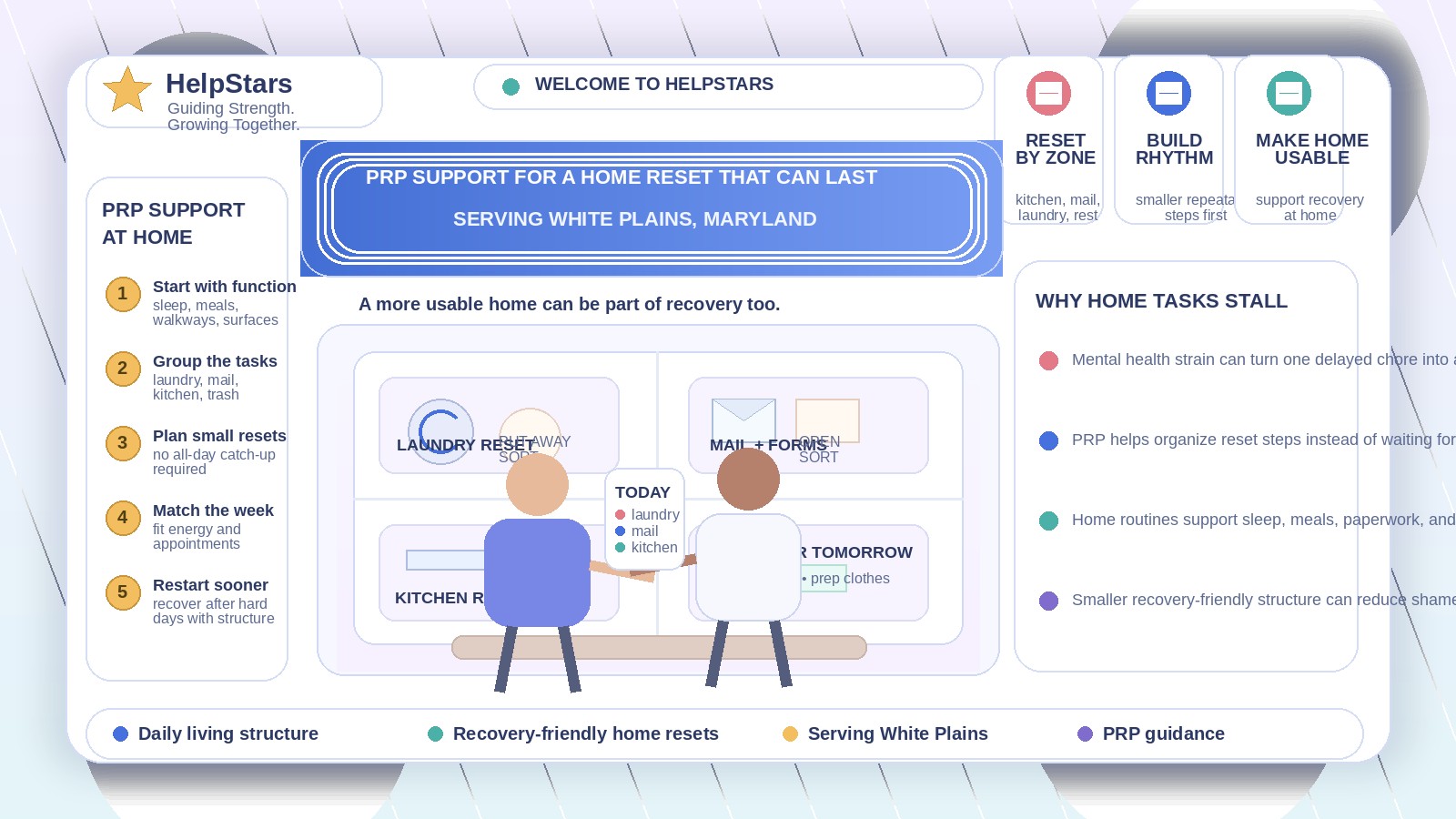
A Home Reset Does Not Have To Wait for Rock Bottom: How PRP Services Can Help Adults Serving White Plains, Maryland Rebuild Daily Living Momentum
Sometimes the most visible sign that a week has gotten hard is not a dramatic crisis. It is a living space that slowly starts telling the truth first. Laundry stays where it landed. Dishes stop rotating back into the cabinet. Mail piles up unopened because each envelope feels like one more demand. A person may still be getting through work, appointments, or basic obligations, yet home begins to feel less like a place to recover and more like proof that energy has been disappearing for a while.
For adults seeking PRP services serving White Plains, Maryland, that kind of slowdown matters. The issue is not simply housekeeping. It is the way depression, anxiety, overwhelm, low activation, or disrupted routine can make ordinary home tasks feel harder to restart each day they are postponed. Psychiatric rehabilitation services can help adults rebuild practical daily-living momentum before a discouraging home pattern turns into something even heavier.
HelpStars LLC supports adults across Southern Maryland with compassionate behavioral health services. When home starts reflecting how hard it has become to stay organized, follow through, and reset after difficult days, PRP support may offer a more workable path forward.
Home Usually Changes Gradually Before People Realize How Stuck They Feel
Many adults do not notice the shift all at once. The first signs may seem temporary: a sink left for tomorrow, a chair collecting clothes, a kitchen counter getting more crowded, one bag from the car never fully unpacked. But when someone is already carrying mental health strain, small delays can stack on each other quickly. The problem is not laziness. The problem is that each unfinished task leaves behind one more visual reminder that the next step is still waiting.
That can sound like:
- “I keep telling myself I will reset the apartment when I get one good day,”
- “Nothing is completely out of control, but everything feels one step behind,”
- “If I start cleaning, I do not know where to begin, so I avoid all of it,”
- “I am using all my energy getting through the day and have nothing left for home,” or
- “The mess makes me feel worse, and feeling worse makes it harder to deal with the mess.”
That loop can become emotionally expensive. A person may feel ashamed inviting anyone over, uneasy walking through their own space, or frustrated that simple household tasks seem to require more activation than they used to.
Why This Is About Recovery Functioning, Not Just Tidiness
Daily living problems often get minimized because they do not sound clinical enough. But the ability to keep a space usable, respond to mail, rotate laundry, manage groceries, and reestablish order after hard days is part of how many adults stay connected to stability. When those tasks keep slipping, the impact reaches farther than clutter alone.
Home-task slowdown can affect:
- sleep, when the bedroom no longer feels settled enough to decompress,
- eating, when the kitchen is harder to reset or groceries go unused,
- appointments and paperwork, when forms and reminders disappear into piles,
- relationships, when the person starts avoiding visitors or feeling embarrassed around family, and
- confidence, when each room seems to confirm the fear that things are getting harder again.
That is one reason PRP services Charles County MD searches can be about much more than “life skills” in the abstract. Adults often need support with the exact real-world routines that make home life feel livable again.
What PRP Support Can Help Rebuild at Home
Psychiatric rehabilitation program support can be useful when the main barrier is not understanding what needs to be done, but restarting it in a realistic order. Many adults already know the dishes need to be washed or the laundry needs to be sorted. What they do not have is enough structure, sequencing, and activation support to turn that knowledge into repeatable action.
Depending on the person’s needs, PRP support may help with:
- breaking one overwhelming home reset into smaller task groups that can actually be finished,
- deciding which household tasks matter most for safety, function, and stress relief first,
- building a routine for mail, groceries, laundry, trash, and surfaces that does not rely on one “perfect catch-up day,”
- connecting home organization to medication routines, appointments, transportation, and other parts of recovery,
- reducing the shame that can make a person avoid their own environment, and
- making it easier to recover after a hard week without starting from zero every time.
The goal is not a flawless apartment. The goal is a home setup that supports recovery instead of quietly fighting against it.
A White Plains Example: The Whole Apartment Feels Like a Delayed To-Do List
Imagine an adult serving White Plains, Maryland and nearby Charles County communities who has been getting through work, treatment, or family responsibilities by using nearly all their available energy outside the home. Nothing has completely crashed, but each room contains one more unfinished thread. Clean clothes are mixed with clothes that still need to be put away. Mail is stacked near the door because opening it feels like starting another responsibility chain. The kitchen is functional enough for the next meal, but never fully reset.
On paper, these may not look like major problems. In daily life, they can create constant background pressure. The person walks into the apartment already bracing for evidence that they are behind. Rest becomes harder because the space itself keeps repeating the message that things are unfinished.
In PRP support, the work may begin with much more practical questions than people expect: Which area creates the most stress first? What reset can be completed in twenty minutes instead of two exhausting hours? What tasks need a weekly rhythm rather than emergency effort? What makes the apartment feel more usable by tomorrow, not just more impressive in theory? Those questions can help recovery become concrete again.
Four Home-Reset Shifts That Often Matter More Than One Big Cleaning Burst
- Choosing function before perfection. Many adults get stuck because they picture a total reset and feel defeated before they start. It often helps to focus first on the parts of home life that improve sleep, meals, movement, and basic follow-through.
- Turning vague pressure into task categories. “I need to fix everything at home” is much harder to act on than “laundry first, then kitchen surfaces, then mail.”
- Linking home tasks to the real week. A routine works better when it fits commute demands, treatment appointments, family responsibilities, and energy patterns instead of assuming unlimited time.
- Planning for recovery after setbacks. Adults often need a reset plan for the week after symptoms spike, sleep drops, or motivation collapses, not just for good weeks.
These shifts matter because many people are not failing due to lack of insight. They are running into a pattern that keeps making restart energy harder to find.
Why Shame Can Make Home Tasks Even Heavier
Once someone starts feeling embarrassed by their space, ordinary support can land badly. A well-meant comment from a loved one may sound like criticism. A simple suggestion may feel like proof that the problem is obvious to everyone else too. That shame can make the person pull back further, which gives the home pattern even more room to grow.
PRP can help by keeping the focus practical and recovery-oriented. Instead of treating the space like a character judgment, support can center on sequencing, daily-living structure, and what will make the next week more manageable. That difference matters. People often reengage faster when help does not sound like blame.
Why Local Routine Still Matters in Charles County
Adults serving White Plains, Waldorf, La Plata, Bryans Road, Indian Head, and nearby Charles County communities are often managing home tasks around commuting, child care, behavioral health appointments, family obligations, and the ordinary stop-and-start rhythm of Southern Maryland life. A home routine that looks easy on paper may still fail if it assumes too much energy at the end of the day or too much uninterrupted time on weekends.
That local context matters because PRP services serving White Plains, Maryland are most useful when they reflect the real week a person is living. The better question is not “Why can’t I just catch up?” It is “What kind of structure helps home life stay more usable when energy, mood, or functioning are not fully reliable?”
Questions Adults Often Ask About PRP and Home Routines
Is PRP only for people with major daily-living problems?
No. Many adults seek support before things feel severe because they can tell daily routine is sliding and do not want to wait for a bigger disruption before addressing it.
Can PRP help if I know what needs to be done but still cannot keep up with it?
Yes. That gap between knowing and consistently doing is a common reason practical support can help.
Does this kind of support replace therapy?
Not necessarily. Depending on the situation, PRP may complement outpatient counseling, medication management, or other behavioral health services by focusing more directly on day-to-day functioning.
What if my biggest problem is shame about letting things pile up?
That still matters. Shame can make activation harder, and support often works better when the goal is a manageable reset plan instead of blame or all-at-once pressure.
A More Usable Home Can Be Part of Recovery Too
Progress is not only measured by symptom language or appointment attendance. Sometimes progress looks like being able to walk into your home without immediately feeling behind, choosing one reset step without spiraling, and rebuilding routines that make tomorrow easier than today. That kind of stability counts.
HelpStars LLC serves adults across Southern Maryland with compassionate behavioral health support. For adults seeking PRP services serving White Plains, Maryland, help with home routines, follow-through, and daily living structure may be an important next step toward steadier recovery.